
The Systems of the Universe, by Coronelli V.M. 1691
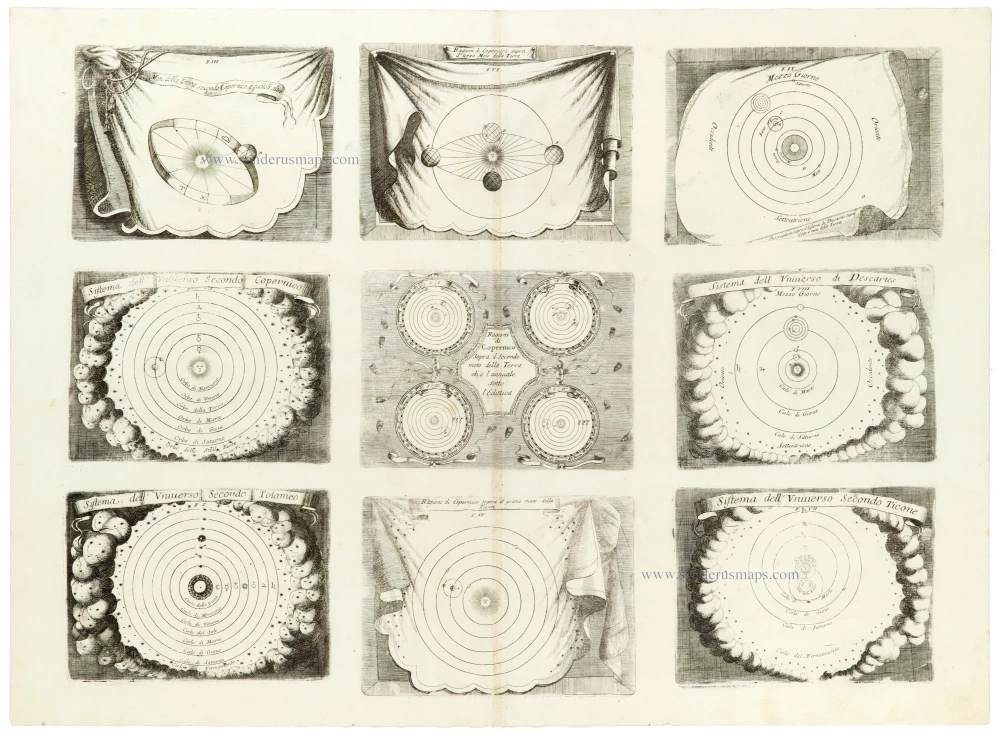
A fascinating seventeenth-century astronomical engraving illustrating nine different diagrams of the universe, including the cosmological systems of Ptolemy, Copernicus, Tycho Brahe and Descartes, by V.M. Coronelli.
The composition consists of nine individually framed diagrams, arranged in three horizontal rows of three. Each diagram presents a particular astronomical model or phenomenon, combining scientific explanation with the elaborate decorative engraving characteristic of Coronelli's work.
The four principal cosmological systems are prominently represented:
The Ptolemaic System (lower left)
Entitled Sistema dell'Universo Secondo Tolomeo, this diagram illustrates the traditional geocentric model associated with the ancient Greek astronomer Claudius Ptolemy. The Earth occupies the centre of the universe, surrounded by concentric celestial spheres carrying the Moon, Sun, planets and fixed stars.
This model dominated European astronomical thought for more than a millennium and remained influential well into the seventeenth century.
The Copernican System (middle left)
Entitled Sistema dell'Universo Secondo Copernico, this diagram illustrates the revolutionary heliocentric model proposed by Nicolaus Copernicus in his De revolutionibus orbium coelestium, published in 1543.
The Sun occupies the centre of the planetary system, with the Earth and other planets revolving around it. The Earth is represented as a planet, accompanied by the Moon.
The Copernican system fundamentally challenged the traditional geocentric conception of the universe and laid the foundations for modern astronomy.
The Tychonic System (lower right)
Entitled Sistema dell'Universo Secondo Ticone, this diagram illustrates the geoheliocentric model developed by the Danish astronomer Tycho Brahe.
In this system, the Earth remains stationary at the centre, while the Sun revolves around it and the other planets orbit the Sun.
The Tychonic model represented an important attempt to reconcile the observational advantages of Copernican astronomy with the traditional belief in an immobile Earth.
The Cartesian System (middle right)
Entitled Sistema dell'Universo di Descartes, this diagram represents the cosmological theories of the French philosopher René Descartes.
Descartes proposed that the universe was filled with matter moving in vast vortices, which carried the planets around the Sun. His mechanical explanation of celestial motion influenced the seventeenth century before Newtonian gravitational theory superseded it.
The remaining five diagrams illustrate additional astronomical arrangements and phenomena, including planetary motions, celestial spheres and geometrical representations of the heavens.
Together, the nine illustrations provide a fascinating overview of the evolution of European cosmological thought, from classical geocentrism to the increasingly sophisticated astronomical theories of the Scientific Revolution.
Vincenzo Coronelli (1650-1718)
Vincenzo Coronelli was born in Venice on 16 August 1650 and primarily brought up in Ravenna. He returned to Venice in 1665 and joined the convent of the Minor Conventuals. Five years later, he was sent to Rome to study, and by 1673, he was already a doctor of theology.
Having achieved fame by constructing two globes for the Duke of Parma, he was invited to Paris for three years in 1681 and made two enormous examples for Louis XIV. On his return to Venice, he assiduously collected cartographic material and founded the Academy of the Argonauts. In 1685, he was appointed Cosmographer to the Republic of Venice and authorised to publish a large atlas. He became a geography lecturer at the University of Venice and brought out an Atlante Veneto the following year.
In 1696, he visited Germany, Holland and southern England. During intervals in compiling his vast encyclopaedia, he continued with cartographic projects up to 1709. He died in his native Venice on 9 December 1718.
Coronelli became famous for his globes. In addition, he was a renowned encyclopaedist, mapmaker and geographer. Most of his maps and other material are gathered in his Atlante Veneto (13 vols, 1690-1705). The first volume, subtitled Descrizione generale istorica geografica, was his masterpiece, planned as an extension of Blaeu’s atlas.
Other volumes of the atlas which contain maps are Isolario, two parts (1696-8), with detailed maps and plans, mostly of islands; Corso geografico, two parts based on the edition 1694-7; Libro de’ globi (1697); and Lo Specchio del Mare, a reprint of Levanto's Lo Specchio del Mare Mediterraneo of 1664.
The other vital aspects of his mapping are those arising from the Venetian conquest and his travels. His most extensive military compilation was the Teatro della Guerra, in more than 30 volumes.
Sistemi dell'Universo.
Item Number: 33381 new Authenticity Guarantee
Category: Antique maps > Africa
The Systems of the Universe, by Coronelli V.M.
Title: Sistemi dell'Universo.
Date: 1691.
Nine copper engravings, printed on a double sheet of paper.
Image size each: 130 x 180mm (5 x 7 inches).
Sheet size: 475 x 650mm (18¾ x 25½ inches).
Verso: Blank.
Condition: Excellent.
Condition Rating: A+.
From: Atlante Veneto, nel quale si contiene la descrittione... degl' Imperii, Regni, Provincie, e Stati dell' Universo. Venice: Girolamo Albrizzi, 1691. Shirley (Brit.Lib.), T.CORO-7a
A fascinating seventeenth-century astronomical engraving illustrating nine different diagrams of the universe, including the cosmological systems of Ptolemy, Copernicus, Tycho Brahe and Descartes, by V.M. Coronelli.
The composition consists of nine individually framed diagrams, arranged in three horizontal rows of three. Each diagram presents a particular astronomical model or phenomenon, combining scientific explanation with the elaborate decorative engraving characteristic of Coronelli's work.
The four principal cosmological systems are prominently represented:
The Ptolemaic System (lower left)
Entitled Sistema dell'Universo Secondo Tolomeo, this diagram illustrates the traditional geocentric model associated with the ancient Greek astronomer Claudius Ptolemy. The Earth occupies the centre of the universe, surrounded by concentric celestial spheres carrying the Moon, Sun, planets and fixed stars.
This model dominated European astronomical thought for more than a millennium and remained influential well into the seventeenth century.
The Copernican System (middle left)
Entitled Sistema dell'Universo Secondo Copernico, this diagram illustrates the revolutionary heliocentric model proposed by Nicolaus Copernicus in his De revolutionibus orbium coelestium, published in 1543.
The Sun occupies the centre of the planetary system, with the Earth and other planets revolving around it. The Earth is represented as a planet, accompanied by the Moon.
The Copernican system fundamentally challenged the traditional geocentric conception of the universe and laid the foundations for modern astronomy.
The Tychonic System (lower right)
Entitled Sistema dell'Universo Secondo Ticone, this diagram illustrates the geoheliocentric model developed by the Danish astronomer Tycho Brahe.
In this system, the Earth remains stationary at the centre, while the Sun revolves around it and the other planets orbit the Sun.
The Tychonic model represented an important attempt to reconcile the observational advantages of Copernican astronomy with the traditional belief in an immobile Earth.
The Cartesian System (middle right)
Entitled Sistema dell'Universo di Descartes, this diagram represents the cosmological theories of the French philosopher René Descartes.
Descartes proposed that the universe was filled with matter moving in vast vortices, which carried the planets around the Sun. His mechanical explanation of celestial motion influenced the seventeenth century before Newtonian gravitational theory superseded it.
The remaining five diagrams illustrate additional astronomical arrangements and phenomena, including planetary motions, celestial spheres and geometrical representations of the heavens.
Together, the nine illustrations provide a fascinating overview of the evolution of European cosmological thought, from classical geocentrism to the increasingly sophisticated astronomical theories of the Scientific Revolution.
Vincenzo Coronelli (1650-1718)
Vincenzo Coronelli was born in Venice on 16 August 1650 and primarily brought up in Ravenna. He returned to Venice in 1665 and joined the convent of the Minor Conventuals. Five years later, he was sent to Rome to study, and by 1673, he was already a doctor of theology.
Having achieved fame by constructing two globes for the Duke of Parma, he was invited to Paris for three years in 1681 and made two enormous examples for Louis XIV. On his return to Venice, he assiduously collected cartographic material and founded the Academy of the Argonauts. In 1685, he was appointed Cosmographer to the Republic of Venice and authorised to publish a large atlas. He became a geography lecturer at the University of Venice and brought out an Atlante Veneto the following year.
In 1696, he visited Germany, Holland and southern England. During intervals in compiling his vast encyclopaedia, he continued with cartographic projects up to 1709. He died in his native Venice on 9 December 1718.
Coronelli became famous for his globes. In addition, he was a renowned encyclopaedist, mapmaker and geographer. Most of his maps and other material are gathered in his Atlante Veneto (13 vols, 1690-1705). The first volume, subtitled Descrizione generale istorica geografica, was his masterpiece, planned as an extension of Blaeu’s atlas.
Other volumes of the atlas which contain maps are Isolario, two parts (1696-8), with detailed maps and plans, mostly of islands; Corso geografico, two parts based on the edition 1694-7; Libro de’ globi (1697); and Lo Specchio del Mare, a reprint of Levanto's Lo Specchio del Mare Mediterraneo of 1664.
The other vital aspects of his mapping are those arising from the Venetian conquest and his travels. His most extensive military compilation was the Teatro della Guerra, in more than 30 volumes.