
Warship HMS Royal Charles by V.M. Coronelli. 1691
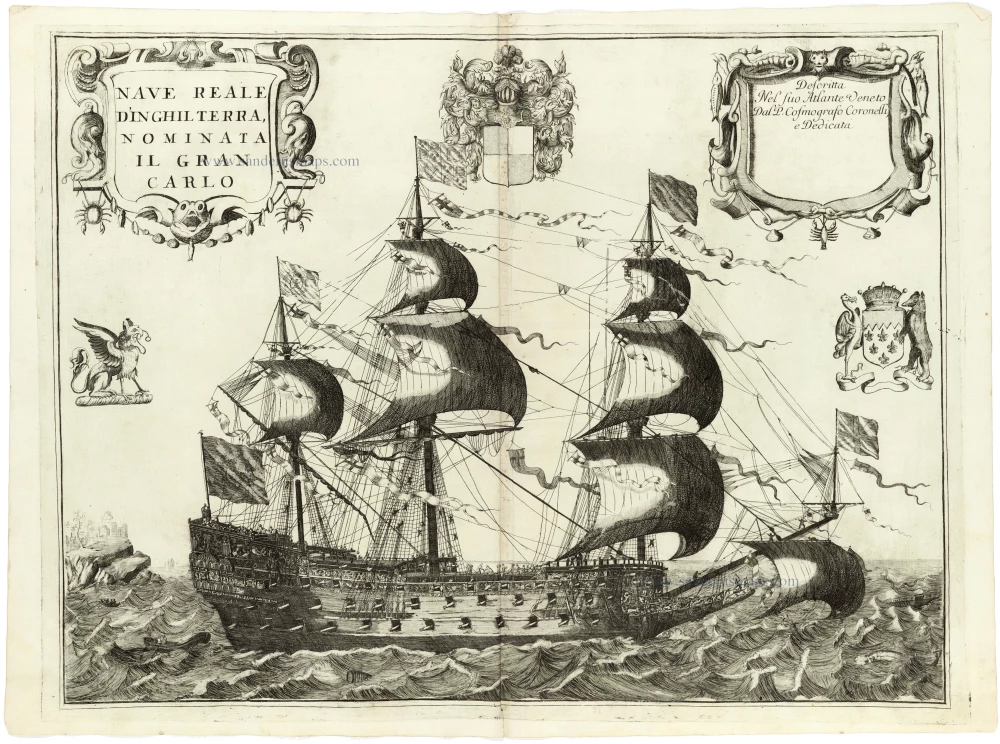
A magnificent and highly decorative seventeenth-century naval engraving, depicting a great English three-decked warship traditionally identified as HMS Royal Charles. An outstanding example of Coronelli's engraving, combining maritime history, naval architecture and the elaborate decorative style of the Italian Baroque.
A spectacular and exceptionally detailed engraving of a great English three-decked warship, identified in the title as Il Gran Carlo (The Great Charles), published by the celebrated Venetian cosmographer Vincenzo Maria Coronelli in his monumental Atlante Veneto of 1691.
The vessel is traditionally identified with HMS Royal Charles, one of the most famous English warships of the seventeenth century, remembered particularly for its dramatic capture by the Dutch fleet during the Second Anglo-Dutch War.
The engraving presents the enormous warship in a striking broadside view, sailing through a turbulent sea under a magnificent display of billowing sails and fluttering flags. The ship's three towering masts, intricate rigging, and multiple decks are rendered with extraordinary precision, creating a vivid impression of the size and complexity of the period's great naval vessels.
The hull shows three tiers of gunports, emphasising the formidable firepower of a first-rate ship of the line. The elaborately ornamented stern, high forecastle, extensive rigging and numerous decorative details illustrate the combination of military power and royal prestige embodied by these enormous warships. Vigorous waves animate the surrounding sea, while small boats and distant coastal features add depth and movement to the composition.
Three elaborate cartouches dominate the upper portion of the engraving. The large title cartouche at upper left, richly ornamented with maritime trophies, identifies the vessel as Nave Reale d'Inghilterra, nominata Il Gran Carlo. At upper right, a second decorative cartouche bears the inscription Descritta Nel suo Atlante Veneto Dal P. Cosmografo Coronelli e Dedicata, explicitly associating the engraving with Coronelli's great geographical publication. Between the two cartouches appears a magnificent heraldic achievement, while additional heraldic emblems and a winged mythical creature embellish the composition.
The extraordinary attention given to the ship's construction, sails, rigging, artillery and ornamentation makes this engraving not only a highly decorative work of art but also a fascinating document of seventeenth-century naval architecture.
Originally launched at Woolwich in 1655 as the Naseby, the vessel was a powerful first-rate ship of the line, carrying approximately 80 guns. After Charles II's restoration to the English throne in 1660, the ship was renamed Royal Charles in honour of the monarch. The vessel served as an important flagship of the English fleet during the Second Anglo-Dutch War (1665–1667). Its most famous episode occurred in June 1667, during the daring Dutch attack on the English naval anchorage in the River Medway, commonly known as the Raid on the Medway or the Raid on Chatham.
Under the command of Admiral Michiel de Ruyter, with Cornelis de Witt accompanying the expedition, the Dutch fleet penetrated the English river defences, destroyed several major warships and captured the Royal Charles as a spectacular trophy of war. Its capture became one of the most humiliating defeats in the history of the English Royal Navy and one of the most celebrated victories in Dutch naval history.
The Dutch eventually dismantled the ship. Its richly decorated stern ornament, bearing the royal arms of England, was preserved as a trophy and survives today in the Rijksmuseum's collection in Amsterdam.
The present engraving reflects Coronelli's interest in maritime subjects and the technological achievements of the great European naval powers. Its impressive scale, elaborate heraldic decoration, and meticulous representation of a seventeenth-century warship make it one of the most visually striking maritime illustrations associated with Coronelli's atlas.
Vincenzo Coronelli (1650-1718)
Vincenzo Coronelli was born in Venice on 16 August 1650 and primarily brought up in Ravenna. He returned to Venice in 1665 and joined the convent of the Minor Conventuals. Five years later, he was sent to Rome to study, and by 1673, he was already a doctor of theology.
Having achieved fame by constructing two globes for the Duke of Parma, he was invited to Paris for three years in 1681 and made two enormous examples for Louis XIV. On his return to Venice, he assiduously collected cartographic material and founded the Academy of the Argonauts. In 1685, he was appointed Cosmographer to the Republic of Venice and authorised to publish a large atlas. He became a geography lecturer at the University of Venice and brought out an Atlante Veneto the following year.
In 1696, he visited Germany, Holland and southern England. During intervals in compiling his vast encyclopaedia, he continued with cartographic projects up to 1709. He died in his native Venice on 9 December 1718.
Coronelli became famous for his globes. In addition, he was a renowned encyclopaedist, mapmaker and geographer. Most of his maps and other material are gathered in his Atlante Veneto (13 vols, 1690-1705). The first volume, subtitled Descrizione generale istorica geografica, was his masterpiece, planned as an extension of Blaeu’s atlas.
Other volumes of the atlas which contain maps are Isolario, two parts (1696-8), with detailed maps and plans, mostly of islands; Corso geografico, two parts based on the edition 1694-7; Libro de’ globi (1697); and Lo Specchio del Mare, a reprint of Levanto's Lo Specchio del Mare Mediterraneo of 1664.
The other vital aspects of his mapping are those arising from the Venetian conquest and his travels. His most extensive military compilation was the Teatro della Guerra, in more than 30 volumes.
Nave Reale d'Inghilterra, nominata Il Gran Carlo.
Item Number: 33379 new Authenticity Guarantee
Category: Antique maps > Curiosities
Warship HMS Royal Charles by.
Title: Nave Reale d'Inghilterra, nominata Il Gran Carlo.
Date of the first edition: 1691.
Date of this map: 1691.
Copper engraving, printed on paper.
Image size: 445 x 585mm (17½ x 23 inches).
Sheet size: 475 x 645mm (18¾ x 25½ inches).
Verso: Blank.
Condition: Excellent.
Condition Rating: A+.
From: Atlante Veneto, nel quale si contiene la descrittione... degl' Imperii, Regni, Provincie, e Stati dell' Universo. Venice: Girolamo Albrizzi, 1691. Shirley (Brit.Lib.), T.CORO-7a
A magnificent and highly decorative seventeenth-century naval engraving, depicting a great English three-decked warship traditionally identified as HMS Royal Charles. An outstanding example of Coronelli's engraving, combining maritime history, naval architecture and the elaborate decorative style of the Italian Baroque.
A spectacular and exceptionally detailed engraving of a great English three-decked warship, identified in the title as Il Gran Carlo (The Great Charles), published by the celebrated Venetian cosmographer Vincenzo Maria Coronelli in his monumental Atlante Veneto of 1691.
The vessel is traditionally identified with HMS Royal Charles, one of the most famous English warships of the seventeenth century, remembered particularly for its dramatic capture by the Dutch fleet during the Second Anglo-Dutch War.
The engraving presents the enormous warship in a striking broadside view, sailing through a turbulent sea under a magnificent display of billowing sails and fluttering flags. The ship's three towering masts, intricate rigging, and multiple decks are rendered with extraordinary precision, creating a vivid impression of the size and complexity of the period's great naval vessels.
The hull shows three tiers of gunports, emphasising the formidable firepower of a first-rate ship of the line. The elaborately ornamented stern, high forecastle, extensive rigging and numerous decorative details illustrate the combination of military power and royal prestige embodied by these enormous warships. Vigorous waves animate the surrounding sea, while small boats and distant coastal features add depth and movement to the composition.
Three elaborate cartouches dominate the upper portion of the engraving. The large title cartouche at upper left, richly ornamented with maritime trophies, identifies the vessel as Nave Reale d'Inghilterra, nominata Il Gran Carlo. At upper right, a second decorative cartouche bears the inscription Descritta Nel suo Atlante Veneto Dal P. Cosmografo Coronelli e Dedicata, explicitly associating the engraving with Coronelli's great geographical publication. Between the two cartouches appears a magnificent heraldic achievement, while additional heraldic emblems and a winged mythical creature embellish the composition.
The extraordinary attention given to the ship's construction, sails, rigging, artillery and ornamentation makes this engraving not only a highly decorative work of art but also a fascinating document of seventeenth-century naval architecture.
Originally launched at Woolwich in 1655 as the Naseby, the vessel was a powerful first-rate ship of the line, carrying approximately 80 guns. After Charles II's restoration to the English throne in 1660, the ship was renamed Royal Charles in honour of the monarch. The vessel served as an important flagship of the English fleet during the Second Anglo-Dutch War (1665–1667). Its most famous episode occurred in June 1667, during the daring Dutch attack on the English naval anchorage in the River Medway, commonly known as the Raid on the Medway or the Raid on Chatham.
Under the command of Admiral Michiel de Ruyter, with Cornelis de Witt accompanying the expedition, the Dutch fleet penetrated the English river defences, destroyed several major warships and captured the Royal Charles as a spectacular trophy of war. Its capture became one of the most humiliating defeats in the history of the English Royal Navy and one of the most celebrated victories in Dutch naval history.
The Dutch eventually dismantled the ship. Its richly decorated stern ornament, bearing the royal arms of England, was preserved as a trophy and survives today in the Rijksmuseum's collection in Amsterdam.
The present engraving reflects Coronelli's interest in maritime subjects and the technological achievements of the great European naval powers. Its impressive scale, elaborate heraldic decoration, and meticulous representation of a seventeenth-century warship make it one of the most visually striking maritime illustrations associated with Coronelli's atlas.
Vincenzo Coronelli (1650-1718)
Vincenzo Coronelli was born in Venice on 16 August 1650 and primarily brought up in Ravenna. He returned to Venice in 1665 and joined the convent of the Minor Conventuals. Five years later, he was sent to Rome to study, and by 1673, he was already a doctor of theology.
Having achieved fame by constructing two globes for the Duke of Parma, he was invited to Paris for three years in 1681 and made two enormous examples for Louis XIV. On his return to Venice, he assiduously collected cartographic material and founded the Academy of the Argonauts. In 1685, he was appointed Cosmographer to the Republic of Venice and authorised to publish a large atlas. He became a geography lecturer at the University of Venice and brought out an Atlante Veneto the following year.
In 1696, he visited Germany, Holland and southern England. During intervals in compiling his vast encyclopaedia, he continued with cartographic projects up to 1709. He died in his native Venice on 9 December 1718.
Coronelli became famous for his globes. In addition, he was a renowned encyclopaedist, mapmaker and geographer. Most of his maps and other material are gathered in his Atlante Veneto (13 vols, 1690-1705). The first volume, subtitled Descrizione generale istorica geografica, was his masterpiece, planned as an extension of Blaeu’s atlas.
Other volumes of the atlas which contain maps are Isolario, two parts (1696-8), with detailed maps and plans, mostly of islands; Corso geografico, two parts based on the edition 1694-7; Libro de’ globi (1697); and Lo Specchio del Mare, a reprint of Levanto's Lo Specchio del Mare Mediterraneo of 1664.
The other vital aspects of his mapping are those arising from the Venetian conquest and his travels. His most extensive military compilation was the Teatro della Guerra, in more than 30 volumes.