
Franconia (Franken) by J. Janssonius c. 1610-1650

In 1626 Abraham Goos engraved a single-sheet map of Franconia with decorative borders for Joannes Janssonius.In the centre part of the top border is the map title, flanked by the views of Nürnberg and Würzburg in oval frames. The map has coats of arms and costumed figures in the side borderss. The bottom border contains views of Bamberg, Fulda, Rotenburg, and Budingen. The town views are based on depictions in the Civitates Orbis Terrarum by Braun and Hogenberg.
The geographical content is based on Gerard Mercator's map of Franconia.
The Janssonius Family
Joannes Janssonius (Arnhem, 1588-1664), son of the Arnhem publisher Jan Janssen, married Elisabeth Hondius, daughter of Jodocus Hondius, in Amsterdam in 1612. After his marriage, he settled down in this town as a bookseller and publisher of cartographic material. In 1618, he established himself in Amsterdam next door to Blaeu’s bookshop. He entered into serious competition with Willem Jansz. Blaeu when copying Blaeu’s Licht der Zeevaert after the expiration of the privilege in 1620. His activities concerned the publication of atlases, books, single maps, and an extensive book trade with branches in Frankfurt, Danzig, Stockholm, Copenhagen, Berlin, Koningsbergen, Geneva, and Lyon. In 1631, he began publishing atlases together with Henricus Hondius.
In the early 1640s, Henricus Hondius left the atlas publishing business to Janssonius. Competition with Joan Blaeu, Willem’s son and successor, in atlas production, prompted Janssonius to enlarge his Atlas Novus finally into a work of six volumes, into which a sea atlas and an atlas of the Old World were inserted. Other atlases published by Janssonius are Mercator’s Atlas Minor, Hornius’s historical atlas (1652), the townbooks in eight volumes (1657), Cellarius’s Atlas Coelestis and several sea atlases and pilot guides.
After the death of Joannes Janssonius, the shop and publishing firm were continued by the heirs under the direction of Johannes van Waesbergen (c. 1616-1681), son-in-law of Joannes Janssonius. Van Waesbergen added Janssonius's name to his own.
In 1676, Joannes Janssonius’s heirs sold by auction “all the remaining Atlases in Latin, French, High and Low German, as well as the Stedeboecken in Latin, in 8 volumes, bound and unbound, maps, plates belonging to the Atlas and Stedeboecken.” The copperplates from Janssonius’s atlases were afterwards sold to Schenk and Valck.
Nova Franconiae Descriptio.
Item Number: 33027 Authenticity Guarantee
Category: Antique maps > Europe > Germany
Franconia (Franken) by J. Janssonius.
Title: Nova Franconiae Descriptio.
Amstelodami, Apud Joannem Janssonium. Anno 1626. - Sculptum apud Abraham Goos.
Engraver: Abraham Goos.
Date of the first edition: 1626.
Date of this map: c. 1610-1650.
Copper engraving, printed on paper.
Image size: 450 x 555mm (17¾ x 21¾ inches).
Sheet size: 505 x 695mm (20 x 27¼ inches).
Verso: Blank.
Condition: Original coloured in outline, some age-toning stains.
Condition Rating: A.
Separate publication - from a French Composite Atlas, c. 1626-1650.
Side margins extended, with an old handwritten French explanatory text in them.
**********************
**********************
Franken by J. Janssonius.
Title: Nova Franconiae Descriptio.
Amstelodami, Apud Joannem Janssonium. Anno 1626. - Sculptum apud Abraham Goos.
Engraver: Abraham Goos.
Date of the first edition: 1626.
Date of this map: c. 1610-1650.
Copper engraving, printed on paper.
Image size: 450 x 555mm (17¾ x 21¾ inches).
Sheet size: 505 x 695mm (20 x 27¼ inches).
Verso: Blank.
Condition: Original coloured in outline, some age-toning stains.
Condition Rating: A.
Separate publication - from a French Composite Atlas, c. 1626-1650.
In 1626 Abraham Goos engraved a single-sheet map of Franconia with decorative borders for Joannes Janssonius.In the centre part of the top border is the map title, flanked by the views of Nürnberg and Würzburg in oval frames. The map has coats of arms and costumed figures in the side borderss. The bottom border contains views of Bamberg, Fulda, Rotenburg, and Budingen. The town views are based on depictions in the Civitates Orbis Terrarum by Braun and Hogenberg.
The geographical content is based on Gerard Mercator's map of Franconia.
The Janssonius Family
Joannes Janssonius (Arnhem, 1588-1664), son of the Arnhem publisher Jan Janssen, married Elisabeth Hondius, daughter of Jodocus Hondius, in Amsterdam in 1612. After his marriage, he settled down in this town as a bookseller and publisher of cartographic material. In 1618, he established himself in Amsterdam next door to Blaeu’s bookshop. He entered into serious competition with Willem Jansz. Blaeu when copying Blaeu’s Licht der Zeevaert after the expiration of the privilege in 1620. His activities concerned the publication of atlases, books, single maps, and an extensive book trade with branches in Frankfurt, Danzig, Stockholm, Copenhagen, Berlin, Koningsbergen, Geneva, and Lyon. In 1631, he began publishing atlases together with Henricus Hondius.
In the early 1640s, Henricus Hondius left the atlas publishing business to Janssonius. Competition with Joan Blaeu, Willem’s son and successor, in atlas production, prompted Janssonius to enlarge his Atlas Novus finally into a work of six volumes, into which a sea atlas and an atlas of the Old World were inserted. Other atlases published by Janssonius are Mercator’s Atlas Minor, Hornius’s historical atlas (1652), the townbooks in eight volumes (1657), Cellarius’s Atlas Coelestis and several sea atlases and pilot guides.
After the death of Joannes Janssonius, the shop and publishing firm were continued by the heirs under the direction of Johannes van Waesbergen (c. 1616-1681), son-in-law of Joannes Janssonius. Van Waesbergen added Janssonius's name to his own.
In 1676, Joannes Janssonius’s heirs sold by auction “all the remaining Atlases in Latin, French, High and Low German, as well as the Stedeboecken in Latin, in 8 volumes, bound and unbound, maps, plates belonging to the Atlas and Stedeboecken.” The copperplates from Janssonius’s atlases were afterwards sold to Schenk and Valck.
Related items
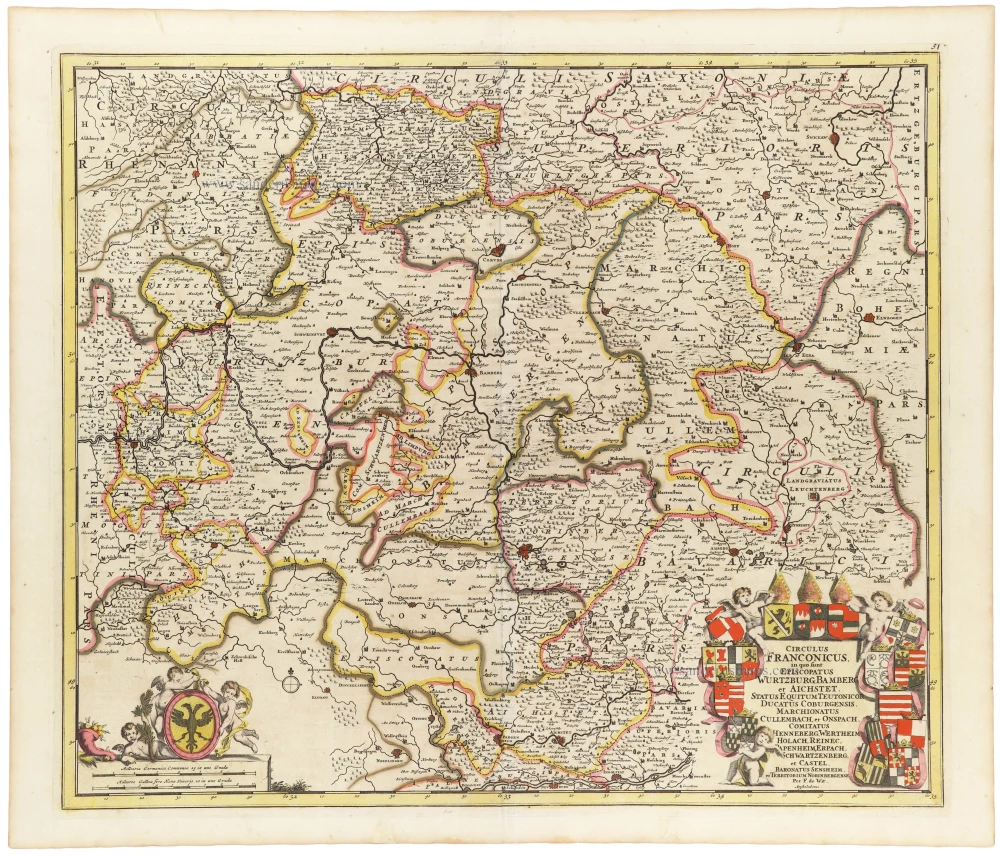
Circulus Franconicus in quo sunt Episcopatus Wurtzburg, Bamberg et Aichstet, Status Equitum Teutonicor Ducatus Coburgensis, Marchionatus Cullembach, et Onspach, Comitatus Henneberg, Wertheim Holach, Reinec, Papenheim, Erpach Schwartzenberg, et Castel, Baronatus Sensheim et Territorium Norinbergensis. c. 1705
Bavaria (Bayern) by F. de Wit
[Item number: 33161]

Circuli Franconiae pars Orientalis et Potoir novissime delineata 1712
Franconia (Bavaria) by Johann Baptist Homann.
[Item number: 33228]
new