
Parma and Piacenza, Marche, and Zadar, by G. de Jode 1593
Gerard and Cornelis de Jode
Gerard de Jode (Judaeus) (1508(?)-1591), a native of Nijmegen, began his career as a printer and engraver in Antwerp about 1550. He lived near the Bourse on the Catelijne Veste, or on "de Catte". He was in regular contact with Christoffel Plantin, to whom he sold many prints and maps. De Jode's business, which must have been a major one among Antwerp's many booksellers and printers, was represented at the Frankfurt fair, where de Jode bought maps that he later copied or resold. Most of the maps sold by De Jode have prototypes of Italian or German origin. Apart from his many separately published maps, Gerard de Jode is known for his atlas, Speculum Orbis Terrarum, published in 1578. Part of the engraving was done by himself, and part by his brothers Jan and Lucas van Doetecum.
Gerard de Jode and Abraham Ortelius, who both lived partly as map sellers, were competitors and were only sometimes on good terms.
After the death of Gerard de Jode in 1591, the business was carried on by his widow, Pascale van Gelder and his son, Cornelis (1568-1600). More a publisher than an engraver, the latter reissued the Speculum in 1593, adding new maps and revising others.
Despite all its deficiencies, the Speculum must have had a good reputation. It is mentioned alongside Mercator's Atlas and Ortelius's Theatrum in Petrus Montanus's preface to Pieter van den Keere's Germania Inferior.
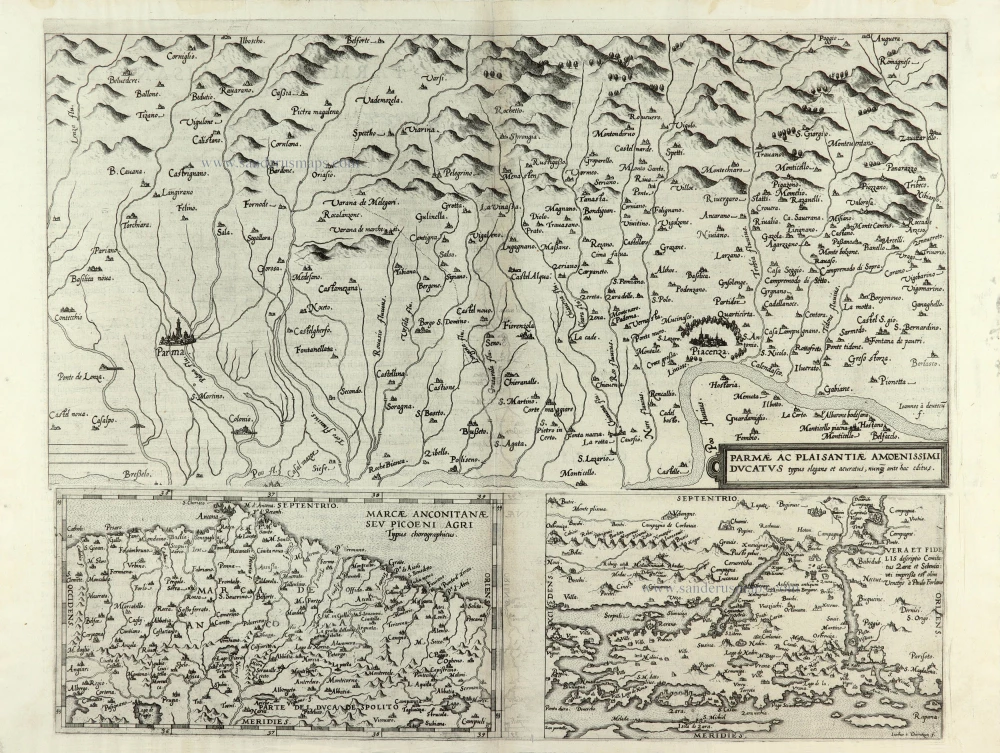
Parmae ac Plaisantiae Amoenissi Ducatus typus elegans et acuratus, nunquam antehac editus [on sheet with:] Marcae Anconitanae seu Picoeni Agri [and] Vera et Fidelis descriptio Comitatus Zarae et Sebenici]
Item Number: 32535 Authenticity Guarantee
Category: Antique maps > Europe > Italy
Parma and Piacenza, Marche, and Zadar, by G. de Jode.
Title: Parmae ac Plaisantiae Amoenissi Ducatus typus elegans et acuratus, nunquam antehac editus [on sheet with:] Marcae Anconitanae seu Picoeni Agri [and] Vera et Fidelis descriptio Comitatus Zarae et Sebenici.
Engraver: Joannes van Doetecum.
Date of the first edition: 1578.
Date of this map: 1593.
Copper engraving, printed from two plates on one sheet of paper.
Image size: 395 x 485mm (15½ x 19 inches).
Sheet size: 410 x 545mm (16¼ x 21½ inches).
Verso: Latin text.
Condition: Excellent.
Condition Rating: A+.
From: Speculum Orbis Terrae. Antwerpen, G. De Jode, 1593. (Van der Krogt 3, 2:02)
Gerard and Cornelis de Jode
Gerard de Jode (Judaeus) (1508(?)-1591), a native of Nijmegen, began his career as a printer and engraver in Antwerp about 1550. He lived near the Bourse on the Catelijne Veste, or on "de Catte". He was in regular contact with Christoffel Plantin, to whom he sold many prints and maps. De Jode's business, which must have been a major one among Antwerp's many booksellers and printers, was represented at the Frankfurt fair, where de Jode bought maps that he later copied or resold. Most of the maps sold by De Jode have prototypes of Italian or German origin. Apart from his many separately published maps, Gerard de Jode is known for his atlas, Speculum Orbis Terrarum, published in 1578. Part of the engraving was done by himself, and part by his brothers Jan and Lucas van Doetecum.
Gerard de Jode and Abraham Ortelius, who both lived partly as map sellers, were competitors and were only sometimes on good terms.
After the death of Gerard de Jode in 1591, the business was carried on by his widow, Pascale van Gelder and his son, Cornelis (1568-1600). More a publisher than an engraver, the latter reissued the Speculum in 1593, adding new maps and revising others.
Despite all its deficiencies, the Speculum must have had a good reputation. It is mentioned alongside Mercator's Atlas and Ortelius's Theatrum in Petrus Montanus's preface to Pieter van den Keere's Germania Inferior.
Related items

Marchia Anconitana cum Spoletano Ducatu 1623
Marche, by Gerard Mercator.
[Item number: 5048]

Parma [on sheet with] Sena [and] Panhormus, Palermo vulgariter, ... [and] Drepanum. 1572
Parma, Siena, Palermo, and Trapani, by Georg Braun & Frans Hogenberg.
[Item number: 22033]

Marchia Anconitana olim Picenum. 1641
Marche, by Henricus Hondius.
[Item number: 26402]

Ducato di Parma et di Piacenza. 1643-50
Parma - Piacenza, by Joan Blaeu.
[Item number: 26763]

Ducato di Parma et di Piacenza. 1640
Parma - Piacenza, by Joan Blaeu.
[Item number: 27217]
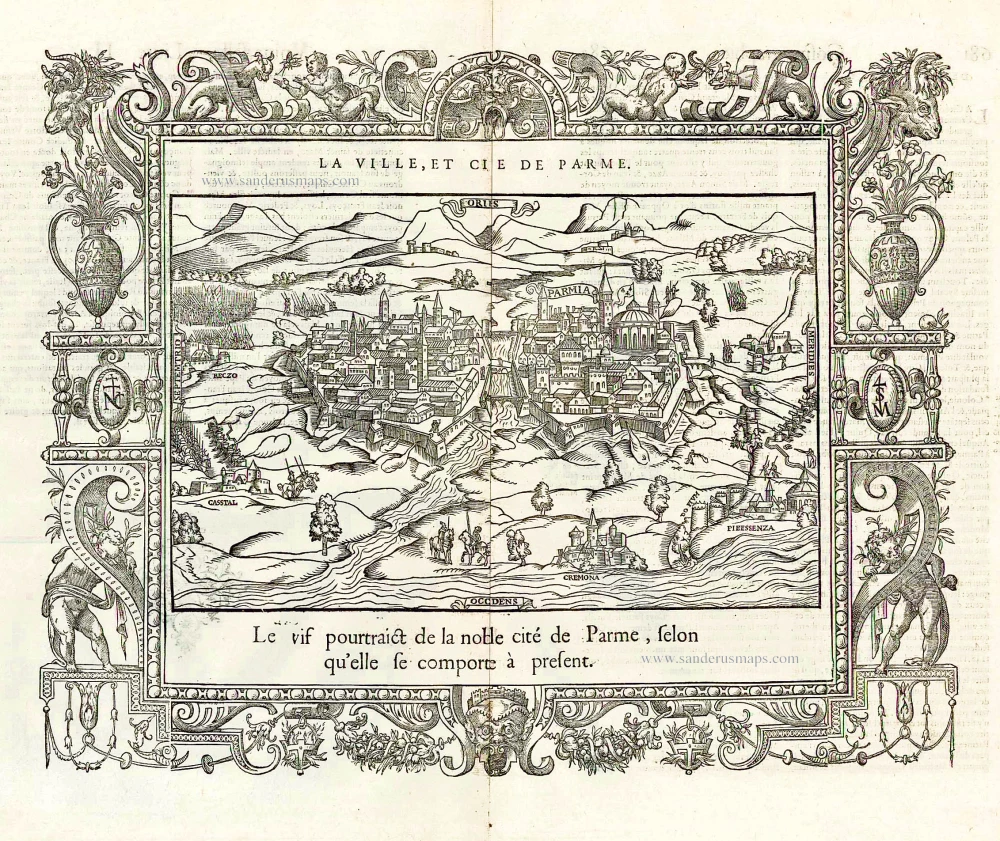
Parmia. - La ville, et cité de Parme. - Le vif pourtraict de la noble cité de Parme, selon qu'elle se comporte à présent. 1575
Parma, by François de Belleforest.
[Item number: 27280]

Marcha Anconitana cum Spoletano Ducatu. 1607
Marche by Gerard Mercator, published by Jodocus Hondius.
[Item number: 31462]

Marchia Anconitana. 1618
Marche by Petrus Bertius, published by Jodocus Hondius II.
[Item number: 31868]