Scarce and decorative map
Spitzbergen by Samuel Purchas 1625
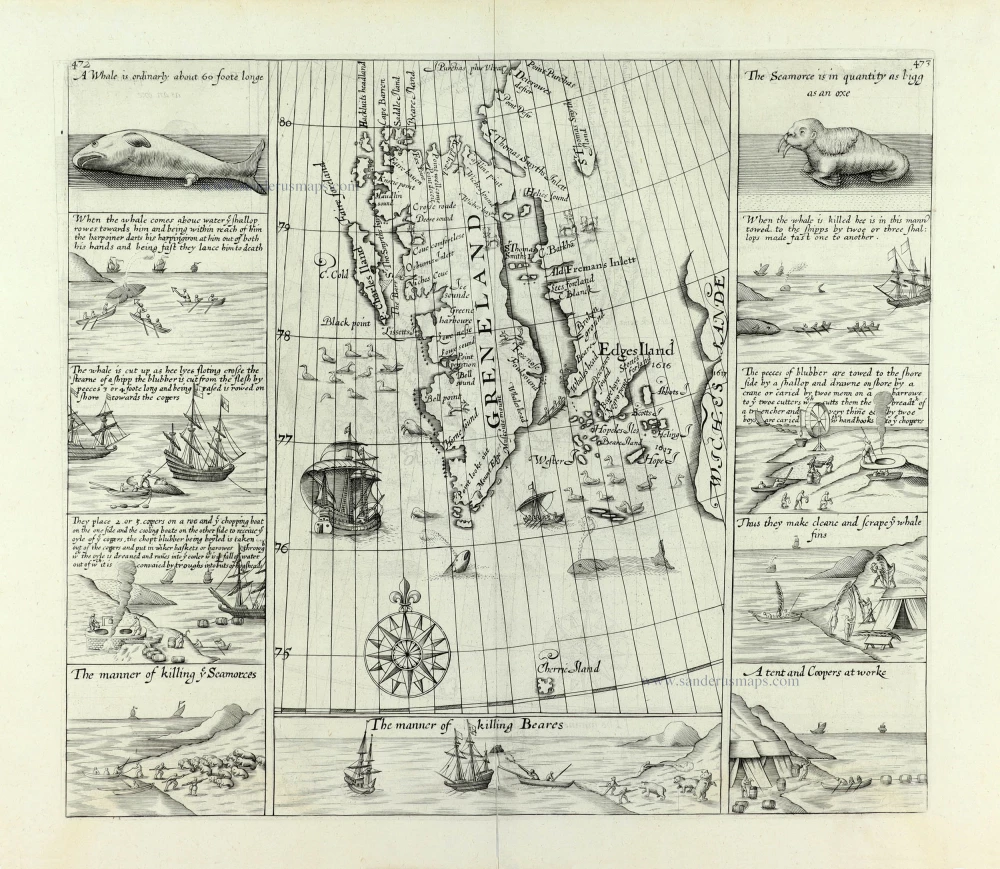
This map shows Svalbard (Spitzbergen), rather than Greenland, as stated on the map. Around the map are eleven scenes depicting bear and walrus hunting, as well as a very early description of whaling. Purchas’s version is one of the earliest printed depictions of Spitsbergen following its “rediscovery” by Willem Barentsz in 1596. The map was regularly reprinted in later accounts of the explorations of the northern seas.
Samuel Purchas (c. 1577-1626)
Samuel Purchas was born around 1577 in Thaxted, Essex, England. Little is known about his childhood, but records indicate he studied at St. John’s College, Cambridge, where he earned a Bachelor of Arts degree and later entered the Anglican clergy. His clerical career eventually led him to a comfortable living as rector of St. Martin's in Ludgate, London. This fortunate position provided him with access to books, travellers, merchants, and manuscripts, which became the foundation of his life's work.
Purchas lived during a period of intense global exploration. England’s growing maritime presence created demand for knowledge about geography, foreign cultures, and distant lands. While not an explorer himself, Purchas played a crucial role in collecting, organising, and publishing geographical and travel information, making him a vital figure for mapmakers, navigators, and scholars.
In 1625, he published his monumental work, Hakluytus Posthumus, or Purchas His Pilgrimes, a massive four-volume compilation (five volumes if you include the new, expanded edition of Purchas His Pilgrimage) of over a thousand travel narratives, maritime logs, ethnographic descriptions, and geographic reports. While this was not itself a map collection, its cartographic impact was enormous: It recorded sailors’ latitudes, longitudes, bearings, and coastal features; It preserved eyewitness descriptions of lands visited by English, Dutch, Portuguese, and Spanish voyagers; It provided raw geographic data used by mapmakers such as John Speed, Henry Briggs, Jodocus Hondius, and other early modern cartographers; It helped shape English understanding of North America, especially New England and Virginia; It supported developing concepts of global geography, including the shape of continents and newly discovered routes.
Samuel Purchas died in 1626, shortly after completing Pilgrimes. Today, Purchas is recognised not as a mapmaker but as a major curator of geographic knowledge, whose compilation efforts significantly shaped cartographic development during a pivotal era.
[No title] Svalbard
Item Number: 32420 Authenticity Guarantee
Category: Antique maps > Europe > Northern Europe
Svalbard (Spitzbergen) by Samuel Purchas.
[No title]
Date of the first edition: 1625.
Date of this map: 1625.
First edition, first state.
Copper engraving, printed on paper.
Image size: 295 x 335mm (11½ x 13¼ inches).
Sheet size: 340 x 420mm (13½ x 16½ inches).
Verso: Blank.
Condition: Excellent.
Condition Rating: A+.
From: Purchas S. Hakluytus Posthumus or Purchas His Pilgrimes. Contayning a History of the World, in Sea Voyages, & lande - Travels, by Englishmen & other. ... Imprinted at London for Henry Fetherston at ye signe of the rose in Pauls Churchyard 1625.
This map shows Svalbard (Spitzbergen), rather than Greenland, as stated on the map. Around the map are eleven scenes depicting bear and walrus hunting, as well as a very early description of whaling. Purchas’s version is one of the earliest printed depictions of Spitsbergen following its “rediscovery” by Willem Barentsz in 1596. The map was regularly reprinted in later accounts of the explorations of the northern seas.
Samuel Purchas (c. 1577-1626)
Samuel Purchas was born around 1577 in Thaxted, Essex, England. Little is known about his childhood, but records indicate he studied at St. John’s College, Cambridge, where he earned a Bachelor of Arts degree and later entered the Anglican clergy. His clerical career eventually led him to a comfortable living as rector of St. Martin's in Ludgate, London. This fortunate position provided him with access to books, travellers, merchants, and manuscripts, which became the foundation of his life's work.
Purchas lived during a period of intense global exploration. England’s growing maritime presence created demand for knowledge about geography, foreign cultures, and distant lands. While not an explorer himself, Purchas played a crucial role in collecting, organising, and publishing geographical and travel information, making him a vital figure for mapmakers, navigators, and scholars.
In 1625, he published his monumental work, Hakluytus Posthumus, or Purchas His Pilgrimes, a massive four-volume compilation (five volumes if you include the new, expanded edition of Purchas His Pilgrimage) of over a thousand travel narratives, maritime logs, ethnographic descriptions, and geographic reports. While this was not itself a map collection, its cartographic impact was enormous: It recorded sailors’ latitudes, longitudes, bearings, and coastal features; It preserved eyewitness descriptions of lands visited by English, Dutch, Portuguese, and Spanish voyagers; It provided raw geographic data used by mapmakers such as John Speed, Henry Briggs, Jodocus Hondius, and other early modern cartographers; It helped shape English understanding of North America, especially New England and Virginia; It supported developing concepts of global geography, including the shape of continents and newly discovered routes.
Samuel Purchas died in 1626, shortly after completing Pilgrimes. Today, Purchas is recognised not as a mapmaker but as a major curator of geographic knowledge, whose compilation efforts significantly shaped cartographic development during a pivotal era.