
WORLDbySchedel H. 1493

Hartmann Schedel (Nuremberg, 1440-1514) and the Nuremberg Chronicle.
Hartmann Schedel grew up in Nuremberg and first studied liberal arts in Leipzig. He earned a medical doctorate in Padua in 1466, then settled in Nuremberg to practice medicine and collect books. According to an inventory done in 1498, Schedel's library contained 370 manuscripts and 670 printed books.
Schedel is best known for writing the text for the Nuremberg Chronicle, an illustrated biblical paraphrase and world history that follows the story of human history related in the Bible; it includes the histories of many important Western cities. The Nuremberg Chronicle was one of the most remarkable books of its time. It was commissioned by Sebald Schreyer (1446–1520) and Sebastian Kammermeister (1446–1503) and published in 1493 in Nuremberg. Maps in the Chronicle were the first-ever illustrations of many cities and countries. Wolgemut and Pleydenwurff, the painters, were commissioned to provide the illustrations and handle the layout. The large workshop of Michael Wolgemut, then Nuremberg's leading artist in various media, provided the 1,809 woodcut illustrations (including duplications).
Albrecht Dürer was an apprentice to Wolgemut from 1486 to 1489, so he may well have participated in the design of some of the illustrations.
The Liber Chronicarum was first published in Latin on 12 July 1493 in Nuremberg by Anton Koberger, the most successful publisher in Germany. A German translation followed on 23 December 1493. An estimated 1,400 to 1,500 Latin and 700 to 1,000 German copies were published.
Due to the great success and prestige of the Chronicle, pirate editions soon appeared on the market. Johann Schönsperger (c. 1455-1521), a printer working out of Augsburg, published smaller editions of the Chronicle in 1496, 1497, and 1500 in German and Latin.
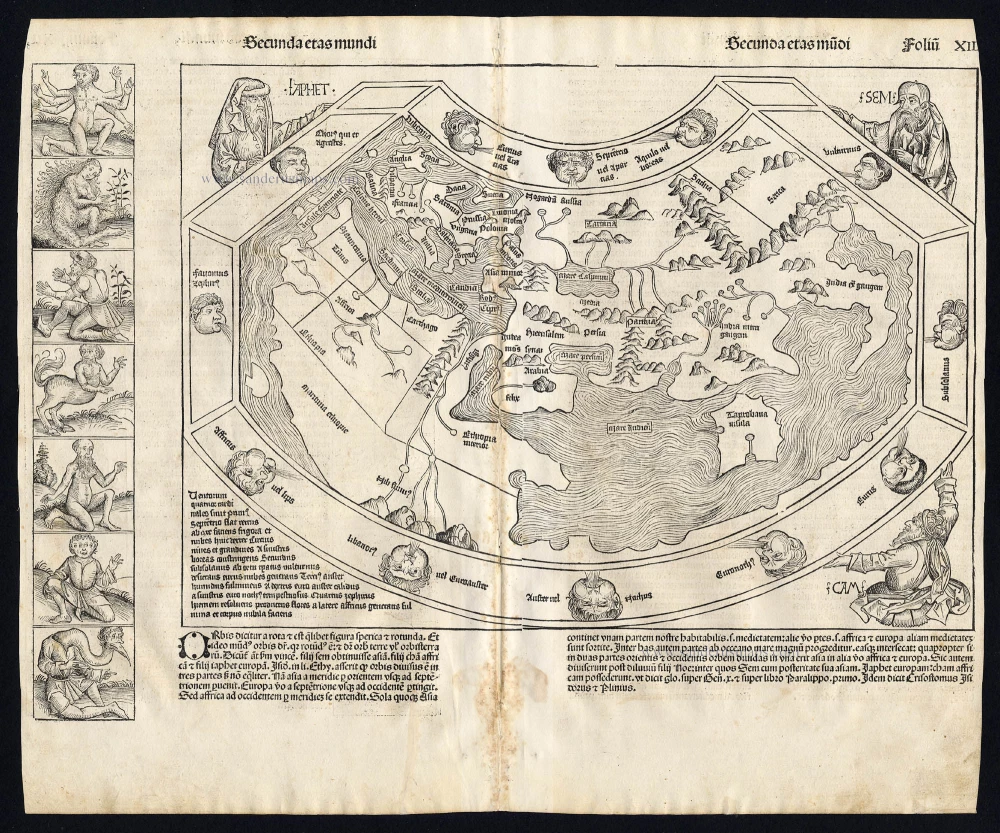
Secunda Etas Mundi
Item Number: 18090 Authenticity Guarantee
Category: Antique maps > World
Woodcut
Size: 31 x 43.5cm (12.1 x 17 inches)
Verso text: Latin
Condition: Centrefold reinforced, repaired tear in lower margin (13 cm), right and left margin trimmed not affecting the picture, brown stain at lower centerfold.
References: Shirley (World), 19.
The Nuremberg Chronicle was one of the most remarkable books of its time. Hartmann Schedel, a physician of Nuremberg, was the editor-in-chief; the printer was Anton Koberger, and among the designers the most famous were Michael Wolgemut and Hanns Pleydenwurff, masters of the Nuremberg workshop where Albrecht Dürer served his apprenticeship.
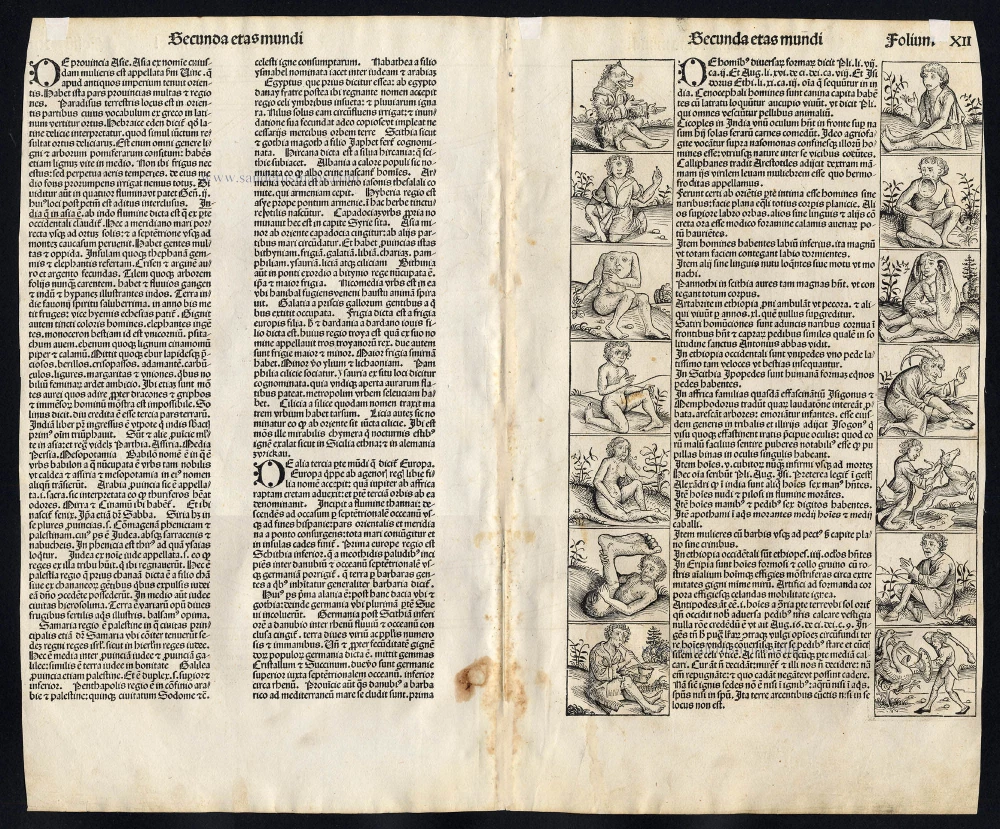
This world map is a robust woodcut taken from Ptolemy. The border contains twelve dour windheads while the map is supported in three of its corners by the solemn figures of Ham, Shem and Japhet taken from the Old Testament. What gives the map its present-day interest and attraction are the panels representing the outlandish creatures and beings that were thought to inhabit the furthermost parts of the earth. There are seven such scenes to the left of the map and a further fourteen on its reverse.
The first edition of the Nuremberg Chronicle in July 1493 was in Latin and there was a reprint with German text in December of the same year. (Shirley).
Dr. Peter Zahn's accounting indicates that there were probably 1500 Latin and 1000 German copies printed, or 2500 in all.
Hartmann Schedel (Nuremberg, 1440-1514) and the Nuremberg Chronicle.
Hartmann Schedel grew up in Nuremberg and first studied liberal arts in Leipzig. He earned a medical doctorate in Padua in 1466, then settled in Nuremberg to practice medicine and collect books. According to an inventory done in 1498, Schedel's library contained 370 manuscripts and 670 printed books.
Schedel is best known for writing the text for the Nuremberg Chronicle, an illustrated biblical paraphrase and world history that follows the story of human history related in the Bible; it includes the histories of many important Western cities. The Nuremberg Chronicle was one of the most remarkable books of its time. It was commissioned by Sebald Schreyer (1446–1520) and Sebastian Kammermeister (1446–1503) and published in 1493 in Nuremberg. Maps in the Chronicle were the first-ever illustrations of many cities and countries. Wolgemut and Pleydenwurff, the painters, were commissioned to provide the illustrations and handle the layout. The large workshop of Michael Wolgemut, then Nuremberg's leading artist in various media, provided the 1,809 woodcut illustrations (including duplications).
Albrecht Dürer was an apprentice to Wolgemut from 1486 to 1489, so he may well have participated in the design of some of the illustrations.
The Liber Chronicarum was first published in Latin on 12 July 1493 in Nuremberg by Anton Koberger, the most successful publisher in Germany. A German translation followed on 23 December 1493. An estimated 1,400 to 1,500 Latin and 700 to 1,000 German copies were published.
Due to the great success and prestige of the Chronicle, pirate editions soon appeared on the market. Johann Schönsperger (c. 1455-1521), a printer working out of Augsburg, published smaller editions of the Chronicle in 1496, 1497, and 1500 in German and Latin.