
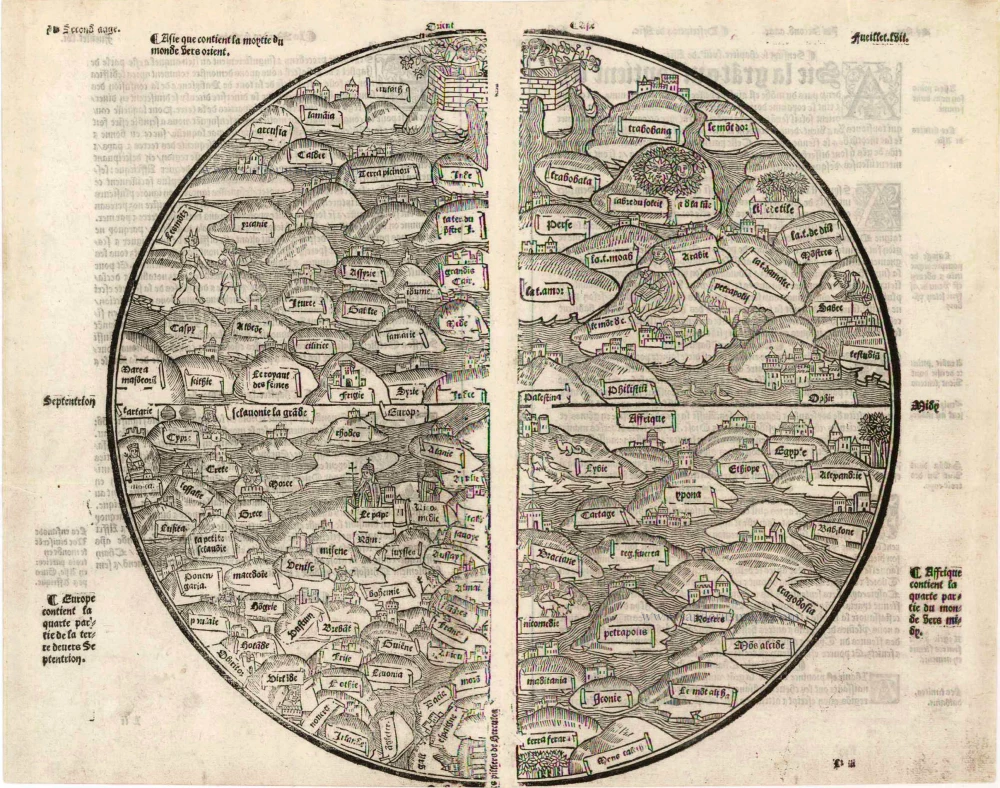
Old, antique map of the World from Mer des Hystoires 1491-1517
[No title]
Item Number: 13088 Authenticity Guarantee
Category: Antique maps > World
Old, antique map of the World from a Mer des Hystoires, oriented to the East
Woodcut
Size: 32 x 42cm (12.5 x 16.4 inches)
Verso text: French
Condition: Age-toned, bottom margin trimmed to neat line.
Condition Rating: B
References: Shirley (World), 17
From: Mer des Hystoires. Paris, c. 1544.
Circular woodcut map printed from 2 woodblocks on 2 sheets joined. First published in 1488 (Shirley 15). In 1491, new slightly reduced woodblocks were cut in Lyons for the "Mer des Hystoires", a French translation of the "Rudimentum Novitiorum". Later published in Paris from 1517 until 1555. Very rare.
The Rudimentum Novitiorum, a popular illustrated world history, was first published at Lübeck in 1475 and later became more widely known through its French translation under the title Mer des Hystoires. Among numerous fine woodcut illustrations and genealogical tables are two double-page maps: one of Palestine and one of the world. These are the first printed maps to try and show land forms and countries in topographical relation to each other. The world map derives from a Christianised medieval tradition without any reference to either Ptolemaic or portolan sources, and is a vivid piece of early cartographical design.
The world map is circular in form, oriented with east at the top and Jerusalem in the centre. The rough outline of Europe and the Mediterranean lands can be made out with the names of individual countries marked on clusters of hills. The Pope is prominent in the walled city of Rome. The Asian and Afrian countries are all represented by hills surrounded by water. Numerous towns, throned kings, and mythical animals are depicted, and extend to Taprobana (beyond Persia and India), Ethiopia (beyond Egypt) and to Tartary and the Sea of Amazons to the north. The pillars of Hercules bar the way westwards at the bottom of the map. At its head - instead of the traditional Adam and Eve - are two priestly figures in a walled orchard holding what may be olive branches. These may be the Master and his novice, source of rivers and all knowledge; alternatively according to H. Winter (Imago Mundi IX, 1952) they may represent ". . . two men of marvellous wisdom, Jew and Christian . . . united in love of God in one law and one road to wisdom", (Shirley)