
Sunflower by J.W. Weinmann. 1742.
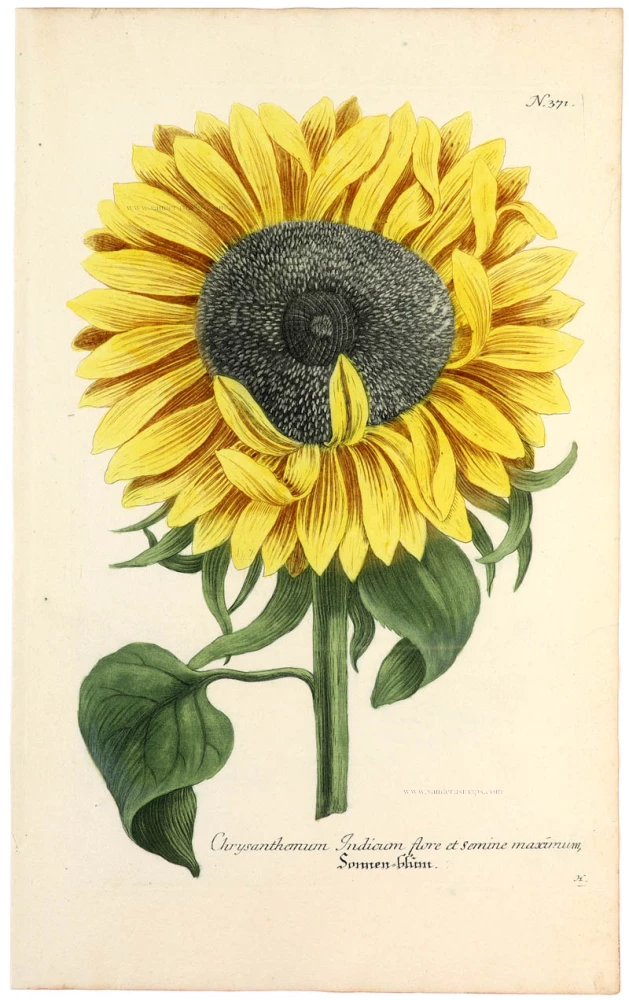
Johan Weinmann (1683-1741) directed the longest-established pharmacy in Regensburg. His "Phytanthoza Iconographia" is a vast work in eight folio volumes with over a thousand engravings representing several thousand plants. The work may be called the first successful botanical book using colour-printed mezzotint, a process which was invented in the Netherlands by Johann Teyler around 1688. As practised here by B. Seuter and J. E. Ridinger, it combined etching and mezzotint, making delicate lines and a very fine grain possible. The addition of hand-tinting brought about unusual and subtle effects. (Hunt)
Chrysanthemum Indicum flore et Semine maximum
Item Number: 33401 new Authenticity Guarantee
Category: Prints > Flowers Weinman
Sunflower by J.W. Weinmann.
Title: Chrysanthemum Indicum flore et Semine maximum
Date: 1742.
Copper engraving, printed on paper.
Size (not including margins): 400 x 245mm (15¾ x 9¾ inches).
Verso: Blank.
Condition: Excellent.
Condition Rating: A+.
From: Weinmann J.W., Phyntantoza Iconographia. Regensburg, H. Lentzen - Amsterdam, Z. Romberg, 1736-1756.
Johan Weinmann (1683-1741) directed the longest-established pharmacy in Regensburg. His "Phytanthoza Iconographia" is a vast work in eight folio volumes with over a thousand engravings representing several thousand plants. The work may be called the first successful botanical book using colour-printed mezzotint, a process which was invented in the Netherlands by Johann Teyler around 1688. As practised here by B. Seuter and J. E. Ridinger, it combined etching and mezzotint, making delicate lines and a very fine grain possible. The addition of hand-tinting brought about unusual and subtle effects. (Hunt)