
A fine example of Bodmer's celebrated Native American portraiture.
North American Indians by Karl Bodmer. 1839-1842
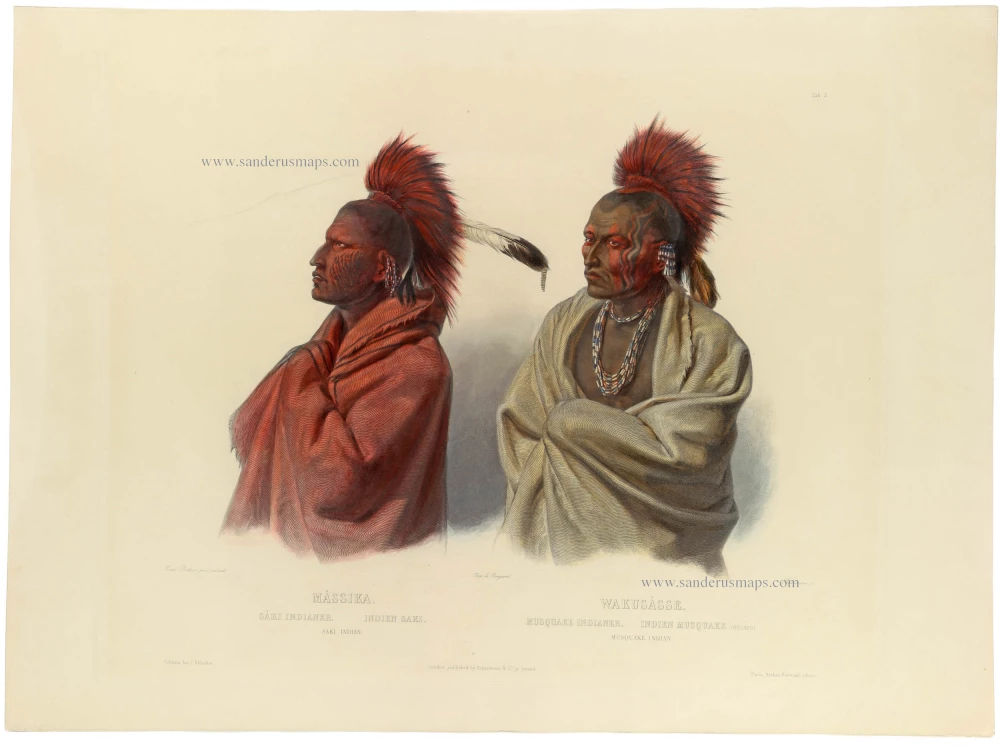
A magnificent, originally hand-coloured aquatint depicting two Native American men, Massika of the Sauk (Sac) people and Wakusasse of the Meskwaki (Fox) people, after a drawing by the celebrated Swiss artist Karl Bodmer.
The two figures are represented in three-quarter length against a delicately shaded background. Massika, on the left, is shown in profile, wrapped in a reddish-brown blanket, with a spectacular upright crest of red-dyed hair. Intricate painted markings decorate his face, while ornamental earrings and a long feather complete his striking appearance.
Wakusasse, on the right, wears a pale grey blanket draped around his shoulders and several necklaces of coloured beads. His elaborate red headdress and distinctive facial painting, with sinuous blue and red lines extending across his cheeks and forehead, are rendered with extraordinary precision. The contrasting poses and colours of the two figures give the composition an exceptional visual balance.
The print belongs to the celebrated series of illustrations Karl Bodmer produced during his expedition through North America with Prince Maximilian of Wied-Neuwied between 1832 and 1834. Travelling extensively along the Missouri River and through the American frontier, Bodmer recorded the landscapes, settlements, customs and inhabitants he encountered with remarkable accuracy.
His portraits of Native Americans are particularly admired for their combination of artistic refinement and ethnographic detail. Unlike the often romanticised representations produced by contemporary European artists, Bodmer's portraits were based on direct observation and individual studies, providing an invaluable visual record of Indigenous peoples during a period of profound historical change.
The aquatints published after Bodmer's watercolours are among the finest examples of nineteenth-century colour printmaking. Their subtle tonal gradations, meticulous detail and delicate original hand-colouring reproduce the qualities of the artist's original drawings with remarkable fidelity.
Massika, Saki Indian - Wakusasse, Musquake Indian
Item Number: 33402 new Authenticity Guarantee
Category: Prints > Miscellaneous
North American Indians by Karl Bodmer.
Title: Massika, Saki Indian - Wakusasse, Musquake Indian
London, published by Ackermann & C°. 90 Strand.
Date: 1839-1842.
First edition.
Aquatint engraving, printed on paper.
Sheet size: 450 x 615mm (17¾ x 24¼ inches).
Verso: Blank.
Condition: Original hand-coloured, faint printer's crease in upper-left blank section.
Condition Rating: A.
From: Bodmer Karl & Maximilian Prince. Travels in the Interior of North America. London: Ackermann & Co. [and Coblenz: J. Holscher; Paris: Bertrand], 1843.
A magnificent, originally hand-coloured aquatint depicting two Native American men, Massika of the Sauk (Sac) people and Wakusasse of the Meskwaki (Fox) people, after a drawing by the celebrated Swiss artist Karl Bodmer.
The two figures are represented in three-quarter length against a delicately shaded background. Massika, on the left, is shown in profile, wrapped in a reddish-brown blanket, with a spectacular upright crest of red-dyed hair. Intricate painted markings decorate his face, while ornamental earrings and a long feather complete his striking appearance.
Wakusasse, on the right, wears a pale grey blanket draped around his shoulders and several necklaces of coloured beads. His elaborate red headdress and distinctive facial painting, with sinuous blue and red lines extending across his cheeks and forehead, are rendered with extraordinary precision. The contrasting poses and colours of the two figures give the composition an exceptional visual balance.
The print belongs to the celebrated series of illustrations Karl Bodmer produced during his expedition through North America with Prince Maximilian of Wied-Neuwied between 1832 and 1834. Travelling extensively along the Missouri River and through the American frontier, Bodmer recorded the landscapes, settlements, customs and inhabitants he encountered with remarkable accuracy.
His portraits of Native Americans are particularly admired for their combination of artistic refinement and ethnographic detail. Unlike the often romanticised representations produced by contemporary European artists, Bodmer's portraits were based on direct observation and individual studies, providing an invaluable visual record of Indigenous peoples during a period of profound historical change.
The aquatints published after Bodmer's watercolours are among the finest examples of nineteenth-century colour printmaking. Their subtle tonal gradations, meticulous detail and delicate original hand-colouring reproduce the qualities of the artist's original drawings with remarkable fidelity.