
Rare, from the supplement volume
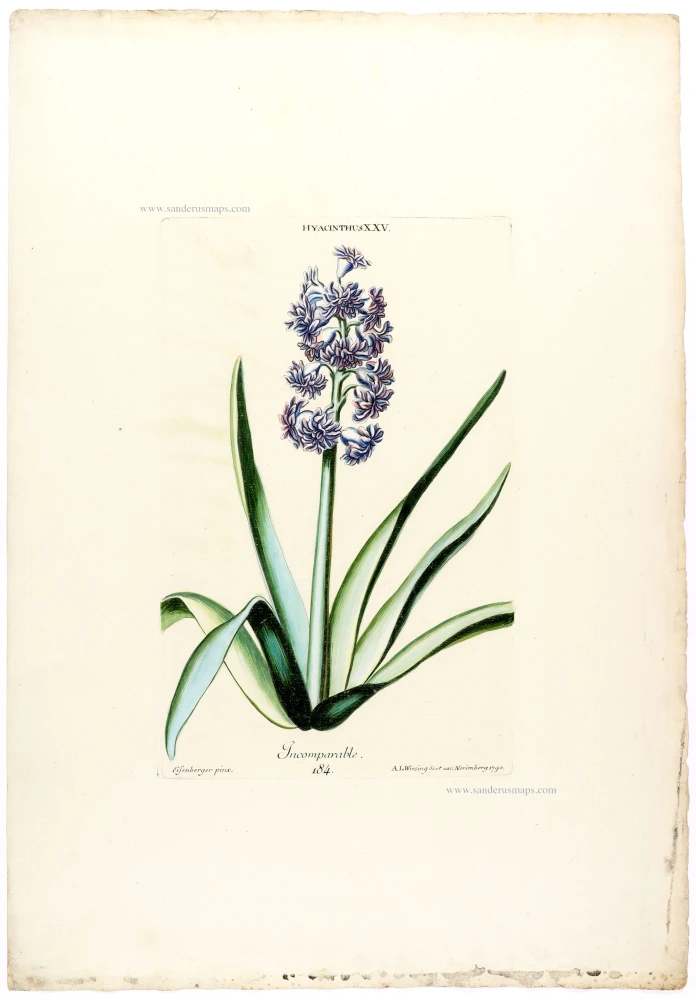
Double-flowered hyacinth by C.J. Trew. 1790
Trew's Hortus Nitidissimus is one of the finest and rarest botanical works of the eighteenth century. Published in Nuremberg in successive instalments over more than forty years, this magnificent florilegium depicts the most prized flowers cultivated in European gardens during the period.
The illustrations are based on drawings from the collection of Christoph Jakob Trew (1695–1769), a prominent German physician, botanist, bibliophile and patron of botanical artists. Among the principal contributors was Georg Dionysius Ehret (1708–1770), widely regarded as the greatest botanical artist of his time, who provided the original drawings for approximately forty plates. Other talented artists involved in the project included Barbara Regina Dietzsch, Nikolaus Friedrich Eisenberger, Georg Wilhelm Baurenfeind and Johann Christoph Keller.
The work was initiated in 1750 by Johann Michael Seligmann and continued after his death in 1762 by his successors, notably Adam Ludwig Wirsing. The publication was divided into three volumes, with accompanying descriptive text in both Latin and German:
-
Volume I: plates 1–59 (1750–1767).
-
Volume II: plates 60–120 (1767–1774).
-
Volume III: plates 121–180 (1775–1786).
-
Supplementary series: plates 181–190, completed around 1792 and issued without accompanying text.
The complete work comprises 190 numbered illustrations on 188 sheets, as plates 60/61 and 121/122 were each engraved together on a single sheet.
The collection includes a remarkable selection of tulips, hyacinths, roses, carnations, auriculas, ranunculi, anemones, lilies, irises, narcissi, fritillaries and crown imperials, including numerous historical garden varieties.
Unlike many contemporary botanical publications, which concentrated primarily on scientific classification, the Hortus Nitidissimus celebrated the ornamental beauty of cultivated flowers. The large-format engravings are distinguished by their exceptionally rich colouring, often applied with such delicacy and intensity that the engraved outlines become almost imperceptible.
The exceptionally long publication period, together with the considerable expense of producing these lavishly coloured engravings, accounts for the great rarity of complete copies. The final ten supplementary plates are particularly elusive and are absent from most surviving sets.
Today, the Hortus Nitidissimus remains one of the great achievements of eighteenth-century botanical illustration and an outstanding historical record of European horticulture.
Bibliographical references: Nissen BBI 1995; Dunthorne 310; Great Flower Books, p. 144 (1990 edition); Stafleu & Cowan, TL2 15.130; W.L. Tjaden, Hortus Nitidissimus, Taxon, 20 (4), 1971, pp. 461–466.
Incomparable.184
Item Number: 33446 new Authenticity Guarantee
Category: Prints > Natural History
Double-flowered hyacinth by C.J. Trew.
(Hyacinthus orientalis)
Plate 184 from the rare supplementary series (plates 181–190), issued without accompanying text.
Title: Incomparable.184
HYACINTHUS XXV
Eisenberger pinx.
A.L. Wirsing Sc. et exc. Norimberg 1790
Designer: Nikolaus Friedrich Eisenberger.
Engraver: Adam Ludwig Wirsing.
Date of the first edition: 1790.
Date of this map: 1790.
Date on map: 1790.
Copper engraving, printed on paper.
Image size: 310 x 195mm (12¼ x 7¾ inches).
Sheet size: 545 x 380mm (21½ x 15 inches).
Verso: Blank.
Condition: Original coloured, excellent.
Condition Rating: A+.
From:
C.J. Trew, Hortus nitidissimis omnem per annum superbiens floribus, sive amoenissimorum florum imagines. Nuremberg: Seligmann's heirs and Adam Ludwig Wirsing, 1750–1792.
Trew's Hortus Nitidissimus is one of the finest and rarest botanical works of the eighteenth century. Published in Nuremberg in successive instalments over more than forty years, this magnificent florilegium depicts the most prized flowers cultivated in European gardens during the period.
The illustrations are based on drawings from the collection of Christoph Jakob Trew (1695–1769), a prominent German physician, botanist, bibliophile and patron of botanical artists. Among the principal contributors was Georg Dionysius Ehret (1708–1770), widely regarded as the greatest botanical artist of his time, who provided the original drawings for approximately forty plates. Other talented artists involved in the project included Barbara Regina Dietzsch, Nikolaus Friedrich Eisenberger, Georg Wilhelm Baurenfeind and Johann Christoph Keller.
The work was initiated in 1750 by Johann Michael Seligmann and continued after his death in 1762 by his successors, notably Adam Ludwig Wirsing. The publication was divided into three volumes, with accompanying descriptive text in both Latin and German:
-
Volume I: plates 1–59 (1750–1767).
-
Volume II: plates 60–120 (1767–1774).
-
Volume III: plates 121–180 (1775–1786).
-
Supplementary series: plates 181–190, completed around 1792 and issued without accompanying text.
The complete work comprises 190 numbered illustrations on 188 sheets, as plates 60/61 and 121/122 were each engraved together on a single sheet.
The collection includes a remarkable selection of tulips, hyacinths, roses, carnations, auriculas, ranunculi, anemones, lilies, irises, narcissi, fritillaries and crown imperials, including numerous historical garden varieties.
Unlike many contemporary botanical publications, which concentrated primarily on scientific classification, the Hortus Nitidissimus celebrated the ornamental beauty of cultivated flowers. The large-format engravings are distinguished by their exceptionally rich colouring, often applied with such delicacy and intensity that the engraved outlines become almost imperceptible.
The exceptionally long publication period, together with the considerable expense of producing these lavishly coloured engravings, accounts for the great rarity of complete copies. The final ten supplementary plates are particularly elusive and are absent from most surviving sets.
Today, the Hortus Nitidissimus remains one of the great achievements of eighteenth-century botanical illustration and an outstanding historical record of European horticulture.
Bibliographical references: Nissen BBI 1995; Dunthorne 310; Great Flower Books, p. 144 (1990 edition); Stafleu & Cowan, TL2 15.130; W.L. Tjaden, Hortus Nitidissimus, Taxon, 20 (4), 1971, pp. 461–466.
Related items

Ranunculus II 1750-1772
Trew C.J. - ORHPEUS
[Item number: 13512]

Ranunculus I 1750-1772
Trew C.J. - Flavia
[Item number: 13514]

Martagon II 1750-1772
Trew C.J. - MARTAGON VIRGINIANUM
[Item number: 13516]

Martagum III 1750-1772
Trew C.J. - THE NEW CRIMSON PENSILVANIA MARTAGON
[Item number: 13519]

Viperino flore - Aquitanica 1750-1772
Trew C.J. - VIPERINO FLORE - AQUITANICA
[Item number: 13533]

Fritillaria III 1750-1772
Trew C.J. - Alexander, Asgrauw
[Item number: 13534]

Herzog von Cumberland 1750-1772
Trew C.J. - HERZOG VON CUMBERLAND
[Item number: 13540]

La Coquine - Duc d'Aquitanie - La Nouvelle - L'Agréable - Fraeulein von Münchingen. 1750-1772
Five tulips prints by C.J. Trew.
[Item number: 31613]
Rare, from the supplement volume. Trew
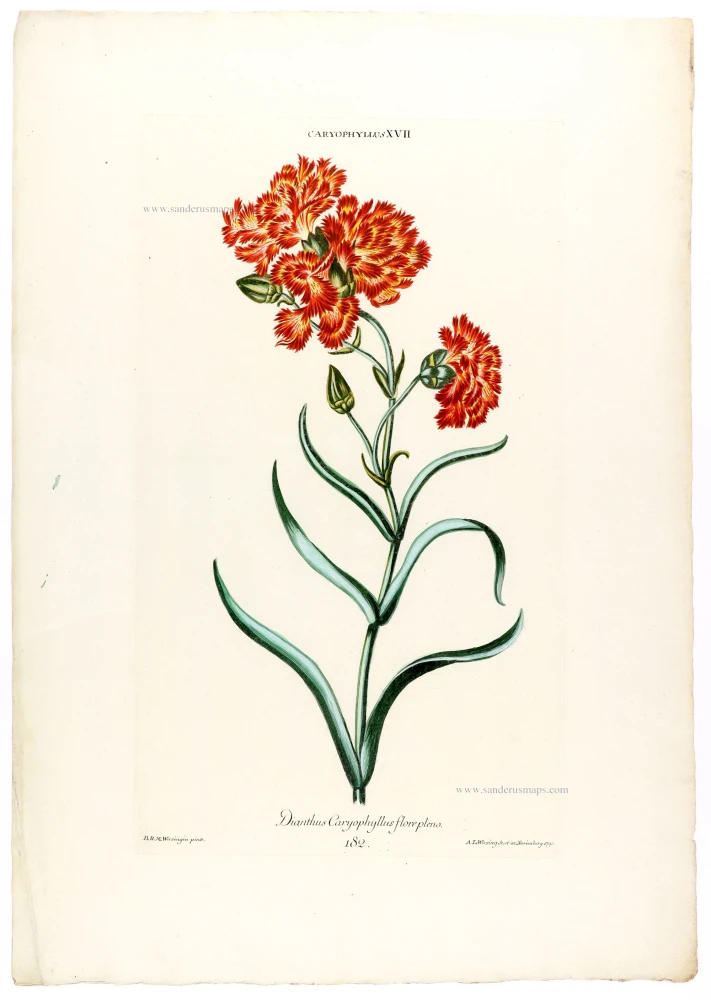
Dianthus Caryophyllus flore pleno. 182 1790
Double-flowered carnation by C.J. Trew.
[Item number: 33444]
new
Rare, from the supplement volume
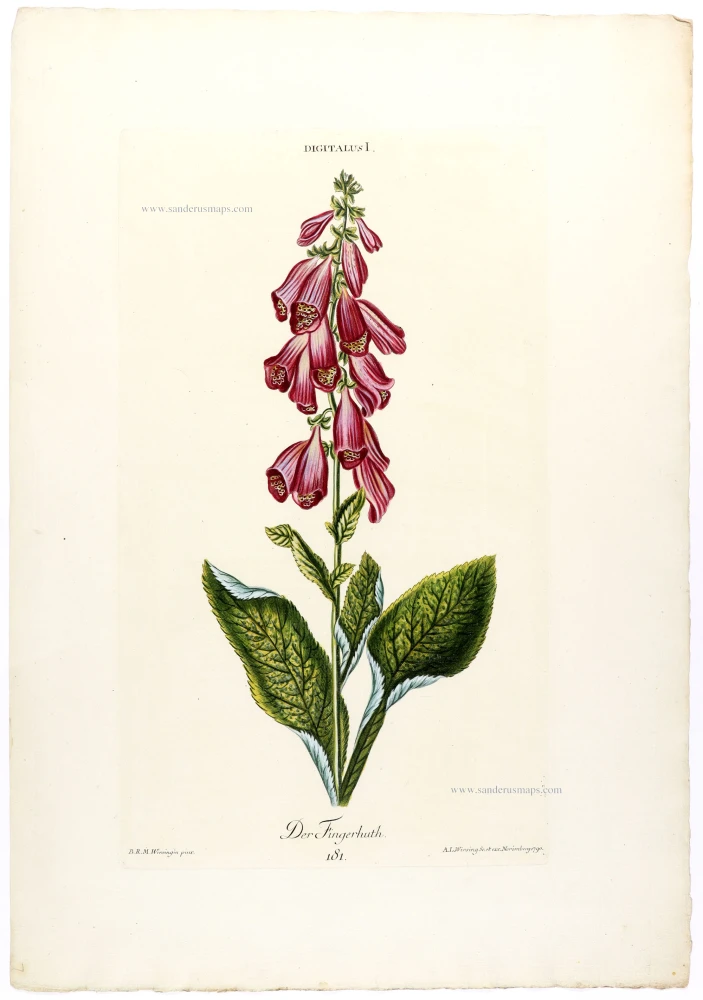
Der Fingerhuth.181 1790
Common foxglove (Purple foxglove) by C.J. Trew.
[Item number: 33445]
new