
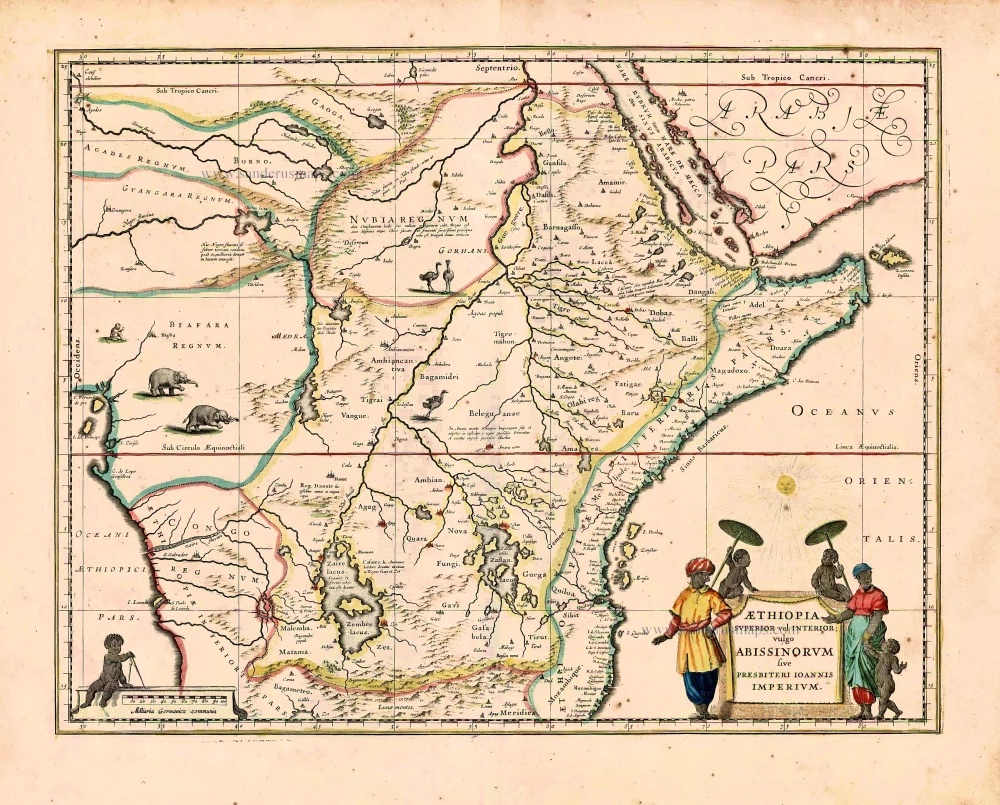
Kingdom of Prester John , by Pieter Van der Aa. 1707

Prester John is a mythical Christian king thought to have lived in East Africa. In 1520, a sizable Portuguese expedition under Francisco Alvares travelled to East Africa, where they were received hospitably by the Coptic Christian king David II. David was considered to be Prester John's successor. Alvares described his journey after his return to Portugal. His book was the most important source of information on Ethiopia for more than a century.
Pieter van der Aa (Leiden, 1659-1733)
Pieter van der Aa was already in 1682 owner of a bookshop and auction house. During his life, he has published an enormous amount of printed material.
After 1700, van der Aa increasingly specialised in books on geography and travel.
He published composite atlases, a series of geographical descriptions of European countries, and some very spectacular works. Between 1706 and 1708 he published the Naauweurige versameling der gedenkwaardigste zee- en land-reysen, in 28 volumes.
Many of Van der Aa’s publications are richly illustrated with maps and plates. He took over many copperplates and prints from other publishers such as Carel Allard and Frederik De Wit. The composite atlases that appeared from his workshop contain a curious mixture of his own material, copies of maps from other publishers, and reprints made from old copper plates, now with his own imprint.
The Galérie agréable du monde, was completed in 1729, and comprised 66 parts, bound in 27 volumes. Van der Aa presented it as a good investment; after publication, the antiquarian value of the work would double, the more so since it was printed in a limited edition of only one hundred copies.
Aethiopie of Abissine, In't gemeen 't Land van Preste Ian Genoemd.
Item Number: 32343 Authenticity Guarantee
Category: Antique maps > Africa
Kingdom of Prester John (Central and eastern Africa), by Pieter Van der Aa.
Title: Aethiopie of Abissine, In't gemeen 't Land van Preste Ian Genoemd.
Uytgevoerd te Leyden door Pieter Vander Aa met Privilegie. - Diego Lopez de Sequeira.
Date of the first edition: 1707.
Date of this map: 1707.
Copper engraving, printed on paper.
Image size: 155 x 220mm (6 x 8¾ inches).
Sheet size: 170 x 310mm (6¾ x 12¼ inches).
Verso: Blank.
Condition: Age-toned.
Condition Rating: A.
From: Naaukeurige Versameling der gedenk-waardigste Zee- en landreysen na Oost en West-Indien. Leiden, Pieter Van der Aa, 1707.
Illustrates the travels of Diego Lopez de Sequeira.
Prester John is a mythical Christian king thought to have lived in East Africa. In 1520, a sizable Portuguese expedition under Francisco Alvares travelled to East Africa, where they were received hospitably by the Coptic Christian king David II. David was considered to be Prester John's successor. Alvares described his journey after his return to Portugal. His book was the most important source of information on Ethiopia for more than a century.
Pieter van der Aa (Leiden, 1659-1733)
Pieter van der Aa was already in 1682 owner of a bookshop and auction house. During his life, he has published an enormous amount of printed material.
After 1700, van der Aa increasingly specialised in books on geography and travel.
He published composite atlases, a series of geographical descriptions of European countries, and some very spectacular works. Between 1706 and 1708 he published the Naauweurige versameling der gedenkwaardigste zee- en land-reysen, in 28 volumes.
Many of Van der Aa’s publications are richly illustrated with maps and plates. He took over many copperplates and prints from other publishers such as Carel Allard and Frederik De Wit. The composite atlases that appeared from his workshop contain a curious mixture of his own material, copies of maps from other publishers, and reprints made from old copper plates, now with his own imprint.
The Galérie agréable du monde, was completed in 1729, and comprised 66 parts, bound in 27 volumes. Van der Aa presented it as a good investment; after publication, the antiquarian value of the work would double, the more so since it was printed in a limited edition of only one hundred copies.
Related items

Abissinorum Sive Pretiosi Ioannis Imperiu. 1641
Kingdom of Prester John by Henricus Hondius.
[Item number: 26451]
Aethiopia Superior vel Interior; vulgo Abissinorum sive Presbiteri Ioannis Imperium. 1640
Kingdom of Prester John, by Willem Blaeu.
[Item number: 27693]