
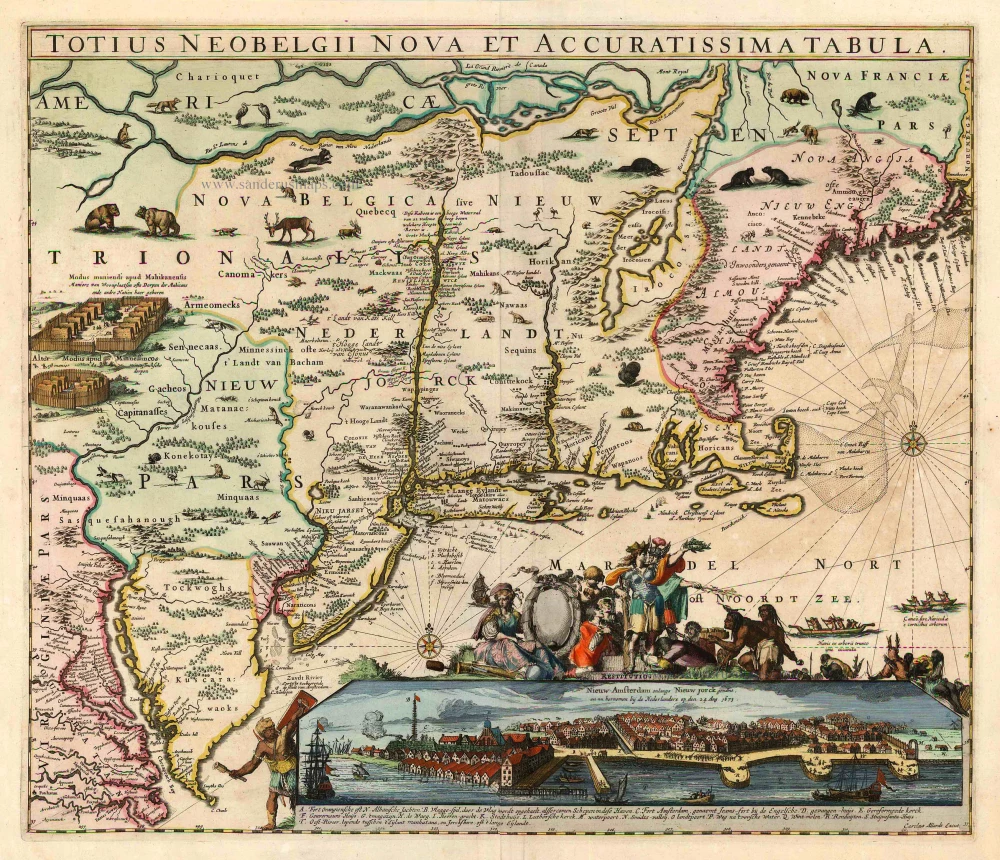
Antique map of the Northeast of the United States, by Allard c.1680


The Allard Family
The founder of this family of map-makers, publishers and print-sellers was Huych (Hugo) Allard (1625-1691). He worked in Amsterdam in 1684 and is supposed to have begun his business as early as 1645. He died in 1691, leaving his shop to his son, Carel Allard (1648-c. 1706). Carel brought out many maps and some atlases. His atlases are mainly composed of maps from the stock of other publishers like Janssonius and De Wit. However, some maps were his original creations. The States of Holland granted him a privilege for these maps in 1683.
One of the sons of Carel, Abraham Allard (1676-c.1730), joined his father in the map trade and was accepted as a member of the ‘Constvercoopers gilde’ (Art dealer’s Guild) in 1708.
The original geographical maps by Allard, designed and cut between 1680 and 1700, are very decorative, well-composed and up-to-date.
Totius Neobelgii Nova et Accuratissima Tabula
Item Number: 24667 Authenticity Guarantee
Category: Antique maps > America > North America
Antique map of the Northeast of the United States, by Allard.
The Restitutio view of New York replaced the Visscher view from the second state on (1674). This was to celebrate the 'restoration' of New Amsterdam to Holland, in August 1673, by the fleet under the command of Cornelius Evertsen. This state was clearly produced shortly after this date as the view bears the title Nieuw-Amsterdam onlangs Nieuw Jorck genaemt, en nu hernomen bij de Nederlanders op den 24 Aug 1673. It would not have been produced after November 1674 when the city was returned to England under the Treaty of Breda, in exchange for the colony of Surinam. Evidence from the view itself indicates that it was probably drawn after October 1673. An increase in the size of the city can be seen, with a wall constructed at the waterfront (which later became Wall Street). The area near the wall is not known to have been so built up at this time. The figure on the pedestal is holding a laurel of victory.
Following the death of Hugo Allard in 1691, the business was continued by his son, Carol, although it seems likely that this plate was already in his possession. He altered the imprint lower right, and probably shortly after added it to the previously blank shield.
The first and third state are recorded in only four examples; the second state in only one.
Date of the first edition: c 1662
Date of this map: c.1680
Copper engraving
Size: 46.5 x 54.5cm (18.1 x 21.3 inches)
Verso: Blank
Condition: Contemporary old coloured with some gold highlights, excellent.
Condition Rating: A
References: Burden, 373, State 4; Tooley (America), p.287-289, 17; Cohen-Augustyn, p.46-47.
From: Separate publication.
The Allard Family
The founder of this family of map-makers, publishers and print-sellers was Huych (Hugo) Allard (1625-1691). He worked in Amsterdam in 1684 and is supposed to have begun his business as early as 1645. He died in 1691, leaving his shop to his son, Carel Allard (1648-c. 1706). Carel brought out many maps and some atlases. His atlases are mainly composed of maps from the stock of other publishers like Janssonius and De Wit. However, some maps were his original creations. The States of Holland granted him a privilege for these maps in 1683.
One of the sons of Carel, Abraham Allard (1676-c.1730), joined his father in the map trade and was accepted as a member of the ‘Constvercoopers gilde’ (Art dealer’s Guild) in 1708.
The original geographical maps by Allard, designed and cut between 1680 and 1700, are very decorative, well-composed and up-to-date.