
Vincenzo Coronelli’s most spectacular cosmographical plate
Cosmographical chart by Vincenzo Coronelli 1691
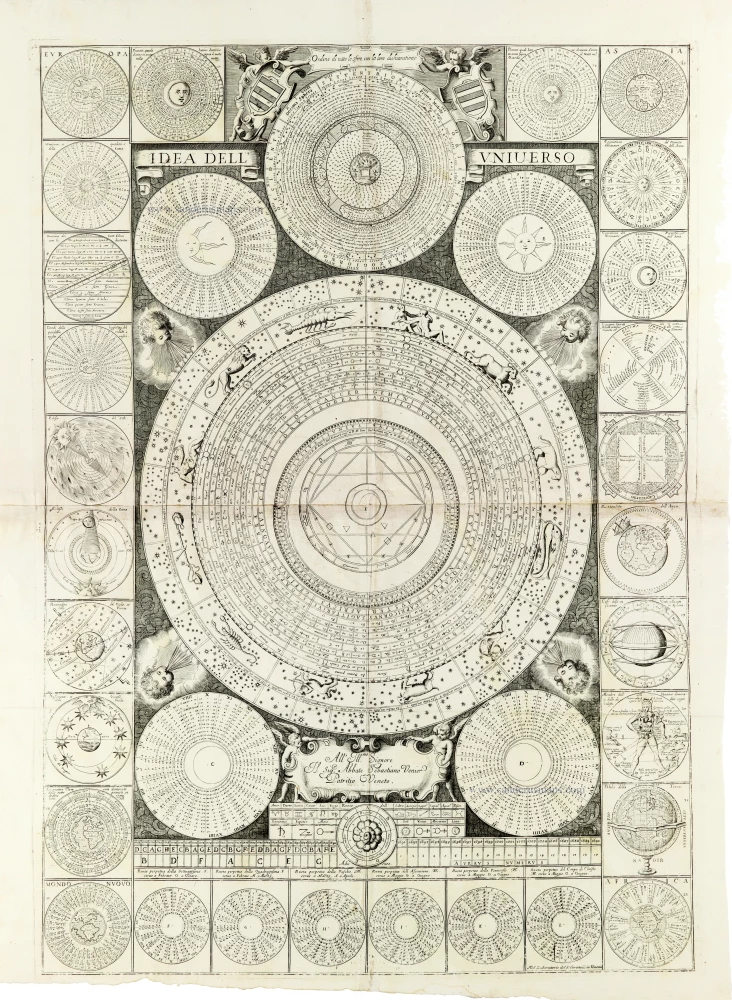
A magnificent and extraordinarily elaborate cosmographical chart by the Venetian Franciscan friar, geographer and globe-maker Vincenzo Coronelli, presenting a visual compendium of seventeenth-century astronomical, cosmological and astrological knowledge.
A monumental circular representation of the universe dominates the composition, surrounded by the twelve signs of the zodiac and extensive astronomical and calendrical information. At its centre is the Earth, represented within a complex series of concentric celestial spheres. Coronelli here draws upon the traditional geocentric or Ptolemaic conception of the cosmos, in which the Earth occupies the centre and is enclosed by the successive spheres of the Moon, Mercury, Venus, the Sun, Mars, Jupiter, Saturn and the fixed stars. The conception recalls the cosmological diagrams traditionally associated with Dante's Divina Commedia.
Above the principal diagram appears a second large circular scheme entitled “Ordine di tutte le Sfere, con la loro dichiaratione”, again explaining the arrangement of the celestial spheres. Large circular tables associated with the Sun and Moon flank the sheet, while additional astronomical tables occupy the lower portion.
The principal cosmological diagram is framed by four personifications of the winds and by an extraordinary array of smaller astronomical and cosmographical figures. Around the outer borders are twenty-eight subsidiary diagrams, illustrating such subjects as the motions and phases of the Sun and Moon, solar and lunar eclipses, planetary systems, the terrestrial globe, climatic and geographical divisions of the Earth, astrological relationships and the correspondence between the signs of the zodiac and parts of the human body.
Of particular interest is Coronelli's combination of what would now be separated into astronomy, geography and astrology. Perpetual calendars and astronomical tables coexist with zodiacal diagrams, planetary theories and astrological correspondences. One diagram even presents a cross-section of the Earth incorporating the circles of Hell according to Dante's cosmology. The whole plate thus functions almost as an illustrated encyclopedia of the universe as it could still be conceived at the end of the seventeenth century.
At the bottom centre is an elaborate baroque dedication cartouche reading: “All’ Ill. mo Signore / Il Sig. Abbate Sebastiano Venier / Patrizio Veneto.”
The presence of this dedication is significant for dating the impression. An early issue of the plate with the Venier dedication is recorded as being printed in Coronelli's workshop around 1690. In contrast, the plate subsequently circulated in different forms and was reissued separately around 1697–1700 under the title Idea dell’Universo.
Coronelli's chart is particularly interesting because it should not simply be interpreted as his endorsement of the Ptolemaic universe. In his writings, he also illustrated and discussed the competing cosmological systems of Ptolemy, Copernicus, Tycho Brahe and Descartes. The Idea dell’Universo therefore represents a synthesis of inherited cosmographical traditions at precisely the period when the European conception of the universe was undergoing fundamental change.
Vincenzo Coronelli (1650-1718)
Vincenzo Coronelli was born in Venice on 16 August 1650 and primarily brought up in Ravenna. He returned to Venice in 1665 and joined the convent of the Minor Conventuals. Five years later, he was sent to Rome to study, and by 1673, he was already a doctor of theology.
Having achieved fame by constructing two globes for the Duke of Parma, he was invited to Paris for three years in 1681 and made two enormous examples for Louis XIV. On his return to Venice, he assiduously collected cartographic material and founded the Academy of the Argonauts. In 1685, he was appointed Cosmographer to the Republic of Venice and authorised to publish a large atlas. He became a geography lecturer at the University of Venice and brought out an Atlante Veneto the following year.
In 1696, he visited Germany, Holland and southern England. During intervals in compiling his vast encyclopaedia, he continued with cartographic projects up to 1709. He died in his native Venice on 9 December 1718.
Coronelli became famous for his globes. In addition, he was a renowned encyclopaedist, mapmaker and geographer. Most of his maps and other material are gathered in his Atlante Veneto (13 vols, 1690-1705). The first volume, subtitled Descrizione generale istorica geografica, was his masterpiece, planned as an extension of Blaeu’s atlas.
Other volumes of the atlas which contain maps are Isolario, two parts (1696-8), with detailed maps and plans, mostly of islands; Corso geografico, two parts based on the edition 1694-7; Libro de’ globi (1697); and Lo Specchio del Mare, a reprint of Levanto's Lo Specchio del Mare Mediterraneo of 1664.
The other vital aspects of his mapping are those arising from the Venetian conquest and his travels. His most extensive military compilation was the Teatro della Guerra, in more than 30 volumes.
Idea dell’Universo. Ordine di tutte le Sfere, con la loro dichiaratione.
Item Number: 33300 new Authenticity Guarantee
Category: Antique maps > Celestial Maps
Cosmographical chart by Vincenzo Coronelli.
Title: Idea dell’Universo. Ordine di tutte le Sfere, con la loro dichiaratione.
With a dedication to the Venetian abbot Sebastiano Venier
Date of the first edition: 1691.
Date of this map: 1691.
Copper engraving, printed on two joined double sheets of paper.
Image size: 765 x 530mm (30 x 20¾ inches).
Sheet size: 810 x 610mm (32 x 24 inches).
Verso: Blank.
Condition: Two small tears at the fold intersections have been closed.
Condition Rating: A.
From: Atlante Veneto, nel quale si contiene la descrittione... degl' Imperii, Regni, Provincie, e Stati dell' Universo. Venice: Girolamo Albrizzi, 1691. Shirley (Brit.Lib.), T.CORO-7a
A magnificent and extraordinarily elaborate cosmographical chart by the Venetian Franciscan friar, geographer and globe-maker Vincenzo Coronelli, presenting a visual compendium of seventeenth-century astronomical, cosmological and astrological knowledge.
A monumental circular representation of the universe dominates the composition, surrounded by the twelve signs of the zodiac and extensive astronomical and calendrical information. At its centre is the Earth, represented within a complex series of concentric celestial spheres. Coronelli here draws upon the traditional geocentric or Ptolemaic conception of the cosmos, in which the Earth occupies the centre and is enclosed by the successive spheres of the Moon, Mercury, Venus, the Sun, Mars, Jupiter, Saturn and the fixed stars. The conception recalls the cosmological diagrams traditionally associated with Dante's Divina Commedia.
Above the principal diagram appears a second large circular scheme entitled “Ordine di tutte le Sfere, con la loro dichiaratione”, again explaining the arrangement of the celestial spheres. Large circular tables associated with the Sun and Moon flank the sheet, while additional astronomical tables occupy the lower portion.
The principal cosmological diagram is framed by four personifications of the winds and by an extraordinary array of smaller astronomical and cosmographical figures. Around the outer borders are twenty-eight subsidiary diagrams, illustrating such subjects as the motions and phases of the Sun and Moon, solar and lunar eclipses, planetary systems, the terrestrial globe, climatic and geographical divisions of the Earth, astrological relationships and the correspondence between the signs of the zodiac and parts of the human body.
Of particular interest is Coronelli's combination of what would now be separated into astronomy, geography and astrology. Perpetual calendars and astronomical tables coexist with zodiacal diagrams, planetary theories and astrological correspondences. One diagram even presents a cross-section of the Earth incorporating the circles of Hell according to Dante's cosmology. The whole plate thus functions almost as an illustrated encyclopedia of the universe as it could still be conceived at the end of the seventeenth century.
At the bottom centre is an elaborate baroque dedication cartouche reading: “All’ Ill. mo Signore / Il Sig. Abbate Sebastiano Venier / Patrizio Veneto.”
The presence of this dedication is significant for dating the impression. An early issue of the plate with the Venier dedication is recorded as being printed in Coronelli's workshop around 1690. In contrast, the plate subsequently circulated in different forms and was reissued separately around 1697–1700 under the title Idea dell’Universo.
Coronelli's chart is particularly interesting because it should not simply be interpreted as his endorsement of the Ptolemaic universe. In his writings, he also illustrated and discussed the competing cosmological systems of Ptolemy, Copernicus, Tycho Brahe and Descartes. The Idea dell’Universo therefore represents a synthesis of inherited cosmographical traditions at precisely the period when the European conception of the universe was undergoing fundamental change.
Vincenzo Coronelli (1650-1718)
Vincenzo Coronelli was born in Venice on 16 August 1650 and primarily brought up in Ravenna. He returned to Venice in 1665 and joined the convent of the Minor Conventuals. Five years later, he was sent to Rome to study, and by 1673, he was already a doctor of theology.
Having achieved fame by constructing two globes for the Duke of Parma, he was invited to Paris for three years in 1681 and made two enormous examples for Louis XIV. On his return to Venice, he assiduously collected cartographic material and founded the Academy of the Argonauts. In 1685, he was appointed Cosmographer to the Republic of Venice and authorised to publish a large atlas. He became a geography lecturer at the University of Venice and brought out an Atlante Veneto the following year.
In 1696, he visited Germany, Holland and southern England. During intervals in compiling his vast encyclopaedia, he continued with cartographic projects up to 1709. He died in his native Venice on 9 December 1718.
Coronelli became famous for his globes. In addition, he was a renowned encyclopaedist, mapmaker and geographer. Most of his maps and other material are gathered in his Atlante Veneto (13 vols, 1690-1705). The first volume, subtitled Descrizione generale istorica geografica, was his masterpiece, planned as an extension of Blaeu’s atlas.
Other volumes of the atlas which contain maps are Isolario, two parts (1696-8), with detailed maps and plans, mostly of islands; Corso geografico, two parts based on the edition 1694-7; Libro de’ globi (1697); and Lo Specchio del Mare, a reprint of Levanto's Lo Specchio del Mare Mediterraneo of 1664.
The other vital aspects of his mapping are those arising from the Venetian conquest and his travels. His most extensive military compilation was the Teatro della Guerra, in more than 30 volumes.