
Old, antique map - Sea chart of Europe by P. Goos and W. Blaeu 1655-1666

Printed on vellum, this is a variant of the second state of Willem Janszoon Blaeu's rare sea chart of Europe, c.1621, now published by P. Goos. The 2nd state described by Schilder IV, 45.2: the 4th line of the title cartouche says: "Nieulijcx aldus uytgegeven", our copy says: "Nieulyez aldus uytgegeven".
The chart was highly influential and was copied by Anthonie Jacobz and Justus Danckerts, as well as by Blaeu's own grandchildren Willem, Pieter and Joan.
Goos made the only re-issue of the original Blaeu plate, and Gunter Schilder dates this state between 1650 and 1666.
The text in the title cartouche, still crowned by the printer's mark of Blaeu, has been replaced and a new imprint has been placed in a new richly decorated cartouche in Greenland. The chart is oriented to the west. It shows the seacoasts of Europe from Novaya Zemlya and the Gulf of Sydra in the east, and the Azores and the west coast of Greenland in the west. In the north the chart extends to the northern coast of Spitsbergen, and in the south to the Canary Islands. The eastern part of the Mediterranean is included in the North African interior (Schilder).
Magnificently decorated, there are richly detailed European coats of arms, scale cartouches in the corners, several ships in the waters, a pair of native people in Greenland, and a number of animals portrayed on land, including polar bears and elephants.
Only 5 copies are listed in public libraries, three on vellum and two on paper. The three copies on vellum are in the Badische Landesbibliothek, Karlsruhe , Kungl. Biblioteket, Stockholm and The Library of Congress, Washington. The two copies on paper are in the Bibliothèque Nationale, Paris.
Pieter Goos (1615-1675)
Pieter Goos, son of the engraver Abraham Goos, was one of the best known maritime booksellers of Amsterdam. He was not only a bookseller but also a copper-engraver and even a book printer.
His first pilot book, the Lichtende Columne ofte Zee-Spiegel appeared in 1650. The well-made pilot guides and the beautiful sea-atlas reflect a high professional standard. The many editions published over 28 years is an indication of the customers’ appreciation. The Zeespiegel was printed in Dutch, French (1662), and English (1658). Goos printed all the time from the same 60 plates. For his Straetsboeck, being the third part of the Zeespiegel, Pieter Goos copied the text from Lootsman’s Straetboeck and copied also the plates. This atlas of the Mediterranean appeared in 1662.
Pieter Goos also published a fourth and fifth part of his Zeespiegel. For the fourth part, he used the second part of Het Brandende Veen by Arent Roggeveen, which dealt with the coasts of West-Africa (No copy with Goos’s imprint is known). For the fifth part, he used the first part of Het Brandende Veen, which appeared in 1675. It contains the charts and sailing directions for the West Indies.
The first edition of his sea-atlas, the Zee-Atlas ofte Water-Wereld, came out in 1666. For the design of the charts, Goos copied nearly all the charts from Hendrik Doncker’s sea-atlas. All the years through, till 1675 (the year of his death), the number of 40 or 41 maps remained the same.
When Pieter Goos died in March 1675, his widow continued the shop. She brought out a few new editions of the Zee-Atlas with 44 charts. Part of the atlases was sold then by the famous Amsterdam bookbinder Albert Magnus. These copies are renowned for their outstanding colouring. She died in 1677; their son, Hendrik Goos, born in 1641, took over and sold his father’s pilot books until 1680.
The Blaeus: Willem Janszoon, Cornelis & Joan
Willem Jansz. Blaeu and his son Joan Blaeu are the seventeenth century's most widely known cartographic publishers.
Willem Jansz. (also written Guilielmus Janssonius) = Willem Janszoon Blaeu was born in Uitgeest (Netherlands), near Alkmaar, in 1571. He studied mathematics under Tycho Brahe and learned the theory and practice of astronomical observations and the art of instrument- and globe-making.
In 1596, he came to Amsterdam, where he settled down as a globe-, instrument- and mapmaker. He published his first cartographic work (a globe) in 1599 and probably published his first printed map (a map of the Netherlands) in 1604. He specialised in maritime cartography, published the first edition of the pilot guide Het Licht der Zeevaert in 1608, and was appointed Hydrographer of the V.O.C. (United East India Company) in 1633. After publishing books, wall maps, globes, charts and pilot guides for thirty years, he brought out his first atlas, Atlas Appendix (1630). This was the beginning of the great tradition of atlas-making by the Blaeus.
In 1618, another mapmaker, bookseller and publisher, Johannes Janssonius, established himself in Amsterdam next door to Blaeu's shop. No wonder these two neighbours began accusing each other of copying and stealing their information and became fierce competitors who did not have a good word to say about each other. In about 1621 Willem Jansz. decided to end the confusion between his name and his competitor's and assumed his grandfather's nickname, 'blauwe Willem' ('blue Willem'), as the family name; after that, he called himself Willem Jansz. Blaeu.
Willem Janszoon Blaeu died in 1638, leaving his prospering business to his sons, Cornelis and Joan. We only know that Cornelis's name occurs in the prefaces of books and atlases until c. 1645.
Joan Blaeu, born in Amsterdam in 1596, became a partner in his father's book trade and printing business. 1638, he was appointed his father's successor in the Hydrographic Office of the V.O.C. His efforts culminated in the magnificent Atlas Major and the town books of the Netherlands and Italy – works unsurpassed in history and modern times, giving eternal fame to the name of the Blaeu's.
A fire ruined the business on February 23, 1672, and one year later, Dr. Joan Blaeu died. The fire and the director's passing caused the complete sale of the Blaeu House's stock. Five public auctions dispersed the remaining books, atlases, copperplates, globes, etc., among many other map dealers and publishers in Amsterdam. The majority was acquired by several booksellers acting in partnership.
In the succeeding years, the remaining printing department remained in the hands of the Blaeu family until 1695, when the printing house's inventory was sold at a public auction. That meant the end of the Blaeu family as a printing house of world renown.
Paskaarte Vertonende alle de Zèkusten van EUROPA. Nieulyez aldus uytgegeven, Door P.Goos.
Item Number: 5531 Authenticity Guarantee
Category: Antique maps > Europe > Europe Continent
Old, antique map - Sea chart of Europe by P. Goos and W. Blaeu
Date of the first edition: After 1621
Date of this map: 1655-1666
Copper engraving and etching on vellum
Size: 69 x 86cm (26.9 x 33.5 inches)
Verso: Blank
Condition: Original coloured. Two small places with loss of vellum in the center (20x25mm, and 5x5mm. replaced and redrawn). Seven small nail holes around the map. Staining mainly in the right and lower part of the map, a few brown stains in the right part. Generally in good condition on an uncut vellum.
Condition Rating: C
References: Schilder 4, 45.2
Separate publication.
Printed on vellum, this is a variant of the second state of Willem Janszoon Blaeu's rare sea chart of Europe, c.1621, now published by P. Goos. The 2nd state described by Schilder IV, 45.2: the 4th line of the title cartouche says: "Nieulijcx aldus uytgegeven", our copy says: "Nieulyez aldus uytgegeven".
The chart was highly influential and was copied by Anthonie Jacobz and Justus Danckerts, as well as by Blaeu's own grandchildren Willem, Pieter and Joan.
Goos made the only re-issue of the original Blaeu plate, and Gunter Schilder dates this state between 1650 and 1666.
The text in the title cartouche, still crowned by the printer's mark of Blaeu, has been replaced and a new imprint has been placed in a new richly decorated cartouche in Greenland. The chart is oriented to the west. It shows the seacoasts of Europe from Novaya Zemlya and the Gulf of Sydra in the east, and the Azores and the west coast of Greenland in the west. In the north the chart extends to the northern coast of Spitsbergen, and in the south to the Canary Islands. The eastern part of the Mediterranean is included in the North African interior (Schilder).
Magnificently decorated, there are richly detailed European coats of arms, scale cartouches in the corners, several ships in the waters, a pair of native people in Greenland, and a number of animals portrayed on land, including polar bears and elephants.
Only 5 copies are listed in public libraries, three on vellum and two on paper. The three copies on vellum are in the Badische Landesbibliothek, Karlsruhe , Kungl. Biblioteket, Stockholm and The Library of Congress, Washington. The two copies on paper are in the Bibliothèque Nationale, Paris.
Printed on vellum, this is a variant of the second state of Willem Janszoon Blaeu's rare sea chart of Europe, c.1621, now published by P. Goos. The 2nd state described by Schilder IV, 45.2: the 4th line of the title cartouche says: "Nieulijcx aldus uytgegeven", our copy says: "Nieulyez aldus uytgegeven".
The chart was highly influential and was copied by Anthonie Jacobz and Justus Danckerts, as well as by Blaeu's own grandchildren Willem, Pieter and Joan.
Goos made the only re-issue of the original Blaeu plate, and Gunter Schilder dates this state between 1650 and 1666.
The text in the title cartouche, still crowned by the printer's mark of Blaeu, has been replaced and a new imprint has been placed in a new richly decorated cartouche in Greenland. The chart is oriented to the west. It shows the seacoasts of Europe from Novaya Zemlya and the Gulf of Sydra in the east, and the Azores and the west coast of Greenland in the west. In the north the chart extends to the northern coast of Spitsbergen, and in the south to the Canary Islands. The eastern part of the Mediterranean is included in the North African interior (Schilder).
Magnificently decorated, there are richly detailed European coats of arms, scale cartouches in the corners, several ships in the waters, a pair of native people in Greenland, and a number of animals portrayed on land, including polar bears and elephants.
Only 5 copies are listed in public libraries, three on vellum and two on paper. The three copies on vellum are in the Badische Landesbibliothek, Karlsruhe , Kungl. Biblioteket, Stockholm and The Library of Congress, Washington. The two copies on paper are in the Bibliothèque Nationale, Paris.
Pieter Goos (1615-1675)
Pieter Goos, son of the engraver Abraham Goos, was one of the best known maritime booksellers of Amsterdam. He was not only a bookseller but also a copper-engraver and even a book printer.
His first pilot book, the Lichtende Columne ofte Zee-Spiegel appeared in 1650. The well-made pilot guides and the beautiful sea-atlas reflect a high professional standard. The many editions published over 28 years is an indication of the customers’ appreciation. The Zeespiegel was printed in Dutch, French (1662), and English (1658). Goos printed all the time from the same 60 plates. For his Straetsboeck, being the third part of the Zeespiegel, Pieter Goos copied the text from Lootsman’s Straetboeck and copied also the plates. This atlas of the Mediterranean appeared in 1662.
Pieter Goos also published a fourth and fifth part of his Zeespiegel. For the fourth part, he used the second part of Het Brandende Veen by Arent Roggeveen, which dealt with the coasts of West-Africa (No copy with Goos’s imprint is known). For the fifth part, he used the first part of Het Brandende Veen, which appeared in 1675. It contains the charts and sailing directions for the West Indies.
The first edition of his sea-atlas, the Zee-Atlas ofte Water-Wereld, came out in 1666. For the design of the charts, Goos copied nearly all the charts from Hendrik Doncker’s sea-atlas. All the years through, till 1675 (the year of his death), the number of 40 or 41 maps remained the same.
When Pieter Goos died in March 1675, his widow continued the shop. She brought out a few new editions of the Zee-Atlas with 44 charts. Part of the atlases was sold then by the famous Amsterdam bookbinder Albert Magnus. These copies are renowned for their outstanding colouring. She died in 1677; their son, Hendrik Goos, born in 1641, took over and sold his father’s pilot books until 1680.
The Blaeus: Willem Janszoon, Cornelis & Joan
Willem Jansz. Blaeu and his son Joan Blaeu are the seventeenth century's most widely known cartographic publishers.
Willem Jansz. (also written Guilielmus Janssonius) = Willem Janszoon Blaeu was born in Uitgeest (Netherlands), near Alkmaar, in 1571. He studied mathematics under Tycho Brahe and learned the theory and practice of astronomical observations and the art of instrument- and globe-making.
In 1596, he came to Amsterdam, where he settled down as a globe-, instrument- and mapmaker. He published his first cartographic work (a globe) in 1599 and probably published his first printed map (a map of the Netherlands) in 1604. He specialised in maritime cartography, published the first edition of the pilot guide Het Licht der Zeevaert in 1608, and was appointed Hydrographer of the V.O.C. (United East India Company) in 1633. After publishing books, wall maps, globes, charts and pilot guides for thirty years, he brought out his first atlas, Atlas Appendix (1630). This was the beginning of the great tradition of atlas-making by the Blaeus.
In 1618, another mapmaker, bookseller and publisher, Johannes Janssonius, established himself in Amsterdam next door to Blaeu's shop. No wonder these two neighbours began accusing each other of copying and stealing their information and became fierce competitors who did not have a good word to say about each other. In about 1621 Willem Jansz. decided to end the confusion between his name and his competitor's and assumed his grandfather's nickname, 'blauwe Willem' ('blue Willem'), as the family name; after that, he called himself Willem Jansz. Blaeu.
Willem Janszoon Blaeu died in 1638, leaving his prospering business to his sons, Cornelis and Joan. We only know that Cornelis's name occurs in the prefaces of books and atlases until c. 1645.
Joan Blaeu, born in Amsterdam in 1596, became a partner in his father's book trade and printing business. 1638, he was appointed his father's successor in the Hydrographic Office of the V.O.C. His efforts culminated in the magnificent Atlas Major and the town books of the Netherlands and Italy – works unsurpassed in history and modern times, giving eternal fame to the name of the Blaeu's.
A fire ruined the business on February 23, 1672, and one year later, Dr. Joan Blaeu died. The fire and the director's passing caused the complete sale of the Blaeu House's stock. Five public auctions dispersed the remaining books, atlases, copperplates, globes, etc., among many other map dealers and publishers in Amsterdam. The majority was acquired by several booksellers acting in partnership.
In the succeeding years, the remaining printing department remained in the hands of the Blaeu family until 1695, when the printing house's inventory was sold at a public auction. That meant the end of the Blaeu family as a printing house of world renown.
Related items

Imperii Caroli Magni et Vicinarum Regionum Descriptio ... 1635
Empire of Charlemagne, by Blaeu W.& J.
[Item number: 9393]
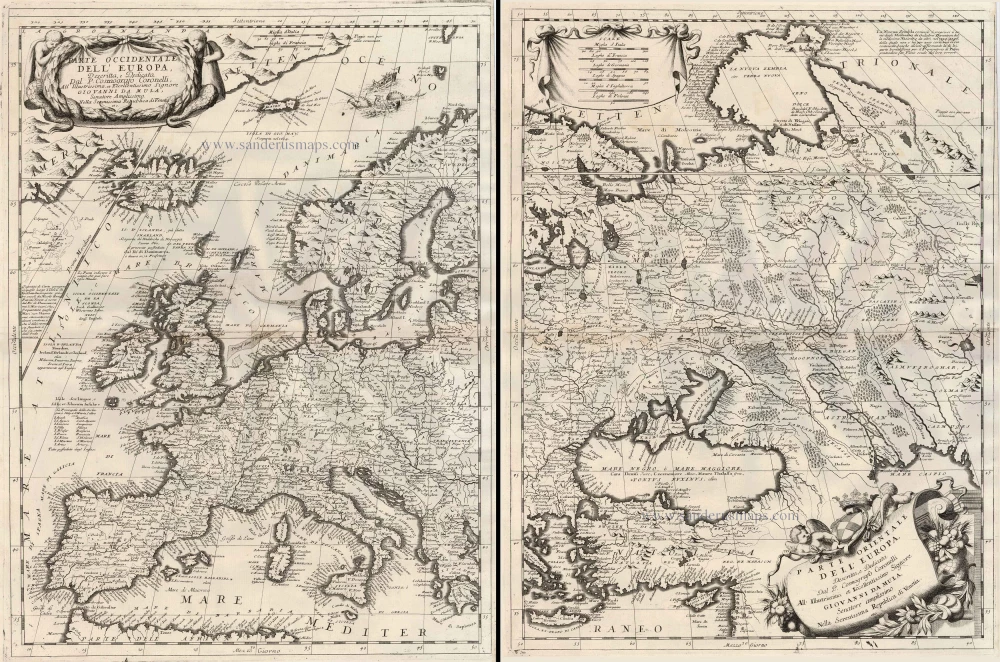
Parte Occidentale dell'Europa ... [in set with] Parte Orientale dell'Europa ... 1691
Europe, by V.M. Coronelli.
[Item number: 23186]

Europa. 1600
Europe, by Matthias Quad.
[Item number: 26666]