
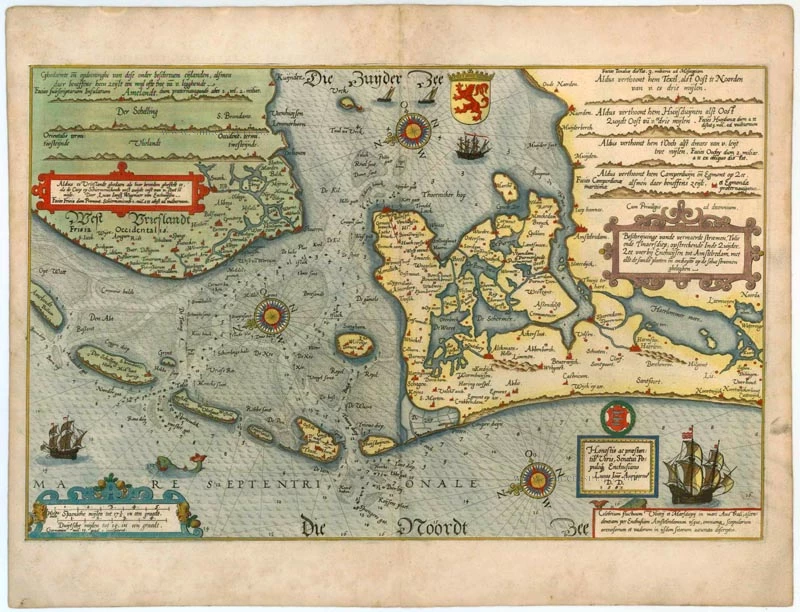
Antique map of Holland - Friesland by Waghenaer L.J. 1586



Lucas Janszoon Waghenaer (c. 1533 – 1606)
Lucas Janszoon Waghenaer grew up in Enkhuizen, a fishing port in the Netherlands on the Zuiderzee. It is known that around 1570, Waghenaer was already involved in drawing sea charts. The first indication of his cartographic activity was the plan of the town, engraved by Harmen Hansz. Muller of Amsterdam and dated 2 February. 1577.
In 1579, he gave up his career as a maritime pilot and obtained a post in the town. At the same time, he prepared his chartbook. The cutting of the plates cost Waghenaer a large sum. He was constantly seeking loans and had to accept small jobs to help in earning a living. In the wealthy town of Enkhuizen, he was a poor man, seeking support in every direction and trusting in the success of his great undertaking: the edition of the Spieghel der Zeevaerdt.
In the spring of 1583, the first part of the 'Spieghel' went to press in Plantijn's then recently established printing house in Leiden. He dedicated the work to Prince William of Orange.
On 25 January 1584, he had a formal certificate drawn up before a notary: they gave an attestation concerning the charts' reliability and originality in the Spieghel der Zeevaerdt.
Waghenaer continued to work on the completion of the second volume of the Spieghel. In the meantime, the first volume had met with considerable success and was reprinted several times during the first two years. The work was reprinted regularly and was also very popular in England. Waghenaer had already become a famous man.
Soon after the appearance of his Spieghel, he formulated a plan also to publish an improved "rutter of the sea'. This was to become the Thresoor der Zeevaerdt of 1592.
In addition to the revenue from his books, he received additional income from the sale of loose portolan charts. In 1580, he was granted a patent for two large charts of the coasts of Europe. One of these portolan charts is the general map from the Spieghel der Zeevaerdt of 1584 and in later editions.
In 1592, Jan Huygen van Linschoten settled in the town and wrote the journal of his voyages in Asia, which he published in 1596. Van Linschoten helped Waghenaer with the compilation of another new seaman's guide: the Enchuyser Zeecaertboeck, with important information about Northern Europe's coasts.
In 1598, Waghenaer was appointed member of the commission set up to find a method of determining longitude at sea. In the last years of his life, he must have been in financial difficulties. He died in 1606, leaving his widow in dire circumstances.
............................................................................................ ?The Spieghel der Zeevaerdt hold a unique place among the printed rutters of the sea in the 16th century because it is the first printed rutter with charts. Further, it outranks any other rutter of its period, with its splendid presentation of charts and text; as such, it stood as a model for the folio-size pilot guides with charts in the 17th century.
However, format and typography were overdone according to the taste of the practical navigators of that time and Lucas Jansz. Waghenaer returned to the traditional, more modest rutter in the oblong format: The Thresoor der Zeevaert, in 1592.
Thanks to the unparalleled skill of the engravers, Baptist and Johannes van Deutecom, the original ms. Charts by Waghenaer were transformed into the most beautiful maps of the period.
The composition and the adornment have contributed significantly to the splendour of what initially were simple sketch-charts; the typography of the Plantijn printing house at Leiden further added to the book's quality. In its concept, the text follows the traditional composition of the 16th-century pilot guides, but the charts form a new element. One remarkable feature is the coastal profiles projected onto the land along the coasts, further elucidated by profiles drawn in the charts' open areas. There is no evidence that Waghenaer copied his charts from existing sources. Some of them must have been based on his observations, and for the whole of the work, he must have relied on his own rich experience in practical navigation.
Beschrijvinge vande vermaerde stroemen, Tvlie ende Tmaersdiep, opstreckende Inde Zuijder Zee voer bij Enchuijsen tot Amstelredam, . . .
Item Number: 23484 Authenticity Guarantee
Category: Antique maps > Europe > The Netherlands
Sea chart of Holland and Friesland, oriented to the East
First state, dated 1583.
Copper engraving
Size: 33.5 x 52cm (13 x 20.2 inches)
Verso text: Latin
Condition: Old coloured, excellent.
Condition Rating: A
References: Koeman, Wag [2a].
From: Speculum nauticum super navigatione maris Occidentalis confectum, continens omnes oras maritimas Galliae, Hispaniae et praecipuarum partiu Angliae, ... - Spieghel der Zeevaerdt, vande navigatie der Westersche zee Innehoudende alle de Custen van Franckrijck, Spaignen, en t' principaelste deel van Engelandt, ... Lugduni Batavorum (Leiden), Excudebat typis Plantiniannis Franciscus Raphelengius, pro Luca Ioannis Aurigario. MDLXXXVI (1586). (Koeman IV, Wag5A)
This work holds a unique place among the printed rutters of the sea in the 16th century because it is the first printed rutter with charts. Further, it outranks any other rutter of its period, with its splendid presentation of charts and text; as such it stood as a model for the folio-size pilot-guides with charts in the 17th century. Thanks to the unparalleled skill of the engravers, Baptist and Johannes van Deutecom, the original ms. charts by Waghenaer were transformed into the most beautiful maps of the period. The composition and the adornment have greatly contributed to the splendour of what originally were simple sketch-charts; the typography of the Plantijn printing house at Leiden further added to the quality of the book. In its concept, the text follows the traditional composition of the 16th century pilot-guides but the charts form a new element. One remarkable feature is the coastal profiles projected onto the land along the coasts, further elucidated by profiles drawn in the open areas of the charts. There is no evidence that Waghenaer copied his charts from existing sources. Some of them must have been based on his personal observations and for the whole of the work he must have relied on his own rich experience in practical navigation. (Koeman)
Lucas Janszoon Waghenaer (c. 1533 – 1606)
Lucas Janszoon Waghenaer grew up in Enkhuizen, a fishing port in the Netherlands on the Zuiderzee. It is known that around 1570, Waghenaer was already involved in drawing sea charts. The first indication of his cartographic activity was the plan of the town, engraved by Harmen Hansz. Muller of Amsterdam and dated 2 February. 1577.
In 1579, he gave up his career as a maritime pilot and obtained a post in the town. At the same time, he prepared his chartbook. The cutting of the plates cost Waghenaer a large sum. He was constantly seeking loans and had to accept small jobs to help in earning a living. In the wealthy town of Enkhuizen, he was a poor man, seeking support in every direction and trusting in the success of his great undertaking: the edition of the Spieghel der Zeevaerdt.
In the spring of 1583, the first part of the 'Spieghel' went to press in Plantijn's then recently established printing house in Leiden. He dedicated the work to Prince William of Orange.
On 25 January 1584, he had a formal certificate drawn up before a notary: they gave an attestation concerning the charts' reliability and originality in the Spieghel der Zeevaerdt.
Waghenaer continued to work on the completion of the second volume of the Spieghel. In the meantime, the first volume had met with considerable success and was reprinted several times during the first two years. The work was reprinted regularly and was also very popular in England. Waghenaer had already become a famous man.
Soon after the appearance of his Spieghel, he formulated a plan also to publish an improved "rutter of the sea'. This was to become the Thresoor der Zeevaerdt of 1592.
In addition to the revenue from his books, he received additional income from the sale of loose portolan charts. In 1580, he was granted a patent for two large charts of the coasts of Europe. One of these portolan charts is the general map from the Spieghel der Zeevaerdt of 1584 and in later editions.
In 1592, Jan Huygen van Linschoten settled in the town and wrote the journal of his voyages in Asia, which he published in 1596. Van Linschoten helped Waghenaer with the compilation of another new seaman's guide: the Enchuyser Zeecaertboeck, with important information about Northern Europe's coasts.
In 1598, Waghenaer was appointed member of the commission set up to find a method of determining longitude at sea. In the last years of his life, he must have been in financial difficulties. He died in 1606, leaving his widow in dire circumstances.
............................................................................................ ?The Spieghel der Zeevaerdt hold a unique place among the printed rutters of the sea in the 16th century because it is the first printed rutter with charts. Further, it outranks any other rutter of its period, with its splendid presentation of charts and text; as such, it stood as a model for the folio-size pilot guides with charts in the 17th century.
However, format and typography were overdone according to the taste of the practical navigators of that time and Lucas Jansz. Waghenaer returned to the traditional, more modest rutter in the oblong format: The Thresoor der Zeevaert, in 1592.
Thanks to the unparalleled skill of the engravers, Baptist and Johannes van Deutecom, the original ms. Charts by Waghenaer were transformed into the most beautiful maps of the period.
The composition and the adornment have contributed significantly to the splendour of what initially were simple sketch-charts; the typography of the Plantijn printing house at Leiden further added to the book's quality. In its concept, the text follows the traditional composition of the 16th-century pilot guides, but the charts form a new element. One remarkable feature is the coastal profiles projected onto the land along the coasts, further elucidated by profiles drawn in the charts' open areas. There is no evidence that Waghenaer copied his charts from existing sources. Some of them must have been based on his observations, and for the whole of the work, he must have relied on his own rich experience in practical navigation.