
Perspective view of Den Haag, by Georg Balthasar Probst. ca. 1780

Optical View (French: Vue d'optique)
An optical view is a type of 18th-century hand-coloured engraved print to be viewed through a special optical device. It depicts architectural, city, or landscape scenes and is designed to give a strong illusion of depth and perspective when seen through a magnifying lens or viewing box. Characteristic of an optical view is the reversed inscription: The titles or captions were often printed backwards, because the viewing device used a mirror that would flip the image right-side up again. The artists enhanced depth with bold converging lines and bright colours. The optical views were used for popular entertainment and education, a way for people to "travel" visually. They originated in France and England around the 1740s and became fashionable across Europe. They were often sold by travelling print sellers or displayed in fairs and parlours.
Gesicht by de Doelen over de Korte Vijverberg; tot Gravenhaghe.
Item Number: 31603 Authenticity Guarantee
Category: Antique maps > Europe > The Netherlands - Cities
Perspective view of Den Haag, by Georg Balthasar Probst.
Title: Gesicht by de Doelen over de Korte Vijverberg; tot Gravenhaghe.
Georg Balthasar Probst excud. A.V.
Engraver: Martin Engelbrecht.
Date: ca. 1780.
Copper engraving, printed on paper.
Image size: 300 x 400mm (11¾ x 15¾ inches).
Sheet size: 335 x 475mm (13¼ x 18¾ inches).
Verso: Blank.
Condition: Original coloured, tear in upper margin reinforced, some soiling.
Condition Rating: B.
Separate publication.
Optical View (French: Vue d'optique)
An optical view is a type of 18th-century hand-coloured engraved print to be viewed through a special optical device. It depicts architectural, city, or landscape scenes and is designed to give a strong illusion of depth and perspective when seen through a magnifying lens or viewing box. Characteristic of an optical view is the reversed inscription: The titles or captions were often printed backwards, because the viewing device used a mirror that would flip the image right-side up again. The artists enhanced depth with bold converging lines and bright colours. The optical views were used for popular entertainment and education, a way for people to "travel" visually. They originated in France and England around the 1740s and became fashionable across Europe. They were often sold by travelling print sellers or displayed in fairs and parlours.
Related items

Curia Hollandiae Exterior. 1652
Den Haag - Buitenhof by Joan Blaeu
[Item number: 6711]
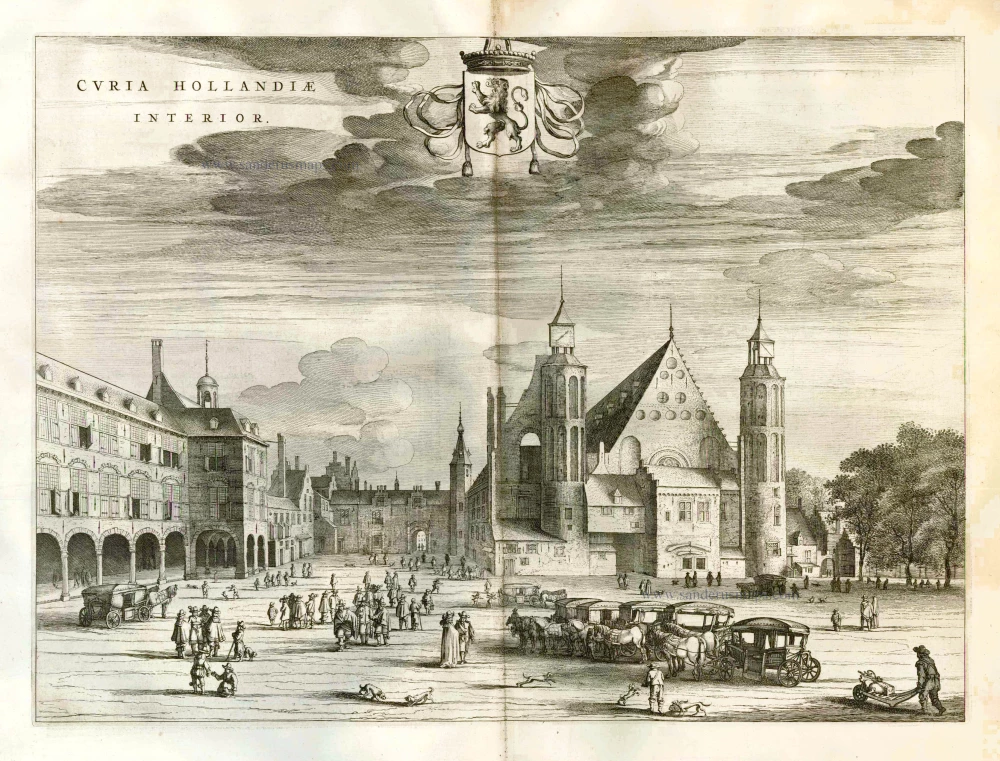
Curia Hollandiae Interior. 1652
Den Haag by Joan Blaeu, Binnenhof
[Item number: 6713]

Hagae Comitis celeberrimi totius Europae municipij typus. c. 1625
The Hague (Den Haag), by Georg Braun and Frans Hogenberg.
[Item number: 16400]

Curia Hollandiae Exterior. 1649
Den Haag by Joan Blaeu, Buitenhof
[Item number: 28717]

Curia Hollandiae Interior. 1652
Den Haag by Joan Blaeu, Binnenhof
[Item number: 28749]
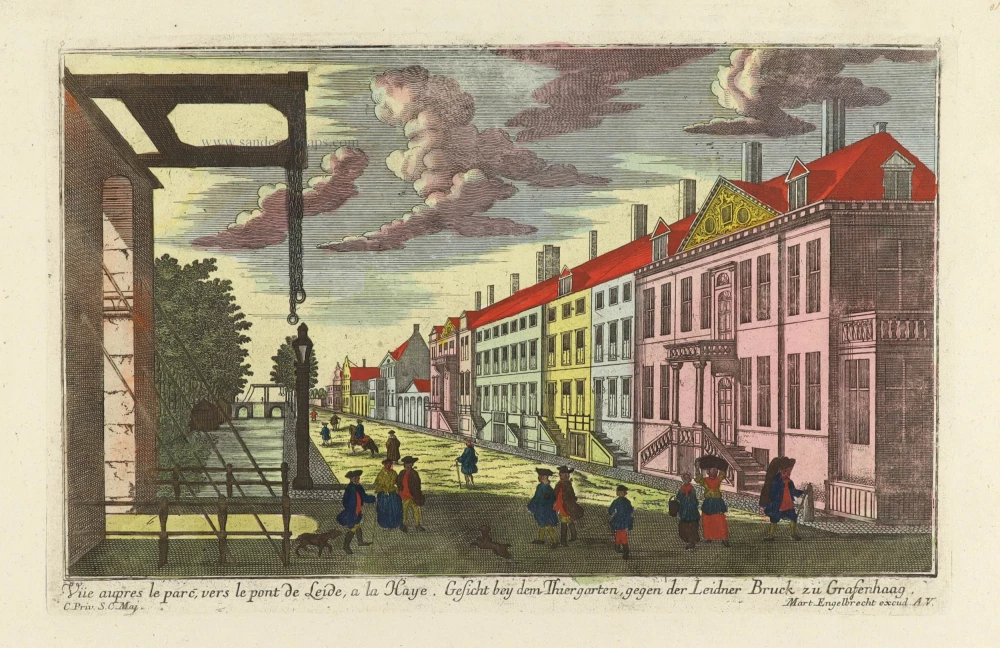
Vue aupres le parc, vers le pont de Leide, a la Haye. - Gesicht bey dem Thiergarten, gegen der Leidner Bruck zu Grafenhaag. c. 1750
Optical View of Den Haag, by Martin Engelbrecht.
[Item number: 31897]

Vue vers le vivier vers la jardin des Tireurs a la Haye. - Gesicht gegen den kleinen fischteich bey dem Schützen Garten zu Grafenhaag. c. 1750
Optical View of Den Haag, by Martin Engelbrecht.
[Item number: 31901]

Haag. 1686
Den Haag by Christoph Riegel.
[Item number: 32108]

Haga Comitis Vulgo 'S Graven-Hage. 1652
Den Haag, by Joan Blaeu.
[Item number: 32922]

Graven Hage, t'Hof van Holla[n]t. 1612
Den Haag by Guicciardini Lodovico
[Item number: 32984]