
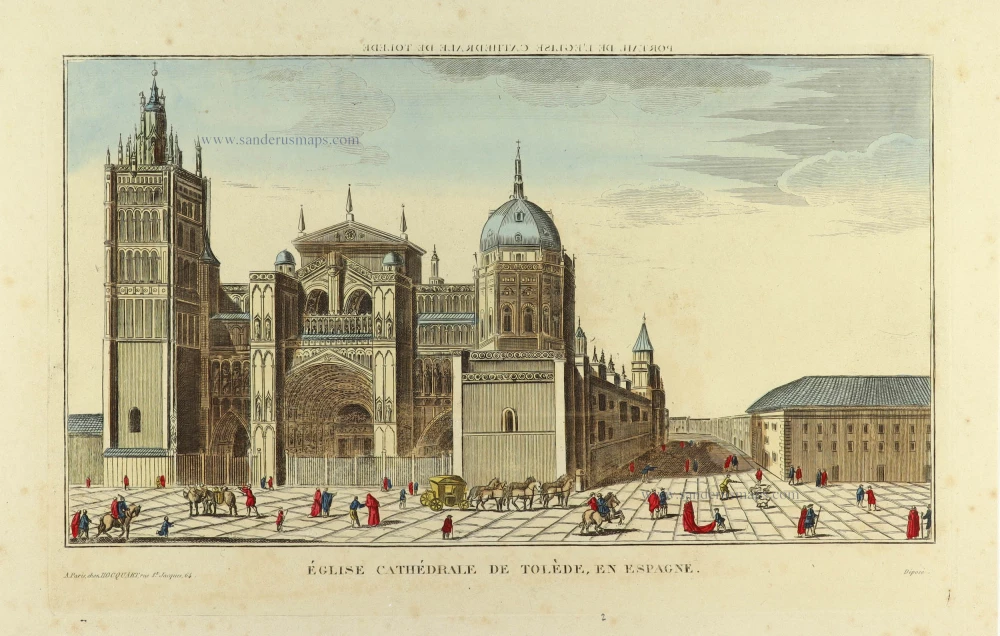
Optical view of the cathedral of Toledo, by Édouard-Auguste-Patrice Hocquart c. 1830
Optical View (French: Vue d'optique)
An optical view is a type of 18th-century hand-coloured engraved print to be viewed through a special optical device. It depicts architectural, city, or landscape scenes and is designed to give a strong illusion of depth and perspective when seen through a magnifying lens or viewing box. Characteristic of an optical view is the reversed inscription: The titles or captions were often printed backwards, because the viewing device used a mirror that would flip the image right-side up again. The artists enhanced depth with bold converging lines and bright colours. The optical views were used for popular entertainment and education, a way for people to "travel" visually. They originated in France and England around the 1740s and became fashionable across Europe. They were often sold by travelling print sellers or displayed in fairs and parlours.
Édouard-Auguste-Patrice Hocquart (1789–1870)
Édouard-Auguste-Patrice Hocquart was a bookseller-publisher and a print and map dealer, as well as an engraver and author. He came from a family of Parisian printers and booksellers active since the late 18th century. He took over his mother’s business (the widow Hocquart) around 1813, and operated successively from several Paris addresses — the Rue Saint-Jacques phase being his most prominent.
Eglise Cathédrale de Tolède, en Espagne.
Item Number: 32390 Authenticity Guarantee
Category: Antique maps > Europe > Spain and Portugal
Optical view of the cathedral of Toledo, by Édouard-Auguste-Patrice Hocquart.
Title: Eglise Cathédrale de Tolède, en Espagne.
A Paris chez Hocquart, rue St. Jacques, 64.
Date: c. 1830.
Copper engraving, printed on paper.
Image size: 220 x 385mm (8¾ x 15¼ inches).
Sheet size: 285 x 440mm (11¼ x 17¼ inches).
Verso: Blank.
Condition: Original coloured, excellent.
Condition Rating: A+.
Separate publication.
Optical View (French: Vue d'optique)
An optical view is a type of 18th-century hand-coloured engraved print to be viewed through a special optical device. It depicts architectural, city, or landscape scenes and is designed to give a strong illusion of depth and perspective when seen through a magnifying lens or viewing box. Characteristic of an optical view is the reversed inscription: The titles or captions were often printed backwards, because the viewing device used a mirror that would flip the image right-side up again. The artists enhanced depth with bold converging lines and bright colours. The optical views were used for popular entertainment and education, a way for people to "travel" visually. They originated in France and England around the 1740s and became fashionable across Europe. They were often sold by travelling print sellers or displayed in fairs and parlours.
Édouard-Auguste-Patrice Hocquart (1789–1870)
Édouard-Auguste-Patrice Hocquart was a bookseller-publisher and a print and map dealer, as well as an engraver and author. He came from a family of Parisian printers and booksellers active since the late 18th century. He took over his mother’s business (the widow Hocquart) around 1813, and operated successively from several Paris addresses — the Rue Saint-Jacques phase being his most prominent.

