
Optical view of the Seville Stock Exchange, by Jean?François Daumont c. 1770

Optical View (French: Vue d'optique)
An optical view is a type of 18th-century hand-coloured engraved print to be viewed through a special optical device. It depicts architectural, city, or landscape scenes and is designed to give a strong illusion of depth and perspective when seen through a magnifying lens or viewing box. Characteristic of an optical view is the reversed inscription: The titles or captions were often printed backwards, because the viewing device used a mirror that would flip the image right-side up again. The artists enhanced depth with bold converging lines and bright colours. The optical views were used for popular entertainment and education, a way for people to "travel" visually. They originated in France and England around the 1740s and became fashionable across Europe. They were often sold by travelling print sellers or displayed in fairs and parlours.
Jean-François Daumont (florished 1740-1775)
Jean-François Daumont was a Paris-based print publisher and seller, active during the second half of the 18th century. While little is known about his personal life, he is primarily recognised for publishing optical prints (known in French as vues d'optique) — a popular form of visual entertainment in the 18th century.
Vue Perspective de la Bouvre [Bourse] de Seville et de la Gde Rue.
Item Number: 32391 Authenticity Guarantee
Category: Antique maps > Europe > Spain and Portugal
Optical view of the Seville Stock Exchange, by Jean?François Daumont
Title: Vue Perspective de la Bouvre [Bourse] de Seville et de la Gde Rue.
A Paris chez Daumont rue St Martin
Date: c. 1770.
Copper engraving, printed on paper.
Image size: 235 x 385mm (9¼ x 15¼ inches).
Sheet size: 335 x 495mm (13¼ x 19½ inches).
Verso: Blank.
Condition: Original coloured, excellent.
Condition Rating: A+.
Separate publication.
Optical View (French: Vue d'optique)
An optical view is a type of 18th-century hand-coloured engraved print to be viewed through a special optical device. It depicts architectural, city, or landscape scenes and is designed to give a strong illusion of depth and perspective when seen through a magnifying lens or viewing box. Characteristic of an optical view is the reversed inscription: The titles or captions were often printed backwards, because the viewing device used a mirror that would flip the image right-side up again. The artists enhanced depth with bold converging lines and bright colours. The optical views were used for popular entertainment and education, a way for people to "travel" visually. They originated in France and England around the 1740s and became fashionable across Europe. They were often sold by travelling print sellers or displayed in fairs and parlours.
Jean-François Daumont (florished 1740-1775)
Jean-François Daumont was a Paris-based print publisher and seller, active during the second half of the 18th century. While little is known about his personal life, he is primarily recognised for publishing optical prints (known in French as vues d'optique) — a popular form of visual entertainment in the 18th century.
Related items

Hispalensis Conventus Delineatio. 1601
Andalucia - Seville (Sevilla), by A. Ortelius.
[Item number: 5730]

Sevilla, Hispalis ... [on sheet with] Cadiz [and] Malaga. 1572-1624
Antique map of Seville (Sevilla) - Cadiz - Malaga by Braun & Hogenberg
[Item number: 22685]

Hispalensis Conventus Delineatio. 1601
Andalucia - Seville (Sevilla), by A. Ortelius.
[Item number: 22872]

Sevilla, Hispalis ... [on sheet with] Cadiz [and] Malaga. 1582
Seville (Sevilla) - Cadiz - Malaga, by Braun & Hogenberg.
[Item number: 25496]
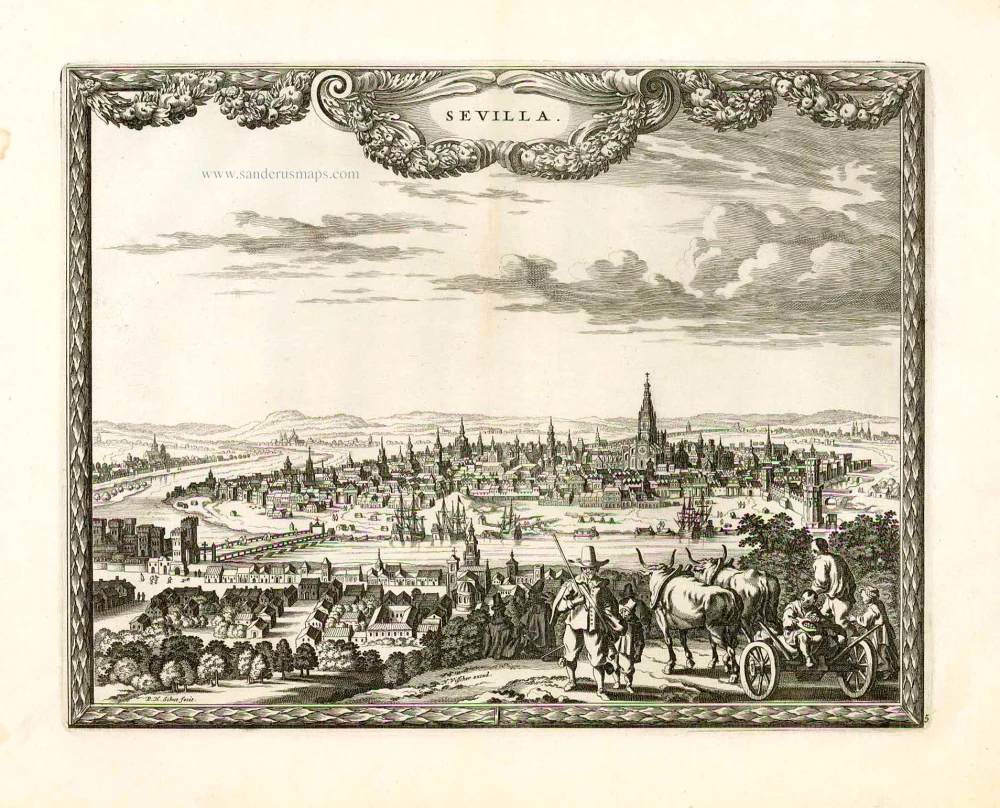
Sevilla. 1658/60
Seville (Sevilla), by N. Visscher & P.H. Schut.
[Item number: 26630]

Unrecorded variant of Schut's view of Sevilla, by Carel Allard
Sevilla. 1673
View of Seville (Sevilla) by Carel Allard.
[Item number: 30556]

Vue de la Cathedrale de Seville. 1766
Seville (Sevilla), optical view of the cathedral
[Item number: 32705]