
Guyana, Suriname, and the Lesser Antilles, by Pieter Van der Aa. 1707

The map illustrates English colonisation attempts in Guyana and the Amazon region, based on Charles Leigh's 1604 voyage, which marked the first English settlement attempt on the Oyapock River and ultimately failed.
The fictitious Parime Lacus is fully shown with the mythical Manoa el Dorado located on its western shore. The whole course of the R. Patria o Orinoq is shown, as is its confluence with the Amazon River. A pictorial title cartouche shows Europeans and sailing ships in the harbour.
Pieter van der Aa (Leiden, 1659-1733)
Pieter van der Aa was already in 1682 owner of a bookshop and auction house. During his life, he has published an enormous amount of printed material.
After 1700, van der Aa increasingly specialised in books on geography and travel.
He published composite atlases, a series of geographical descriptions of European countries, and some very spectacular works. Between 1706 and 1708 he published the Naauweurige versameling der gedenkwaardigste zee- en land-reysen, in 28 volumes.
Many of Van der Aa’s publications are richly illustrated with maps and plates. He took over many copperplates and prints from other publishers such as Carel Allard and Frederik De Wit. The composite atlases that appeared from his workshop contain a curious mixture of his own material, copies of maps from other publishers, and reprints made from old copper plates, now with his own imprint.
The Galérie agréable du monde, was completed in 1729, and comprised 66 parts, bound in 27 volumes. Van der Aa presented it as a good investment; after publication, the antiquarian value of the work would double, the more so since it was printed in a limited edition of only one hundred copies.
d'Engelze Volkplanting in't Amerikaans gewest Gujana, en Rio de Las Amazones, Door de Scheeps-togt van Charles Leig begonnen.
Item Number: 32403 Authenticity Guarantee
Category: Antique maps > America > South America
Guyana, Suriname, and the Lesser Antilles, by Pieter Van der Aa.
Title: d'Engelze Volkplanting in't Amerikaans gewest Gujana, en Rio de Las Amazones, Door de Scheeps-togt van Charles Leig begonnen.
Uytgevoerd te Leyden door Pieter Vander Aa met Privilegie. - Charles Leig.
Date of the first edition: 1707.
Date of this map: 1707.
Copper engraving, printed on paper.
Image size: 155 x 230mm (6 x 9 inches).
Sheet size: 175 x 280mm (7 x 11 inches).
Verso: Blank.
Condition: Excellent.
Condition Rating: A+.
From: Naaukeurige Versameling der gedenk-waardigste Zee- en landreysen na Oost en West-Indien. Leiden, Pieter Van der Aa, 1707.
The map illustrates English colonisation attempts in Guyana and the Amazon region, based on Charles Leigh's 1604 voyage, which marked the first English settlement attempt on the Oyapock River and ultimately failed.
The fictitious Parime Lacus is fully shown with the mythical Manoa el Dorado located on its western shore. The whole course of the R. Patria o Orinoq is shown, as is its confluence with the Amazon River. A pictorial title cartouche shows Europeans and sailing ships in the harbour.
Pieter van der Aa (Leiden, 1659-1733)
Pieter van der Aa was already in 1682 owner of a bookshop and auction house. During his life, he has published an enormous amount of printed material.
After 1700, van der Aa increasingly specialised in books on geography and travel.
He published composite atlases, a series of geographical descriptions of European countries, and some very spectacular works. Between 1706 and 1708 he published the Naauweurige versameling der gedenkwaardigste zee- en land-reysen, in 28 volumes.
Many of Van der Aa’s publications are richly illustrated with maps and plates. He took over many copperplates and prints from other publishers such as Carel Allard and Frederik De Wit. The composite atlases that appeared from his workshop contain a curious mixture of his own material, copies of maps from other publishers, and reprints made from old copper plates, now with his own imprint.
The Galérie agréable du monde, was completed in 1729, and comprised 66 parts, bound in 27 volumes. Van der Aa presented it as a good investment; after publication, the antiquarian value of the work would double, the more so since it was printed in a limited edition of only one hundred copies.
Related items

Guiana Sive Amazonum Regio. 1633
Guyana by H. Hondius.
[Item number: 7558]

Guiana sive Amazonum Regio. 1673
Guiana, by A. Montanus.
[Item number: 12480]

Guiana Sive Amazonum Regio 1654-1662
Guiana, by J. Blaeu.
[Item number: 14719]

Guiana sive Amazonum Regio 1680-1710
Guyana, by Janssonius J.
[Item number: 15700]

Landkaart van het Eiland en de Volkplanting van Cayenne aan de Kust van Zuid-Amerika c. 1770
Guiana - Cayenne, by Tirion I.
[Item number: 19192]

Guajana, ou le Pays des Amazones, dans la partie Meridionale de l'Amerique. 1713
Guyana, by Pieter van der Aa.
[Item number: 26149]

Partie de Terre Ferme ou sont Guiane et Caribane. 1658
Guiana by Nicolas Sanson.
[Item number: 28504]

From the first Dutch folio printed sea atlas
Insula S. Iuan de Puerto Rico Caribes, Vel Canibalum Insulae. 1650
Puerto Rico and the Carribean, by Joannes Janssonius.
[Item number: 32625]
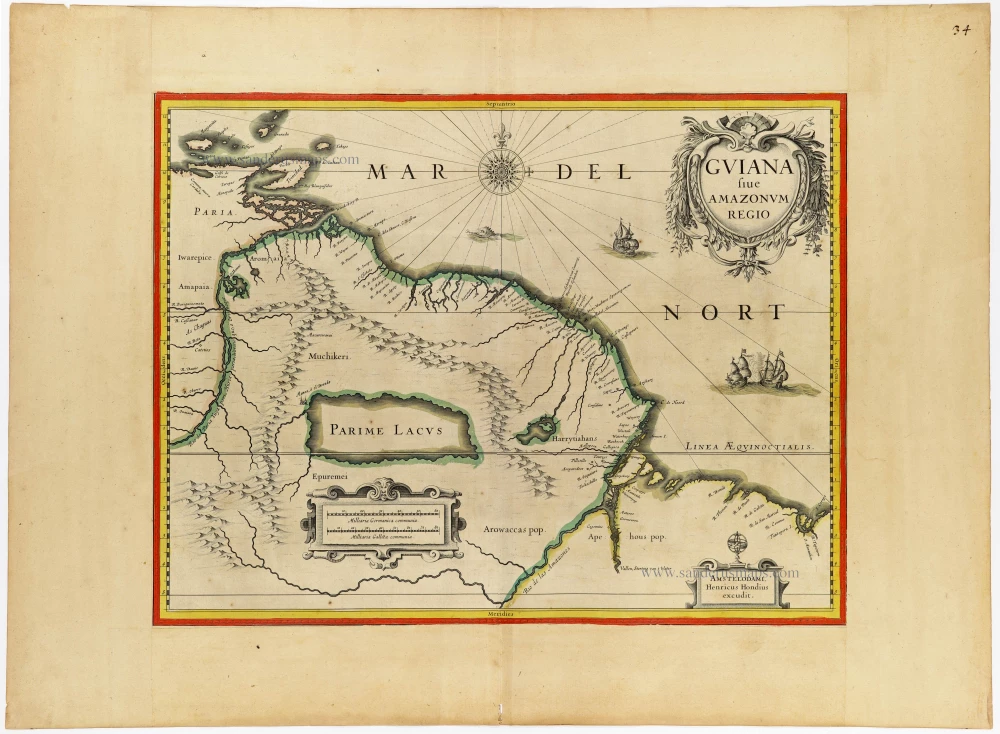
Guiana sive Amazonum Regio. c. 1630
Guyana by J. Janssonius.
[Item number: 33128]