
Scarce
Strait of Magellan by Matthäus Merian, published by J.L. Gottfried. 1631

Matthäus Merian the Elder (1593-1650)
Matthäus Merian, the leading German illustrator of the 17th century, was born in Basel in 1593. He learned the art of copperplate engraving in Zurich and subsequently worked and studied in Strasbourg, Nancy, Paris, and the Low Countries. In 1618 he went to Frankfurt, wherein in 1618, he married the eldest daughter of J.T. de Bry, publisher and engraver. After de Bry died in 1623, he took over his business. De Bry’s business remained in Merian’s family until 1726, when a fire destroyed it. In 1635 he began the series Theatrum Europaeum. Between 1642 and 1688, he published Martin Zeiller’s Topographia Germaniae, with more than 2,000 plates etched and engraved by himself and his sons Matthäus and Caspar. He also took over and completed the later parts and editions of the Grand Voyages and Petits Voyages, initially started by de Bry in 1590. Matthäus Merian died after in 1650 in Bad Schwalbach near Wiesbaden.
Johann Ludwig Gottfried (ca. 1584 - 1633)
For a long time, Gottfried was considered a pseudonym of Johann Philipp Abelin, and his existence was denied.
From 1601, Johann Ludwig Gottfried studied theology in Heidelberg. From 1603 until 1624, he was first employed as a deacon and then as a reformed minister.
Through a Latin retelling of Ovid's Metamorphoses, he came into contact with the de Bry publishers in Oppenheim in 1619. From that moment on, thanks to his versatile language skills and his education, he worked as a valued employee for publishers in Oppenheim and Frankfurt, such as Johann Theodor de Bry, de Bry's nephew Lucas Jennis and de Bry's son-in-law Matthäus Merian the Elder. He provided translations, epigrams, paraphrases, and compilations for many of these publishers' extensive publications. As editor and proofreader, he supervised various publishing projects.
In 1624, he came to Frankfurt as a proofreader. He never completely gave up his spiritual office; from 1625 until the end of his life, he was officially a minister of the Reformed Church in Offenbach. He devoted himself undisturbed to his work as a translator and author for the Frankfurt publishing house (particularly for Merian).
His most extensive work is the Gottfried Chronicle. It was continued after his death by Johann Philipp Abelin in 1634 and remained a widely read historical work until the 18th century.
FRETUM MAGELLANNICUM und dessen eigentüche Beschreibung, so die Hollender durchfuhren und auch der lang beschrieben.
Item Number: 32439 Authenticity Guarantee
Category: Antique maps > America > South America
Strait of Magellan by Matthäus Merian, published by J.L. Gottfried.
Title: FRETUM MAGELLANNICUM und dessen eigentüche Beschreibung, so die Hollender durchfuhren und auch der lang beschrieben.
Date of the first edition: 1630.
Date of this map: 1631.
Copper engraving, printed on paper.
Image size: 165 x 300mm (6½ x 11¾ inches).
Sheet size: 280 x 390mm (11 x 15¼ inches).
Verso: Blank.
Condition: Centrefold split reinforced.
Condition Rating: A.
From: GOTTFRIED J.L., Newe Welt und Americanische Historien. Inhaltende Warhafftige und volkommene Beschreibungen Aller West-Indianischen Landschaften Insulen Königreichen und Provinzen Seecusten fliessenden und stehenden Wassern Port und Anländungen. . . Frankfurt am Main, Matthias Merian, 1631.
Matthäus Merian the Elder (1593-1650)
Matthäus Merian, the leading German illustrator of the 17th century, was born in Basel in 1593. He learned the art of copperplate engraving in Zurich and subsequently worked and studied in Strasbourg, Nancy, Paris, and the Low Countries. In 1618 he went to Frankfurt, wherein in 1618, he married the eldest daughter of J.T. de Bry, publisher and engraver. After de Bry died in 1623, he took over his business. De Bry’s business remained in Merian’s family until 1726, when a fire destroyed it. In 1635 he began the series Theatrum Europaeum. Between 1642 and 1688, he published Martin Zeiller’s Topographia Germaniae, with more than 2,000 plates etched and engraved by himself and his sons Matthäus and Caspar. He also took over and completed the later parts and editions of the Grand Voyages and Petits Voyages, initially started by de Bry in 1590. Matthäus Merian died after in 1650 in Bad Schwalbach near Wiesbaden.
Johann Ludwig Gottfried (ca. 1584 - 1633)
For a long time, Gottfried was considered a pseudonym of Johann Philipp Abelin, and his existence was denied.
From 1601, Johann Ludwig Gottfried studied theology in Heidelberg. From 1603 until 1624, he was first employed as a deacon and then as a reformed minister.
Through a Latin retelling of Ovid's Metamorphoses, he came into contact with the de Bry publishers in Oppenheim in 1619. From that moment on, thanks to his versatile language skills and his education, he worked as a valued employee for publishers in Oppenheim and Frankfurt, such as Johann Theodor de Bry, de Bry's nephew Lucas Jennis and de Bry's son-in-law Matthäus Merian the Elder. He provided translations, epigrams, paraphrases, and compilations for many of these publishers' extensive publications. As editor and proofreader, he supervised various publishing projects.
In 1624, he came to Frankfurt as a proofreader. He never completely gave up his spiritual office; from 1625 until the end of his life, he was officially a minister of the Reformed Church in Offenbach. He devoted himself undisturbed to his work as a translator and author for the Frankfurt publishing house (particularly for Merian).
His most extensive work is the Gottfried Chronicle. It was continued after his death by Johann Philipp Abelin in 1634 and remained a widely read historical work until the 18th century.
Related items

Provinciae Sitae ad Fretum Magallanis itemque Fretum le Maire. 1630
Magellan Straits & Tierra Del Fuego, by Johannes de Laet.
[Item number: 25391]

La Terre Magellanique avec son Détroit et la Terre de Feu, avec ses petites Iles, Bayes et Rivieres. 1713
Magellan Straits & Tierra del Fuego, by Pieter van der Aa.
[Item number: 26153]

La Terre et les Isles Magellaniques. 1670
Southern South America with the Straits of Magellan, by Guillaume Sanson.
[Item number: 28510]
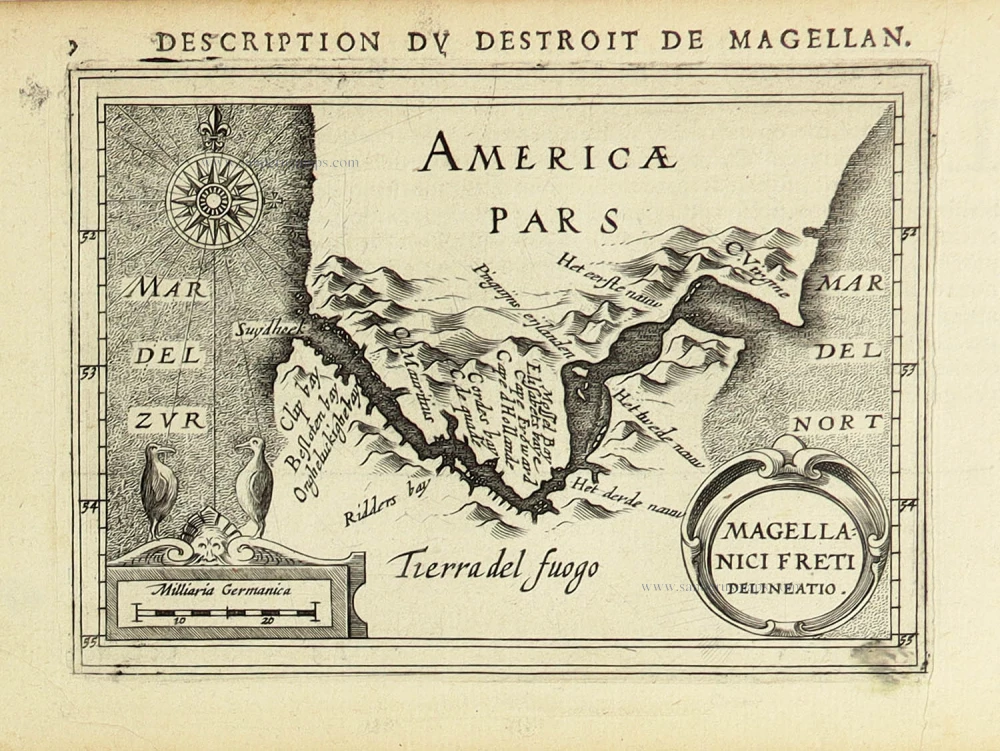
Magellanici Freti Delineatio. 1618
Straits of Magellan by Petrus Bertius, published by Jodocus Hondius II.
[Item number: 31529]
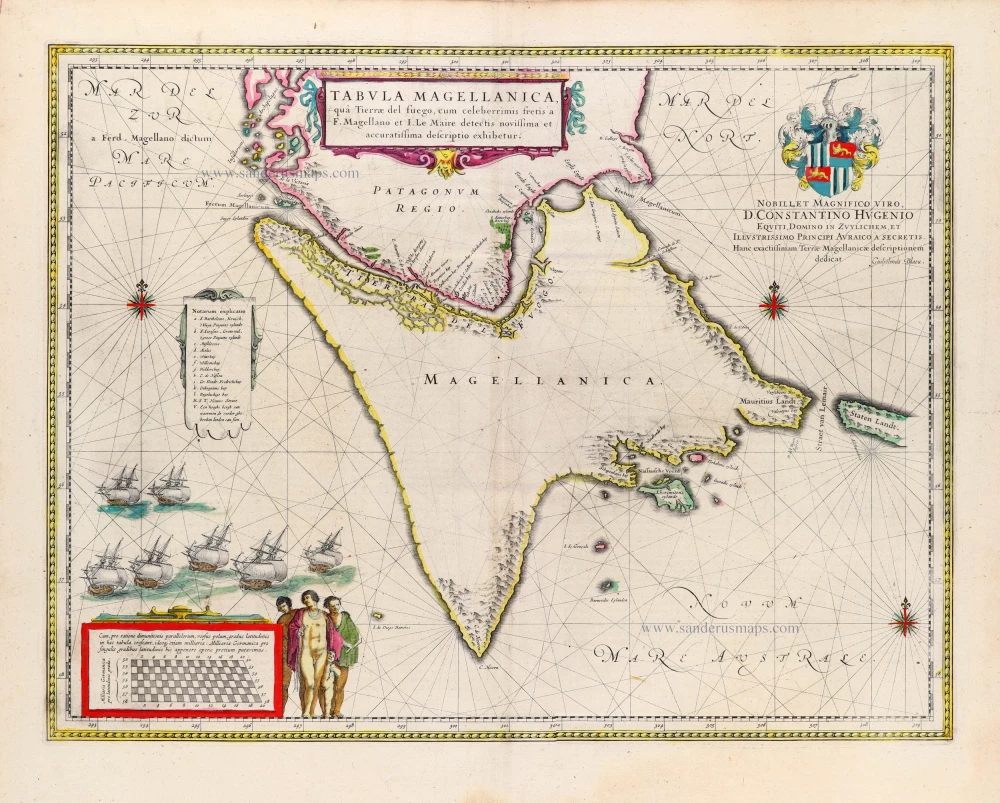
Tabula Magellanica, qua Tierrae del fuego, cum celeberrimis fretis a F. Magellano et I. Le Maire detectis novissima et accuratissima descriptio exhibetur. 1645
Straits of Magellan, by Willem & Joan Blaeu.
[Item number: 31602]

Rare and interesting map
Scheeps-Togt door Ferdinand Magellaan uit Kastilien gedaan na R. de la Plata en van daar door zyn ontdekte straat tot aan de Moluccas. 1707
Voyage of Magellan from Spain to Asia, by Pieter Van der Aa.
[Item number: 32347]

Early map which includes Straits Lemaire. First edition
Freti Magellanici ac Novi Freti vulgo Le Maire exactissima delineatio. 1630
Straits of Magellan, by Joannes Janssonius.
[Item number: 32424]