
Oudenaarde - Pamele, lithograph by Dewasme, after Séraphin Vermote. 1823

Antoine Dewasme (1797–1851): Pioneer of Belgian Lithography
Antoine Dewasme, often known as Antoine Dewasme-Plétinckx, was one of the most influential figures in the early history of Belgian lithography. Born in Tournai in 1797, he trained as an engraver and lithographer at a moment when lithography was still a relatively new and experimental medium in Europe.
In the 1820s, Dewasme established himself as a printer and publisher, first in Tournai and later in Brussels, where he founded a major lithographic workshop. His press became a hub for leading artists of the period, including Jean-Baptiste Madou, Eugène Verboeckhoven, François Stroobant and Théodore Fourmois. Through these collaborations, Dewasme played a crucial role in elevating lithography from a technical novelty to a respected artistic and commercial medium.
His workshop produced a wide range of prints: landscapes, genre scenes, historical subjects and politically significant imagery, including works connected to the Belgian Revolution. The quality and scope of his production earned him the title of Court Lithographer in 1828. Following his marriage to Élisabeth Plétinckx, he often signed his work and publications as Dewasme-Plétinckx.
Eglise de Pamele à Audenarde.
Item Number: 32808 Authenticity Guarantee
Category: Antique maps > Europe > Belgium - Cities
Oudenaarde - Pamele, lithograph by Dewasme, after Séraphin Vermote.
Title: Eglise de Pamele à Audenarde.
Vermote del. - J.B. De Jonghe ft. - Lith. de Dewasme et Cie.
Designer: Séraphin Vermote.
Engraver: J.B. De Jonghe.
Date: 1823.
Lithograph, printed on paper.
Image size: 160 x 215mm (6¼ x 8½ inches).
Sheet size: 270 x 405mm (10¾ x 16 inches).
Verso: Blank.
Condition: Excellent.
Condition Rating: A+.
From: Collection Historique des Principales Vues des Pays-Bas. Tournay, Dewasme, 1823.
Antoine Dewasme (1797–1851): Pioneer of Belgian Lithography
Antoine Dewasme, often known as Antoine Dewasme-Plétinckx, was one of the most influential figures in the early history of Belgian lithography. Born in Tournai in 1797, he trained as an engraver and lithographer at a moment when lithography was still a relatively new and experimental medium in Europe.
In the 1820s, Dewasme established himself as a printer and publisher, first in Tournai and later in Brussels, where he founded a major lithographic workshop. His press became a hub for leading artists of the period, including Jean-Baptiste Madou, Eugène Verboeckhoven, François Stroobant and Théodore Fourmois. Through these collaborations, Dewasme played a crucial role in elevating lithography from a technical novelty to a respected artistic and commercial medium.
His workshop produced a wide range of prints: landscapes, genre scenes, historical subjects and politically significant imagery, including works connected to the Belgian Revolution. The quality and scope of his production earned him the title of Court Lithographer in 1828. Following his marriage to Élisabeth Plétinckx, he often signed his work and publications as Dewasme-Plétinckx.
Related items

Audenaerde. 1659
Oudenaarde, by Matthäus Merian & Martin Zeiller.
[Item number: 2239]

Audenarde. 1726
Oudenaarde by Fassmann
[Item number: 5958]
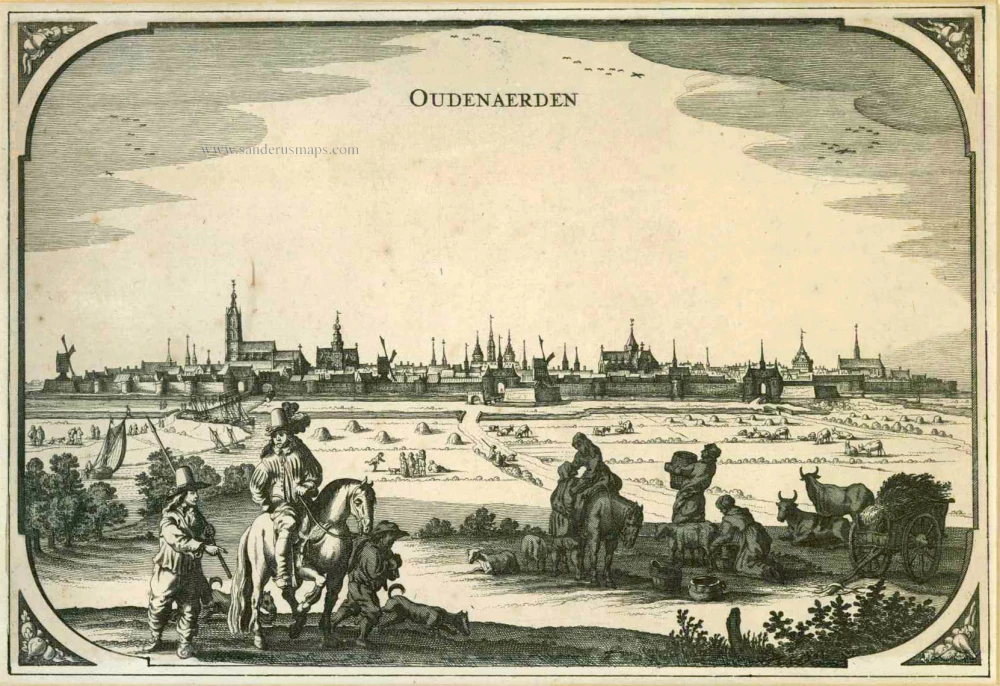
Oudenaerden. 1656
Oudenaarde, by N. Visscher & P.H. Schut.
[Item number: 6998]

Glorieuse Batalye by Oudenaarden voorgevalletussen de Geallieerde en Franse Legers op den 11 Juli 1708. 1708
Military plan of Oudenaarde
[Item number: 25304]

Castellum de Pamele. 1652
Oudenaarde - Pamele Castle, by Joan Blaeu.
[Item number: 25576]

Spectacular view of the Siege.
Veuë de la Ville et du Siege d'Oudenarde, ou le Roy commande en personne, en lannée 1667. - Aldenardae a Rege obsessae prospectus, anno 1667. 1685
Oudenaarde by Frans Vander Meulen
[Item number: 25797]
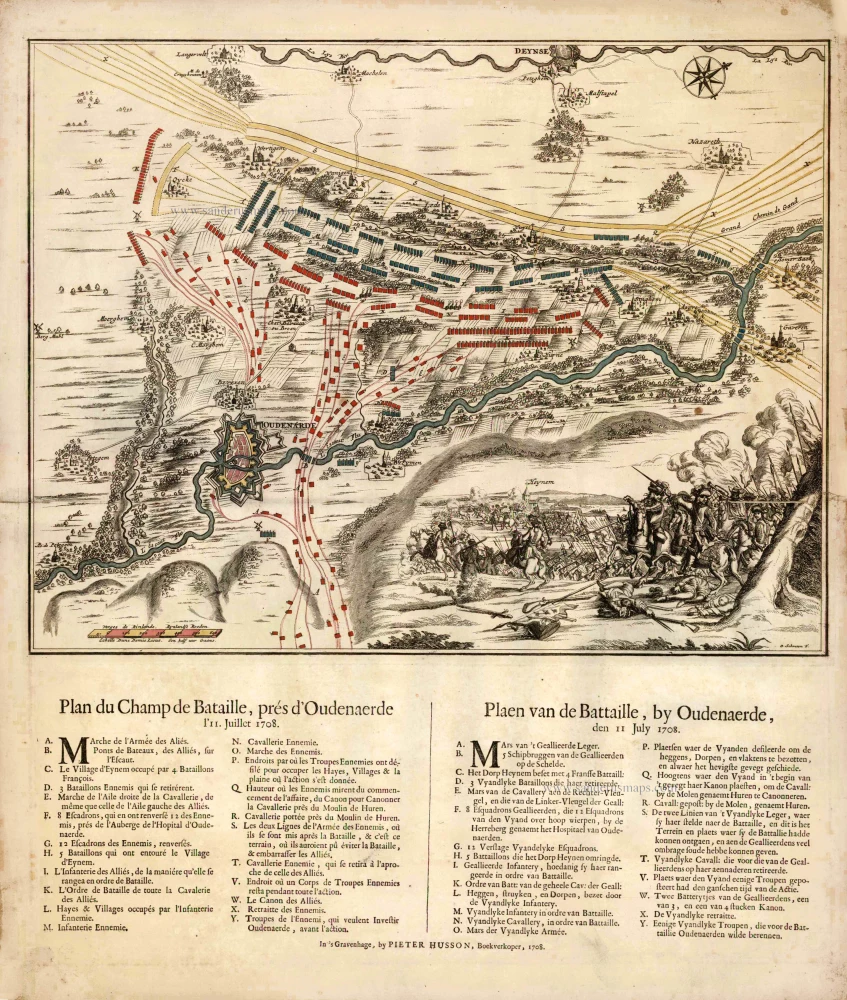
Plan du Champ de Bataille, prés d'Oudenaerde l'11. Juillet 1708. - Plaen van de Bataille, by Oudenaerde, den 11 July 1708. c. 1709
The vicinity of Oudenaarde, by Pieter Husson.
[Item number: 27525]
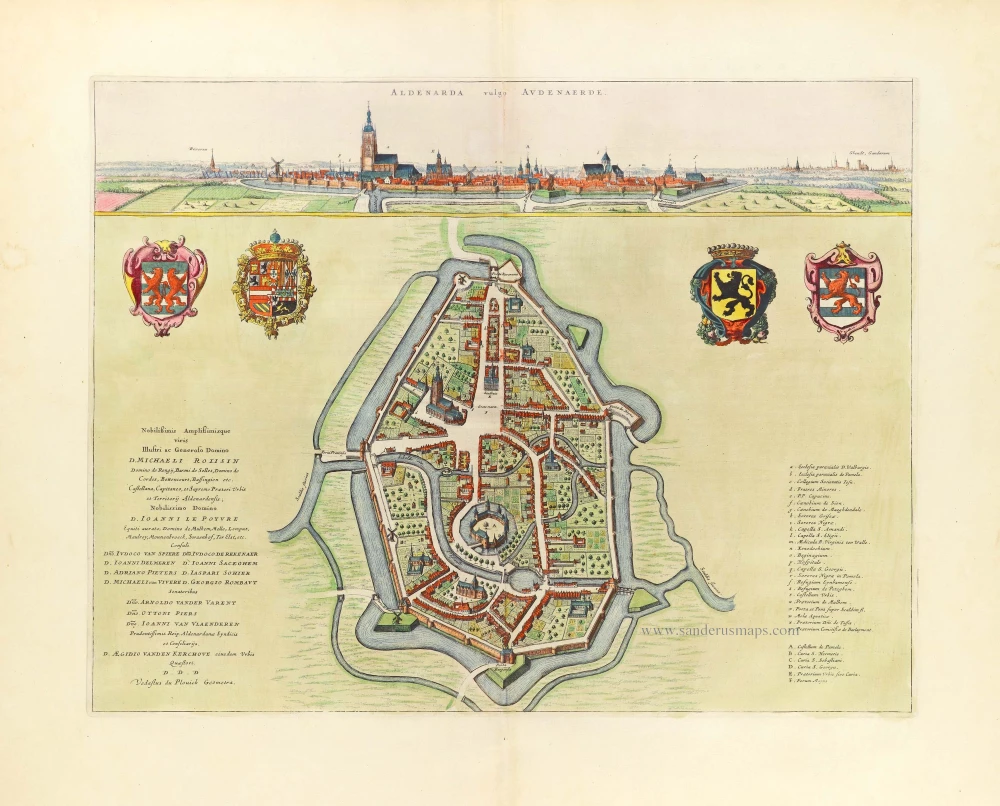
Aldenarda vulgo Audenaerde. 1652
Bird's-eye view plan + panoramic view of Oudenaarde by Antonius Sanderus, published by Joan Blaeu.
[Item number: 29017]

Plan de la Bataille d'Oudenaerde du 11 Juillet 1708. 1712
Oudenaarde by Eugène Fricx.
[Item number: 29585]

Beverwaen. 1644
Hof De Bruwaan (Castle in Beveren-Oudenaarde) by Antonius Sanderus.
[Item number: 29987]

Oudenarde. - Carte du Gouvernement d'Oudenarde. - Plan de la Ville d'Oudenarde. ca. 1668
Oudenaarde by Sr. S. de Beaulieu - three plates.
[Item number: 30300]
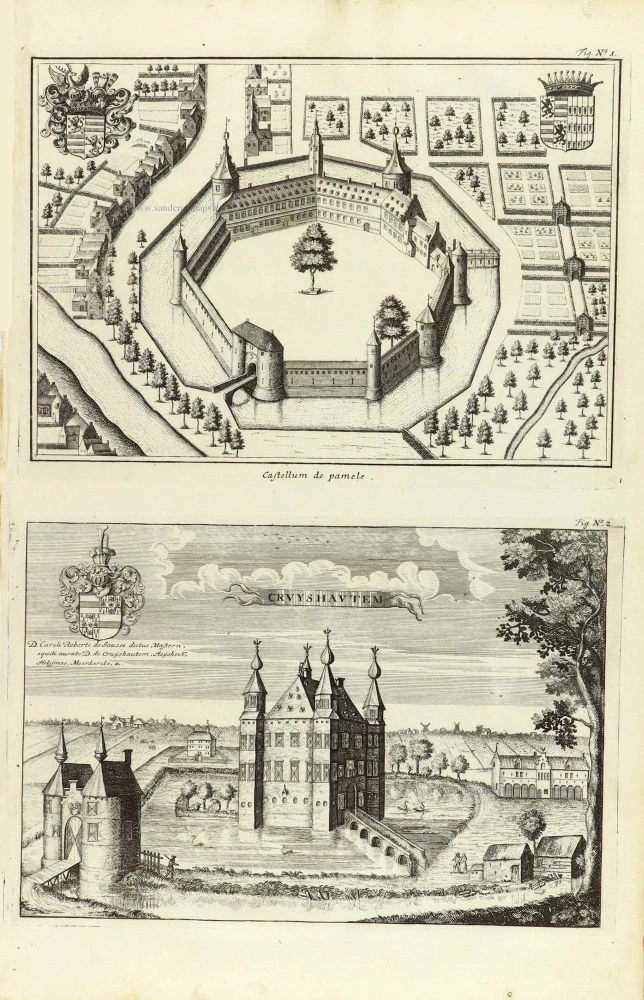
Castellum de Pamele [on sheet with:] Cruyshautem. 1732
Two views of the castles of Pamele (Oudenaarde) and Kruishoutem by Antonius Sanderus.
[Item number: 30759]

Beverwaen [on sheet with:] Castellum de Nokere 1732
Views of the castles of Beveren-Oudenaarde & Nokere by Antonius Sanderus.
[Item number: 30760]

Castellania Aldenardensis. 1732
Casselrij Oudenaarde by Antonius Sanderus.
[Item number: 30766]

Aldenarda vulgo Audenaerde. 1732
Panoramic view and plan of Oudenaarde by Antonius Sanderus.
[Item number: 30767]

Rare Dutch text edition
Aldenarda vulgo Audenaerde. 1652
Oudenaarde by Joan Blaeu.
[Item number: 30810]

Aldenarda vulgo Audenaerde. 1652
Oudenaarde by Antonius Sanderus, published by Joan Blaeu.
[Item number: 31179]
![Merelbeke [Verso:] Oudenaarde - Ename (Abbey), door Antonius Sanderus](https://sanderusmaps.com/assets/IMG/webp/m32963.webp)
Merelbeke in ditione Alostana. [verso:] Het Clooster Eename. 1644 (= first edition)
Merelbeke [Verso:] Oudenaarde - Ename (Abbey), door Antonius Sanderus
[Item number: 32963]

Hôtel de ville d'Audenarde. 1823
Oudenaarde, lithograph by Dewasme, after Séraphin Vermote
[Item number: 33143]