
Extremely rare Italian Scotland-map
Scotland by an Italian mapmaker, derived from a map by A. Lafreri and Bishop Leslie. c. 1590

caburdenraremaps: "An extremely rare Italian derivative of Bishop Leslie’s folio map of 1578, one of the earliest printed maps of Scotland. The first known printed map survives in a single known example and is dated c.1561 (Bifolco I p. 780). It is held at the National Library of Scotland and is thought to be by Paolo Forlani. ..."
Bishop John Leslie (1527–1596)
John Leslie — often spelt Lesley — was a Scottish bishop, diplomat, historian, political adviser, and cartographer closely associated with the court of Mary Queen of Scots.
He was born in 1527 in Aberdeenshire, Scotland, and studied at the universities of Aberdeen, Paris, and Poitiers. Leslie became one of the most educated Scottish churchmen of his generation, trained in canon law, theology, and classical scholarship.
John Leslie occupies a distinctive place in the history of cartography because he helped create one of the earliest substantially improved maps of Scotland during the Renaissance.
Although Leslie was not a professional surveyor in the modern sense, he belonged to the learned humanist tradition in which geography, history, politics, and scholarship were closely connected. His cartographic work emerged from both patriotic and political motives: he wanted continental Europe to possess a more accurate understanding of Scotland at a time when the kingdom played a central role in dynastic and religious struggles.
Before Leslie’s work, Scotland was poorly represented on most European maps. Earlier maps depended heavily on medieval geographic traditions and second-hand reports. Even important cosmographers frequently had little direct knowledge of northern Britain. Leslie sought to correct this.
Around 1578, while living in exile in Rome, Leslie oversaw the creation of a new map of Scotland, usually known as Scotiae Descriptio or Scotiae Nova et Accurata Descriptio.
The work was engraved and circulated through the Roman publishing world associated with Antonio Lafreri and later engravers such as Natale Bonifacio. It presented Scotland to Europe as a coherent historic kingdom worthy of serious scholarly attention.
Today, original examples of maps associated with Leslie and the Roman Lafreri school are considered among the rarest and most desirable products of 16th-century British cartography.
Scotiae nova et accurata descriptio. - Scotia Britannicae Insule pars septentrionalior, ...
Item Number: 33066 new Authenticity Guarantee
Category: Antique maps > Europe > British Isles
Scotland by an Italian mapmaker, derived from a map by A. Lafreri and Bishop Leslie.
Title: Scotiae nova et accurata descriptio. - Scotia Britannicae Insule pars septentrionalior, ...
Oriented to the west.
Designer: Bishop John Leslie.
Date: Rome, c. 1590.
Copper engraving, printed on paper.
Image size: 405 x 530mm (16 x 20¾ inches).
Sheet size: 510 x 685mm (20 x 27 inches).
Verso: Blank.
Condition: Original coloured in outline, on thick paper, original extended side margins.
Condition Rating: A.
Separate publication.
caburdenraremaps: "An extremely rare Italian derivative of Bishop Leslie’s folio map of 1578, one of the earliest printed maps of Scotland. The first known printed map survives in a single known example and is dated c.1561 (Bifolco I p. 780). It is held at the National Library of Scotland and is thought to be by Paolo Forlani. ..."
Bishop John Leslie (1527–1596)
John Leslie — often spelt Lesley — was a Scottish bishop, diplomat, historian, political adviser, and cartographer closely associated with the court of Mary Queen of Scots.
He was born in 1527 in Aberdeenshire, Scotland, and studied at the universities of Aberdeen, Paris, and Poitiers. Leslie became one of the most educated Scottish churchmen of his generation, trained in canon law, theology, and classical scholarship.
John Leslie occupies a distinctive place in the history of cartography because he helped create one of the earliest substantially improved maps of Scotland during the Renaissance.
Although Leslie was not a professional surveyor in the modern sense, he belonged to the learned humanist tradition in which geography, history, politics, and scholarship were closely connected. His cartographic work emerged from both patriotic and political motives: he wanted continental Europe to possess a more accurate understanding of Scotland at a time when the kingdom played a central role in dynastic and religious struggles.
Before Leslie’s work, Scotland was poorly represented on most European maps. Earlier maps depended heavily on medieval geographic traditions and second-hand reports. Even important cosmographers frequently had little direct knowledge of northern Britain. Leslie sought to correct this.
Around 1578, while living in exile in Rome, Leslie oversaw the creation of a new map of Scotland, usually known as Scotiae Descriptio or Scotiae Nova et Accurata Descriptio.
The work was engraved and circulated through the Roman publishing world associated with Antonio Lafreri and later engravers such as Natale Bonifacio. It presented Scotland to Europe as a coherent historic kingdom worthy of serious scholarly attention.
Today, original examples of maps associated with Leslie and the Roman Lafreri school are considered among the rarest and most desirable products of 16th-century British cartography.
Related items
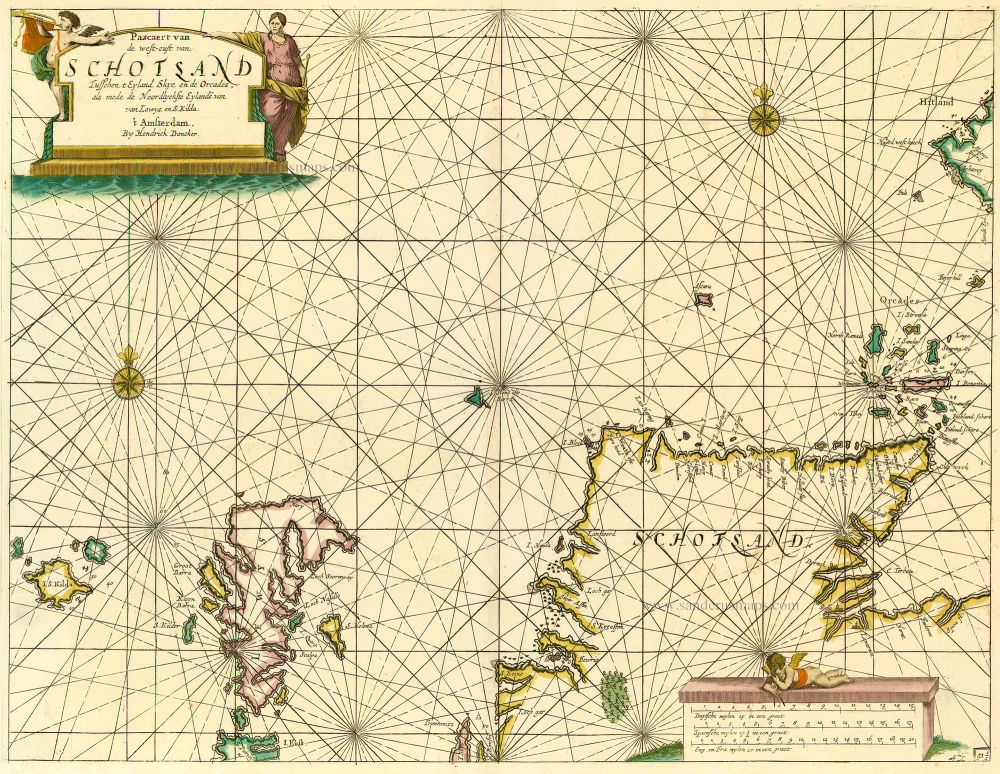
Pascaert van de Westcust van Schotland Tusschen t Eyland Kye en de Orcades, als mede de Noordlyckste Eylande van Lewys en S. Kilda. 1686
Scotland, by Doncker H.
[Item number: 13737]
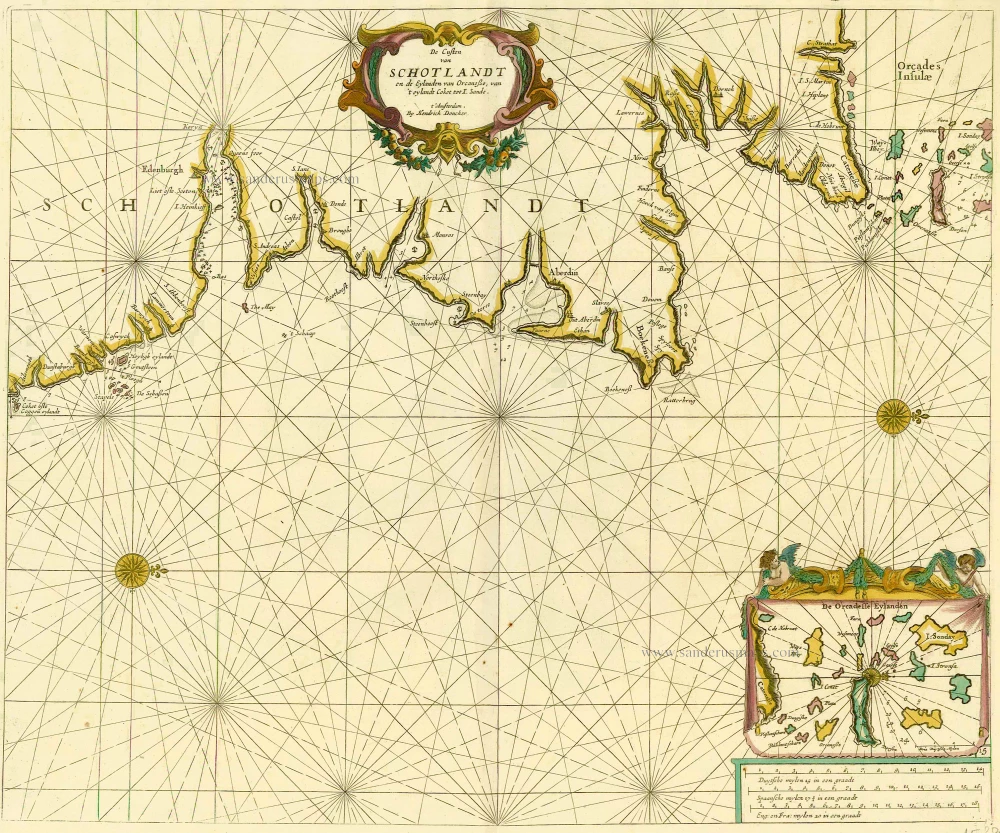
De Custen van Schotlandt en de Eylanden van Orcanese, van 't eylandt Coket tot I. Sande. 1686
Scotland and Orkney Islands, by Doncker H.
[Item number: 15386]
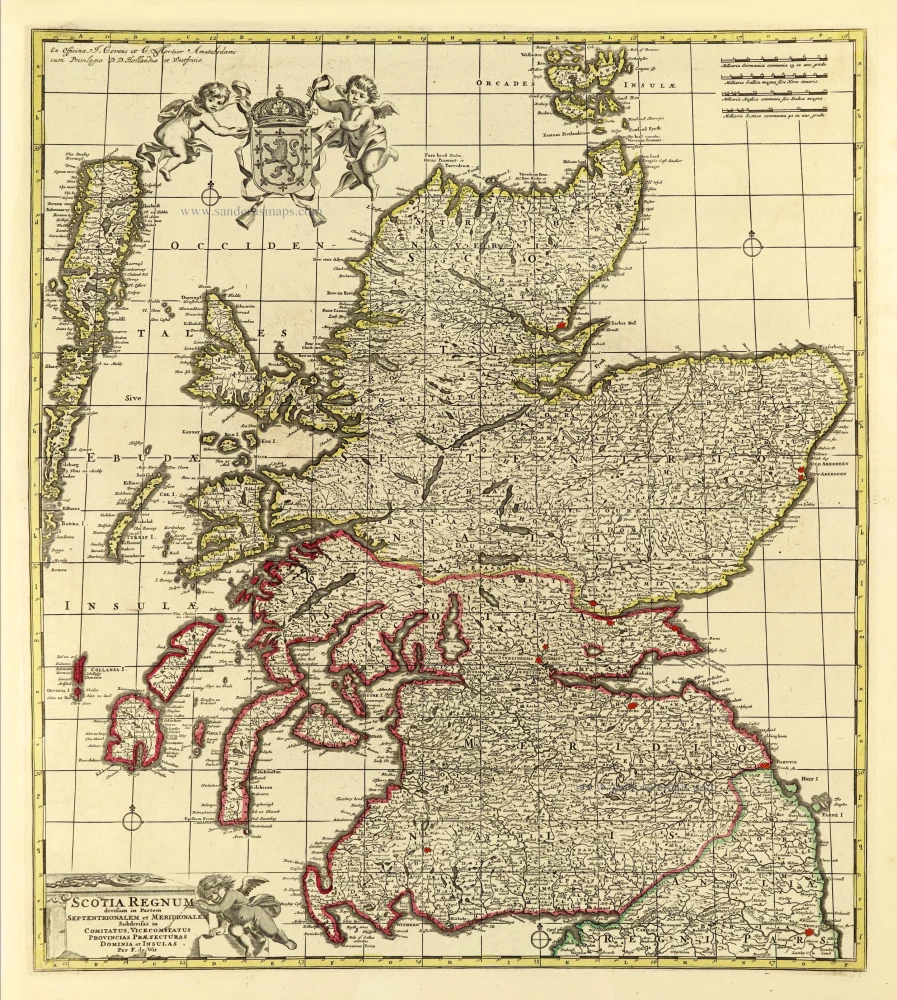
Scotia Regnum divisum in Partem Septentrionalem et Meridionalem. After 1721
Scotland by Frederik de Wit, published by Covens & Mortier.
[Item number: 28242]

Scotia - Parte Settentrionale. [in set with:] Parte Meridionale. 1696
Scotland by Vincenzo Coronelli.
[Item number: 28661]

Scotia. - [Above map :] Descrittione del L'Isola di Scotia. 1572
Scotland by Thomaso Porcacchi.
[Item number: 28915]
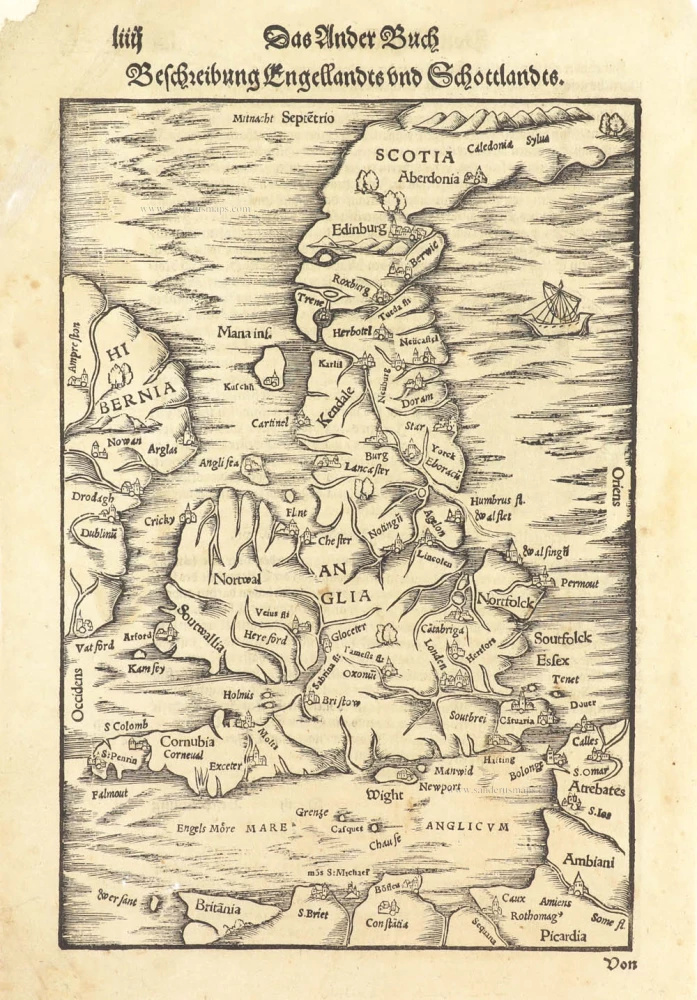
Beschreibung Engellandts und Schottlandts. 1578
Great Brittain by Sebastian Münster.
[Item number: 29468]

Isole Hebride, et Orcade. - [Above map :] Descrittione dell'Isole Hebridi, et Orcade. 1590
Northern Scotland - Hebrids and Orkney Islands, by Thomaso Porcacchi.
[Item number: 29733]
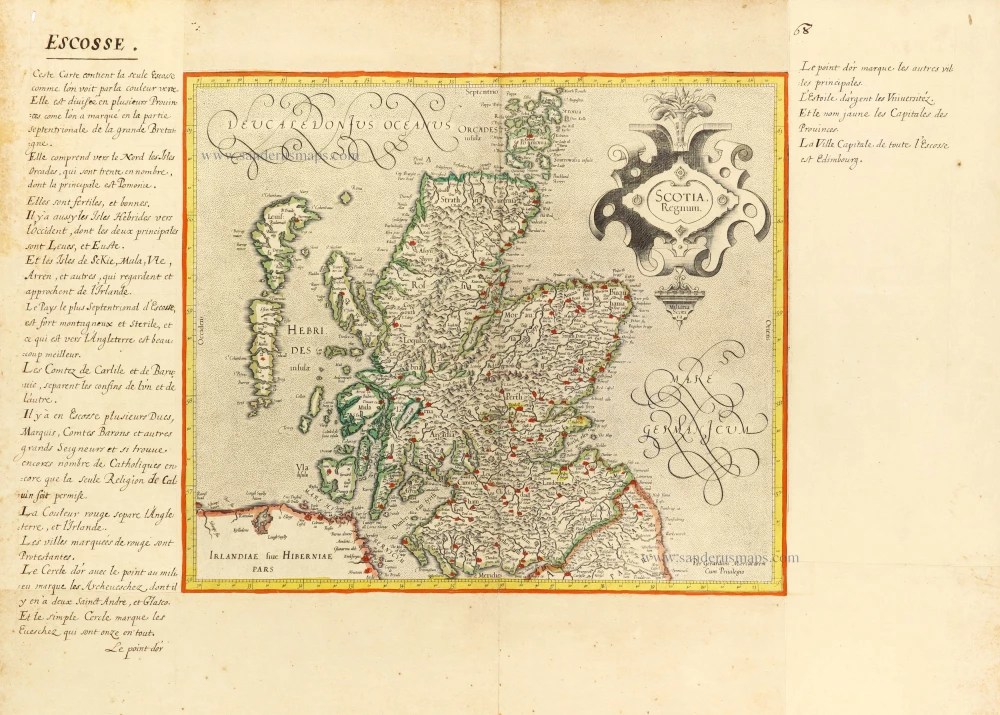
Scotia Regnum. c. 1610-1650
Scotland, by Gerard Mercator.
[Item number: 31015]
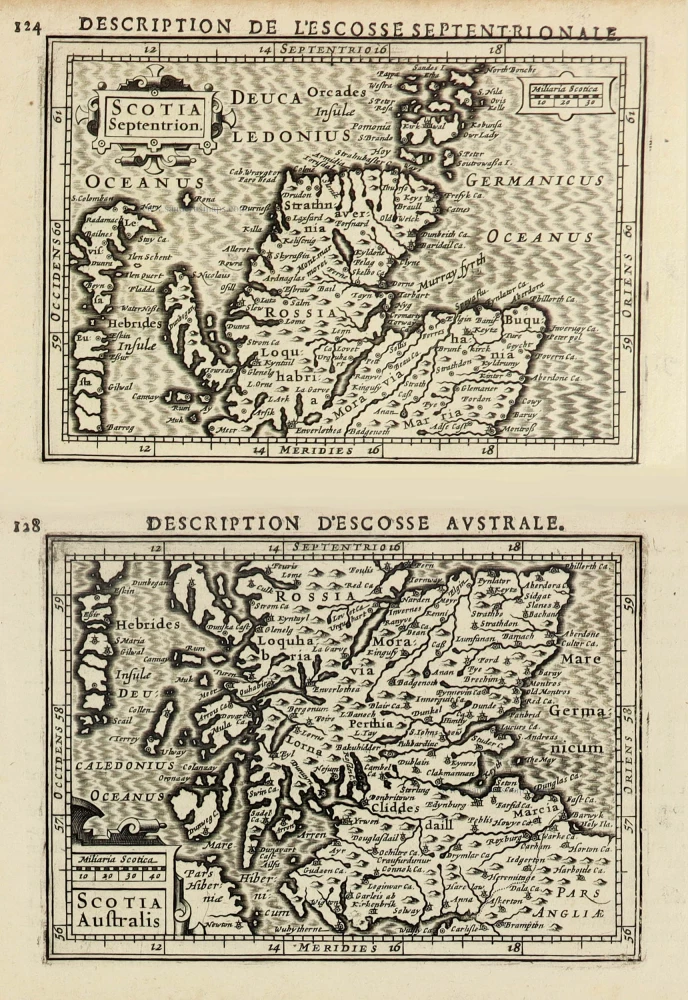
Scotia Septentrion. [in set with] Scotia Australis. 1618
Scotland by Petrus Bertius, published by Jodocus Hondius II.
[Item number: 31537]
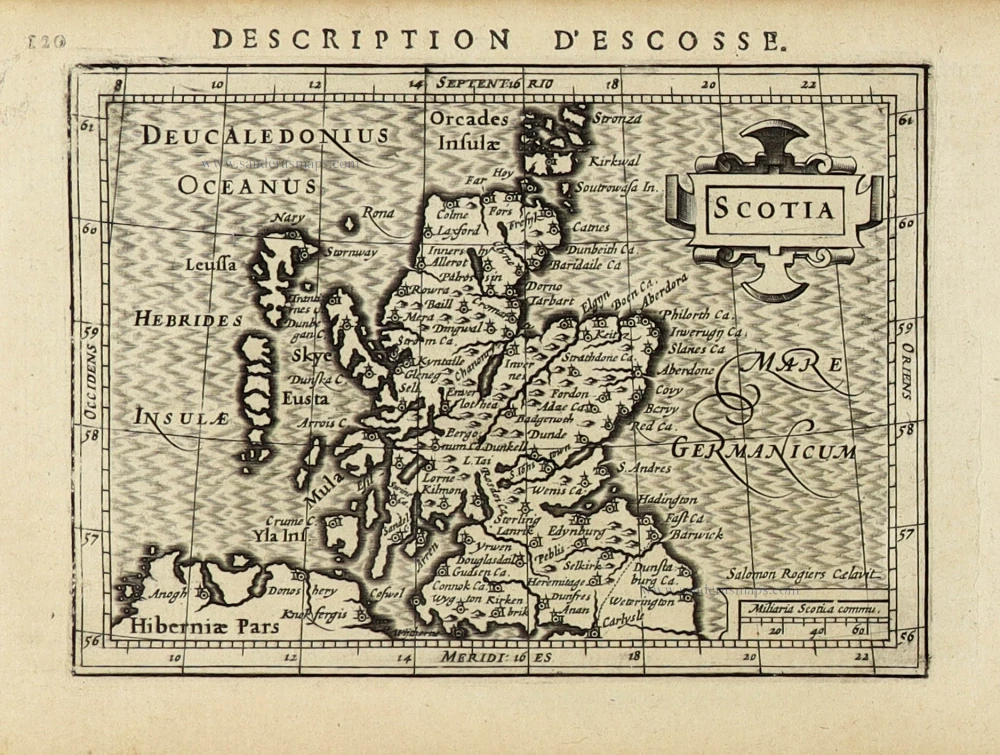
Scotia. 1618
Scotland by Petrus Bertius, published by Jodocus Hondius II.
[Item number: 31539]
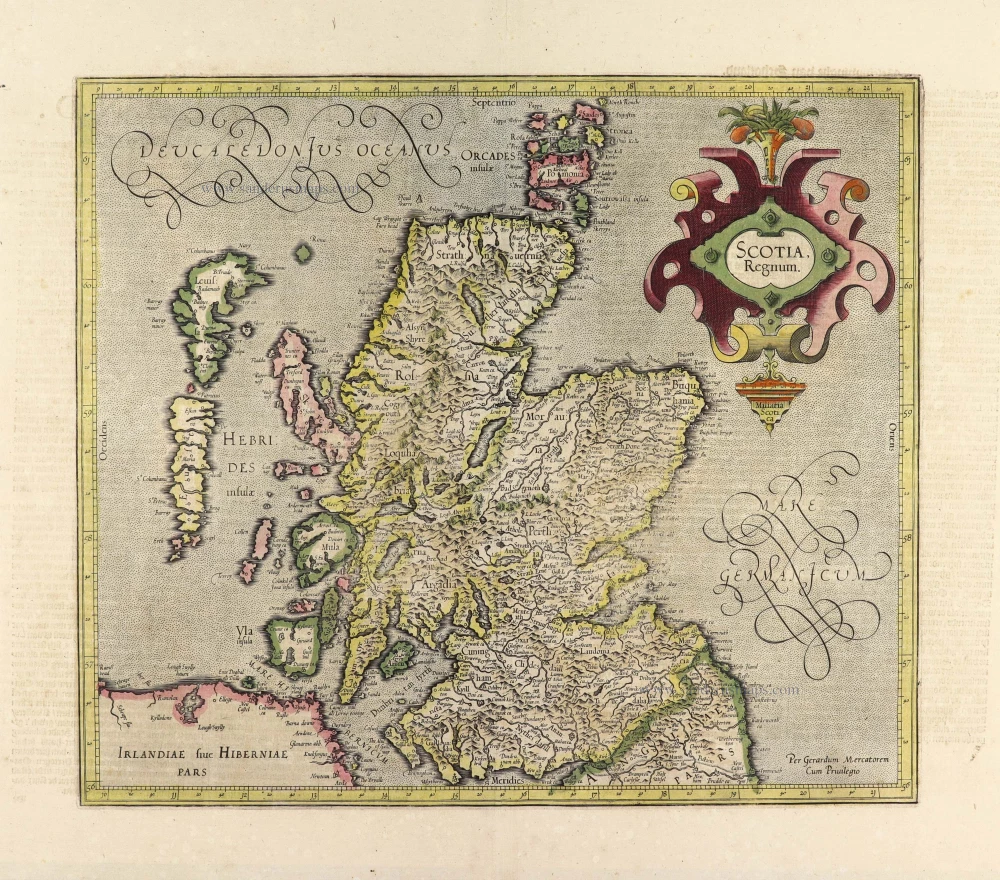
Scotia Regnum. 1633
Scotland, by Gerard Mercator.
[Item number: 32180]

Regnum Scotiae, seu Pars Septent: Magnae Britanniae Divisa ... c. 1700
Scotland, by G. & L. Valck.
[Item number: 32209]