
Papal States - Tuscany (Toscana), by Michel Antoine Baudrand, published by Giovanni de Rossi. 1687

de Rossi Family
Seventeenth-century Rome was home to the famous publishing house of de Rossi. Two branches of the family used the addresses in Piazza Navona and Piazza della Pace; the latter was the more important house. Giuseppe de Rossi founded the house in 1613 and continued until he died in 1639. Giovanni Giacomo de Rossi flourished from 1649 to 1691. In 1677, he published a folio atlas titled Mercurio Geografico. It was drawn almost entirely from the cartography of the Sanson family in Paris. Whether it was with their permission or simple plagiarism is unknown, but they are credited. (Burden)
Giuseppe Rossi (flourished 1613-1639), Publisher at 'Piazza della Pace'.
Giovanni Giacomo de Rossi (1627-1691), Printer and publisher at 'Alla Pace all'insegna di Parigi', Rome.
Domenico de Rossi (flourished c. 1691-c. 1720), Successor to Giovanni Giacomo Rossi.
Lorenzo Filippo Rossi (flourished c. 1720-1738). Successor to Domenico.
In 1738, the Rossi plates were sold to the government of the Papal States.
Michel-Antoine Baudrand (1633 – 1700)
Michel-Antoine Baudrand was a French historian, cleric, and geographer active in the late 17th century. He served as secretary to Cardinal Francesco Barberini. In this position, he travelled and attended the papal conclaves of 1655 and 1667, which exposed him to European intellectual networks and geographical knowledge. Baudrand’s reputation rests largely on his reference works on geography, which scholars and readers widely used in the late 17th and early 18th centuries.
He is mainly remembered for compiling some of the earliest large geographical dictionaries of the early modern period.
Descrittione dello Stato della Chiesa e della Toscana
Item Number: 32919 Authenticity Guarantee
Category: Antique maps > Europe > Italy
Papal States - Tuscany (Toscana), by Michel Antoine Baudrand, published by Giovanni de Rossi.
Title: Descrittione dello Stato della Chiesa e della Toscana
di Michele Antonio Baudrand Parigino Abbate di Rouvres
Intagliata da Giovanni Lhuilier, in Roma
Per Gio. Giacomo Rossi all' insegna di Parigi alla Pace, 1669.
Con licentia de Superiori, & Priv. Sum Pont.
Cartographer: Baudrand Michel Antoine.
Engraver: Lhuilier Giovanni.
Date of the first edition: 1678.
Date of this map: 1687.
Date on map: 1678.
Copper engraving, printed on paper.
Image size: 430 x 550mm (17 x 21¾ inches).
Sheet size: 480 x 615mm (19 x 24¼ inches).
Verso: Blank.
Condition: Original coloured in outline, excellent.
Condition Rating: A+.
From: Mercurio Geografico overo Guida Geografica in Tutte le Parti di Mondo Conforme le Tavole Geografiche del Sansone Baudrand e Cantelli. Rome, [1687]. (Shirley (Brit. Lib.), T.ROSS-1b)
de Rossi Family
Seventeenth-century Rome was home to the famous publishing house of de Rossi. Two branches of the family used the addresses in Piazza Navona and Piazza della Pace; the latter was the more important house. Giuseppe de Rossi founded the house in 1613 and continued until he died in 1639. Giovanni Giacomo de Rossi flourished from 1649 to 1691. In 1677, he published a folio atlas titled Mercurio Geografico. It was drawn almost entirely from the cartography of the Sanson family in Paris. Whether it was with their permission or simple plagiarism is unknown, but they are credited. (Burden)
Giuseppe Rossi (flourished 1613-1639), Publisher at 'Piazza della Pace'.
Giovanni Giacomo de Rossi (1627-1691), Printer and publisher at 'Alla Pace all'insegna di Parigi', Rome.
Domenico de Rossi (flourished c. 1691-c. 1720), Successor to Giovanni Giacomo Rossi.
Lorenzo Filippo Rossi (flourished c. 1720-1738). Successor to Domenico.
In 1738, the Rossi plates were sold to the government of the Papal States.
Michel-Antoine Baudrand (1633 – 1700)
Michel-Antoine Baudrand was a French historian, cleric, and geographer active in the late 17th century. He served as secretary to Cardinal Francesco Barberini. In this position, he travelled and attended the papal conclaves of 1655 and 1667, which exposed him to European intellectual networks and geographical knowledge. Baudrand’s reputation rests largely on his reference works on geography, which scholars and readers widely used in the late 17th and early 18th centuries.
He is mainly remembered for compiling some of the earliest large geographical dictionaries of the early modern period.
Related items

Thusciae. 1601
Tuscany (Toscana), by A. Ortelius.
[Item number: 8067]

Stato della Chiesa con la Toscana 1644-58
Papal State - Tuscany (Toscana) by Janssonius J. - Hondius H.
[Item number: 19236]

Status Ecclesiasticus et Magnus Ducatus Thoscanae. c. 1680
Papal States & Toscana by Frederik De Wit.
[Item number: 24382]

Le Grand Duché de Toscane. 1713
Tuscany (Toscana) by P. Van der Aa.
[Item number: 26079]
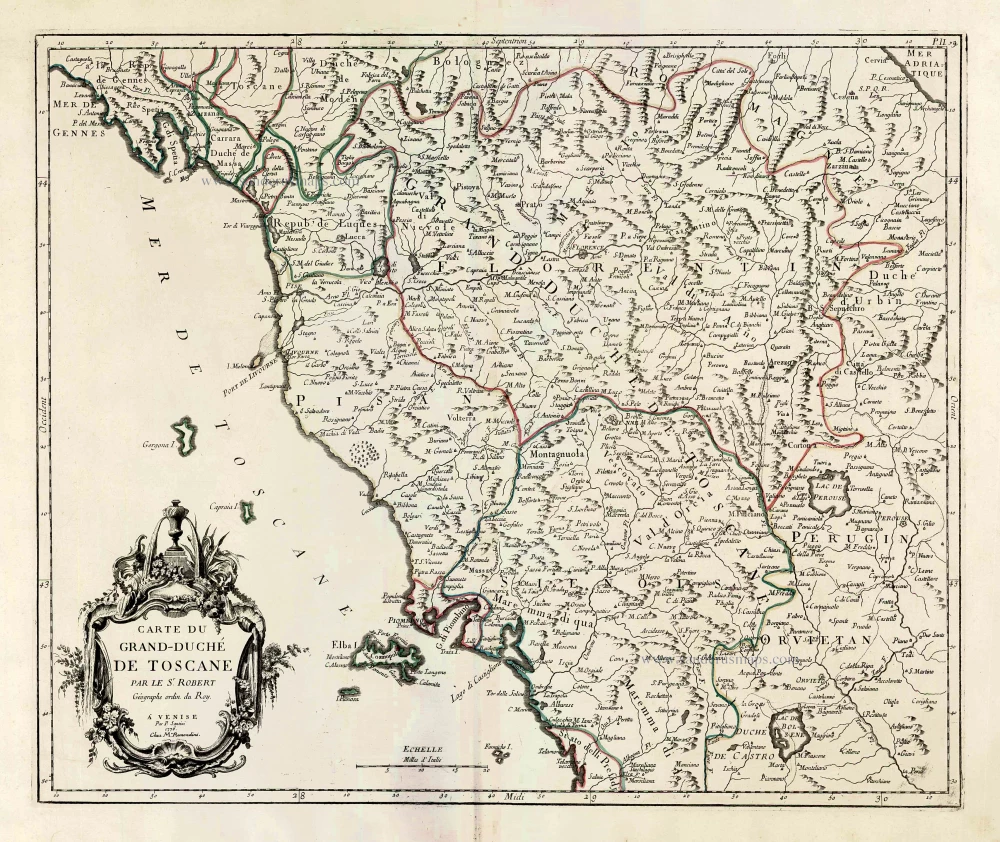
Carte du Grand-Duché de Toscane. 1776-79
Tuscany (Toscana) by Francesco & Paolo Santini
[Item number: 27724]

Nouvelle Carte de L'Etat de L'Eglise, dressée sur celle du P. Boscovich, divisée en trois feuilles, qui peuvent être jointes ensemble. Avec la Géographie ancienne respective. 1776-79
Papal States, by Paolo Santini.
[Item number: 27728]

Parergon map
Tusciae Antiquae Typus. 1595
Ancient Tuscany (Toscana), by Abraham Ortelius.
[Item number: 30672]

Tuscia. c. 1610-1650
Tuscany (Toscana), by Gerard Mercator.
[Item number: 30924]

Stato della Chiesa, con la Toscana. 1647
Papal State - Tuscany (Toscana), by Willem Blaeu.
[Item number: 31840]

Scarce
Status Ecclesiasticus et Magnus Ducatus Thoscanae. c. 1696
Tuscany - Papal States by Cornelis Danckerts.
[Item number: 32509]
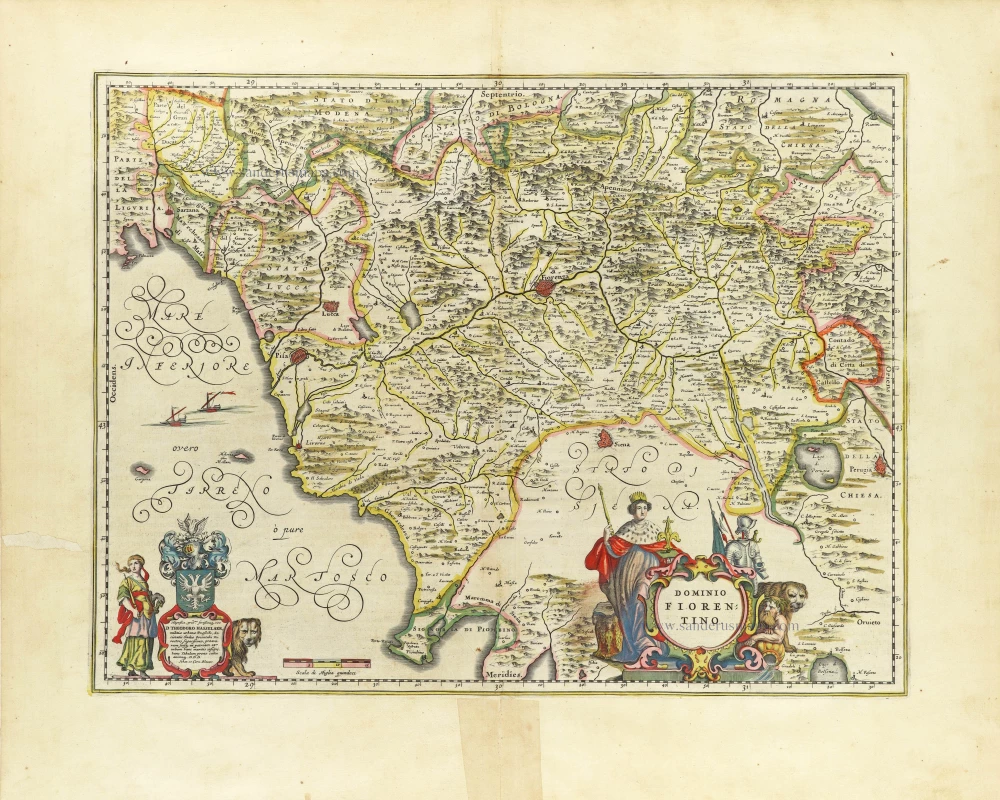
Dominio Fiorentino. 1645
Tuscany - Florence, by Joan Blaeu.
[Item number: 32529]

Rare
Toscana Inferiore, Detta Anticamente Tuscia Suburbicaria. 1675
Toscana (Tuscany) by Joannes Janssonius.
[Item number: 32601]
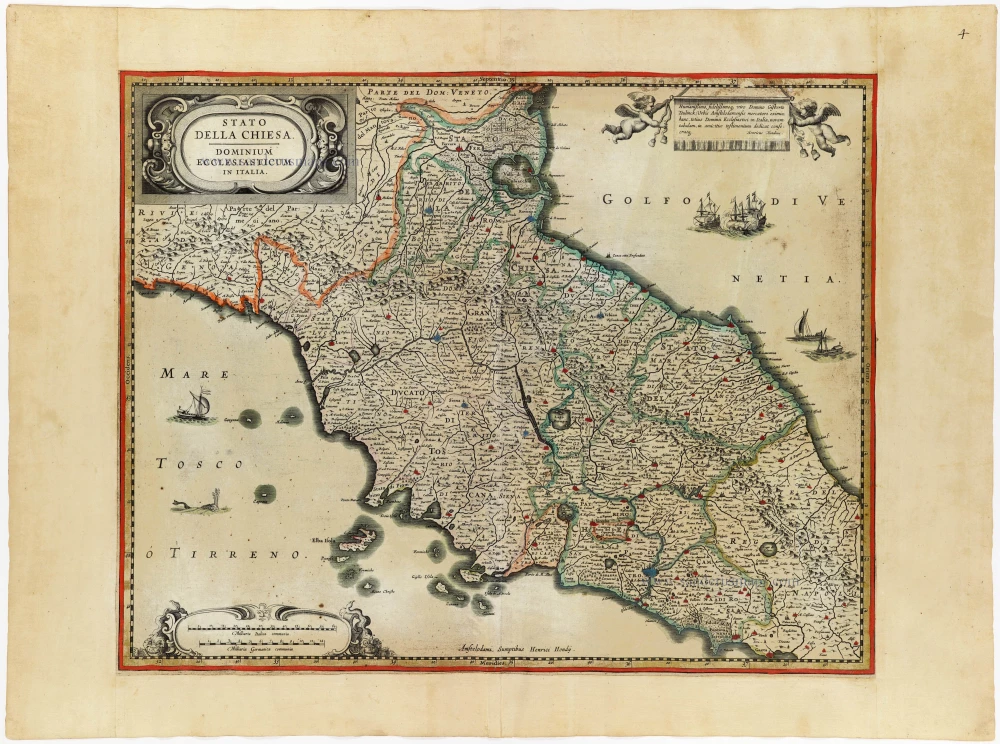
Stato della Chiesa. - Dominium Ecclesiasticum in Italia. c. 1633-1650
Papal State & central Italy by Henricus Hondius
[Item number: 33030]