
Amazon River Basin by V.M. Coronelli 1691
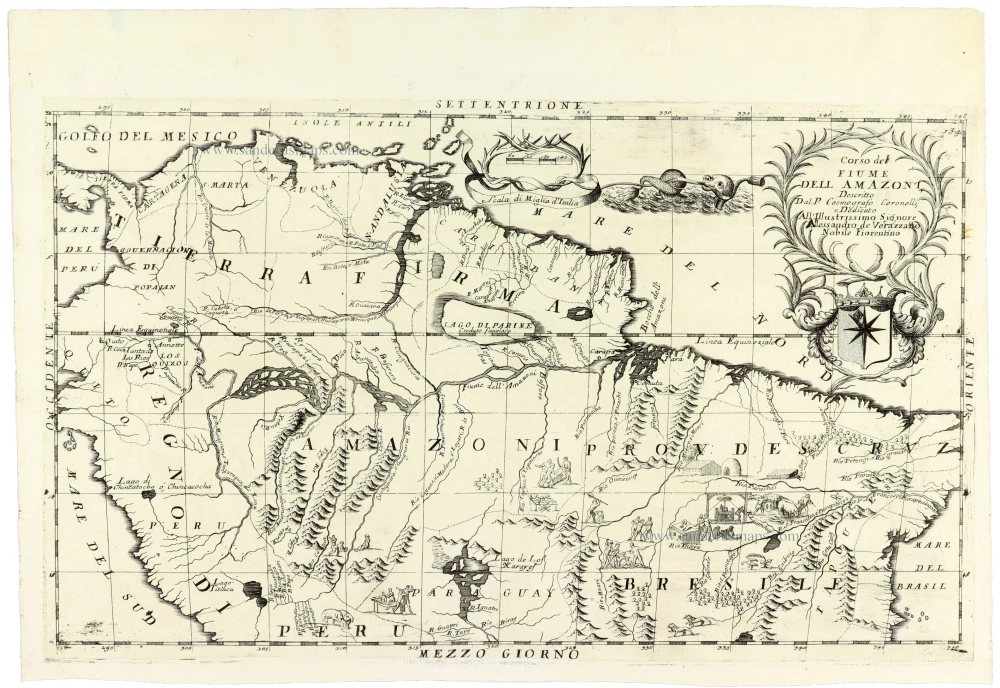
An attractive and detailed map of the Amazon River basin and northern South America, extending from the Pacific coast of Peru and the eastern slopes of the Andes to the Atlantic coast of Brazil and the Guianas.
The mighty Amazon River dominates the composition, flowing from its presumed sources in the Andean highlands across the South American continent to its enormous estuary on the Atlantic coast. Numerous tributaries are carefully delineated and named, forming an intricate hydrographic network that reflects growing European interest in the region's geography.
The map covers a vast territory encompassing parts of present-day Peru, Ecuador, Colombia, Venezuela, Bolivia, Brazil and the Guianas. The Andes are prominently represented by extensive chains of individually engraved mountains, while the great tropical lowlands are traversed by an elaborate system of rivers.
Particularly interesting is the depiction of Lago di Parime, the legendary lake traditionally associated with the mythical golden city of El Dorado. Situated in the northern interior of South America, this imaginary geographical feature appeared on numerous European maps from the late sixteenth century onwards. Its inclusion illustrates the persistence of geographical myths alongside increasingly accurate information obtained through exploration and missionary activity.
The map also records numerous indigenous place names, settlements and geographical features, reflecting the information available to European cartographers through Spanish and Portuguese colonial sources, missionaries and travellers. Small pictorial scenes enliven the interior, depicting indigenous inhabitants and showing cannibals preparing human bodies for eating. These details provide a fascinating insight into contemporary European perceptions of the largely unexplored Amazonian region.
The map is dedicated to Alessandro de Verazzano, a Florentine nobleman.
Vincenzo Coronelli (1650-1718)
Vincenzo Coronelli was born in Venice on 16 August 1650 and primarily brought up in Ravenna. He returned to Venice in 1665 and joined the convent of the Minor Conventuals. Five years later, he was sent to Rome to study, and by 1673, he was already a doctor of theology.
Having achieved fame by constructing two globes for the Duke of Parma, he was invited to Paris for three years in 1681 and made two enormous examples for Louis XIV. On his return to Venice, he assiduously collected cartographic material and founded the Academy of the Argonauts. In 1685, he was appointed Cosmographer to the Republic of Venice and authorised to publish a large atlas. He became a geography lecturer at the University of Venice and brought out an Atlante Veneto the following year.
In 1696, he visited Germany, Holland and southern England. During intervals in compiling his vast encyclopaedia, he continued with cartographic projects up to 1709. He died in his native Venice on 9 December 1718.
Coronelli became famous for his globes. In addition, he was a renowned encyclopaedist, mapmaker and geographer. Most of his maps and other material are gathered in his Atlante Veneto (13 vols, 1690-1705). The first volume, subtitled Descrizione generale istorica geografica, was his masterpiece, planned as an extension of Blaeu’s atlas.
Other volumes of the atlas which contain maps are Isolario, two parts (1696-8), with detailed maps and plans, mostly of islands; Corso geografico, two parts based on the edition 1694-7; Libro de’ globi (1697); and Lo Specchio del Mare, a reprint of Levanto's Lo Specchio del Mare Mediterraneo of 1664.
The other vital aspects of his mapping are those arising from the Venetian conquest and his travels. His most extensive military compilation was the Teatro della Guerra, in more than 30 volumes.
Corso del Fiume dell Amazoni,
Item Number: 33377 new Authenticity Guarantee
Category: Antique maps > America > South America
Amazon River Basin by V.M. Coronelli.
Title: Corso del Fiume dell Amazoni,
Descritto dal P. Cosmografo Coronelli, Dedicato all'Illustrissimo Sionore Alessandro de Verazzano Nobile Fiorentino.
Date of the first edition: 1691.
Date of this map: 1691.
Copper engraving, printed on paper.
Image size: 275 x 460mm (10¾ x 18 inches).
Sheet size: 330 x 475mm (13 x 18¾ inches).
Verso: Blank.
Condition: Excellent.
Condition Rating: A+.
From: Atlante Veneto, nel quale si contiene la descrittione... degl' Imperii, Regni, Provincie, e Stati dell' Universo. Venice: Girolamo Albrizzi, 1691. Shirley (Brit.Lib.), T.CORO-7a
An attractive and detailed map of the Amazon River basin and northern South America, extending from the Pacific coast of Peru and the eastern slopes of the Andes to the Atlantic coast of Brazil and the Guianas.
The mighty Amazon River dominates the composition, flowing from its presumed sources in the Andean highlands across the South American continent to its enormous estuary on the Atlantic coast. Numerous tributaries are carefully delineated and named, forming an intricate hydrographic network that reflects growing European interest in the region's geography.
The map covers a vast territory encompassing parts of present-day Peru, Ecuador, Colombia, Venezuela, Bolivia, Brazil and the Guianas. The Andes are prominently represented by extensive chains of individually engraved mountains, while the great tropical lowlands are traversed by an elaborate system of rivers.
Particularly interesting is the depiction of Lago di Parime, the legendary lake traditionally associated with the mythical golden city of El Dorado. Situated in the northern interior of South America, this imaginary geographical feature appeared on numerous European maps from the late sixteenth century onwards. Its inclusion illustrates the persistence of geographical myths alongside increasingly accurate information obtained through exploration and missionary activity.
The map also records numerous indigenous place names, settlements and geographical features, reflecting the information available to European cartographers through Spanish and Portuguese colonial sources, missionaries and travellers. Small pictorial scenes enliven the interior, depicting indigenous inhabitants and showing cannibals preparing human bodies for eating. These details provide a fascinating insight into contemporary European perceptions of the largely unexplored Amazonian region.
The map is dedicated to Alessandro de Verazzano, a Florentine nobleman.
Vincenzo Coronelli (1650-1718)
Vincenzo Coronelli was born in Venice on 16 August 1650 and primarily brought up in Ravenna. He returned to Venice in 1665 and joined the convent of the Minor Conventuals. Five years later, he was sent to Rome to study, and by 1673, he was already a doctor of theology.
Having achieved fame by constructing two globes for the Duke of Parma, he was invited to Paris for three years in 1681 and made two enormous examples for Louis XIV. On his return to Venice, he assiduously collected cartographic material and founded the Academy of the Argonauts. In 1685, he was appointed Cosmographer to the Republic of Venice and authorised to publish a large atlas. He became a geography lecturer at the University of Venice and brought out an Atlante Veneto the following year.
In 1696, he visited Germany, Holland and southern England. During intervals in compiling his vast encyclopaedia, he continued with cartographic projects up to 1709. He died in his native Venice on 9 December 1718.
Coronelli became famous for his globes. In addition, he was a renowned encyclopaedist, mapmaker and geographer. Most of his maps and other material are gathered in his Atlante Veneto (13 vols, 1690-1705). The first volume, subtitled Descrizione generale istorica geografica, was his masterpiece, planned as an extension of Blaeu’s atlas.
Other volumes of the atlas which contain maps are Isolario, two parts (1696-8), with detailed maps and plans, mostly of islands; Corso geografico, two parts based on the edition 1694-7; Libro de’ globi (1697); and Lo Specchio del Mare, a reprint of Levanto's Lo Specchio del Mare Mediterraneo of 1664.
The other vital aspects of his mapping are those arising from the Venetian conquest and his travels. His most extensive military compilation was the Teatro della Guerra, in more than 30 volumes.
Related items
Important map in excellent condition
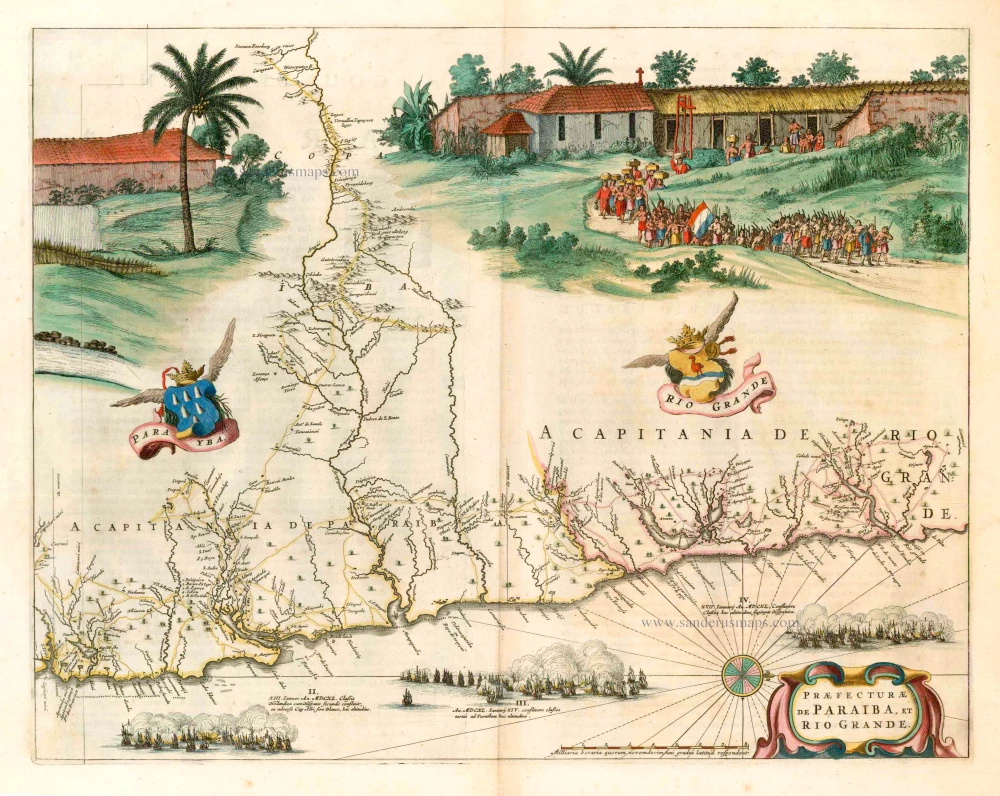
Praefecturae de Paraiba, et Rio Grande. 1663
Brazil - Paraiba, by Joan Blaeu.
[Item number: 25258]

Provincia de Brasil cum Adiacentibus Provinciis. 1630
Brazil, by Johannes de Laet.
[Item number: 25390]

Brasil. 1563
Brazil, by Ramusio G.B.
[Item number: 26186]
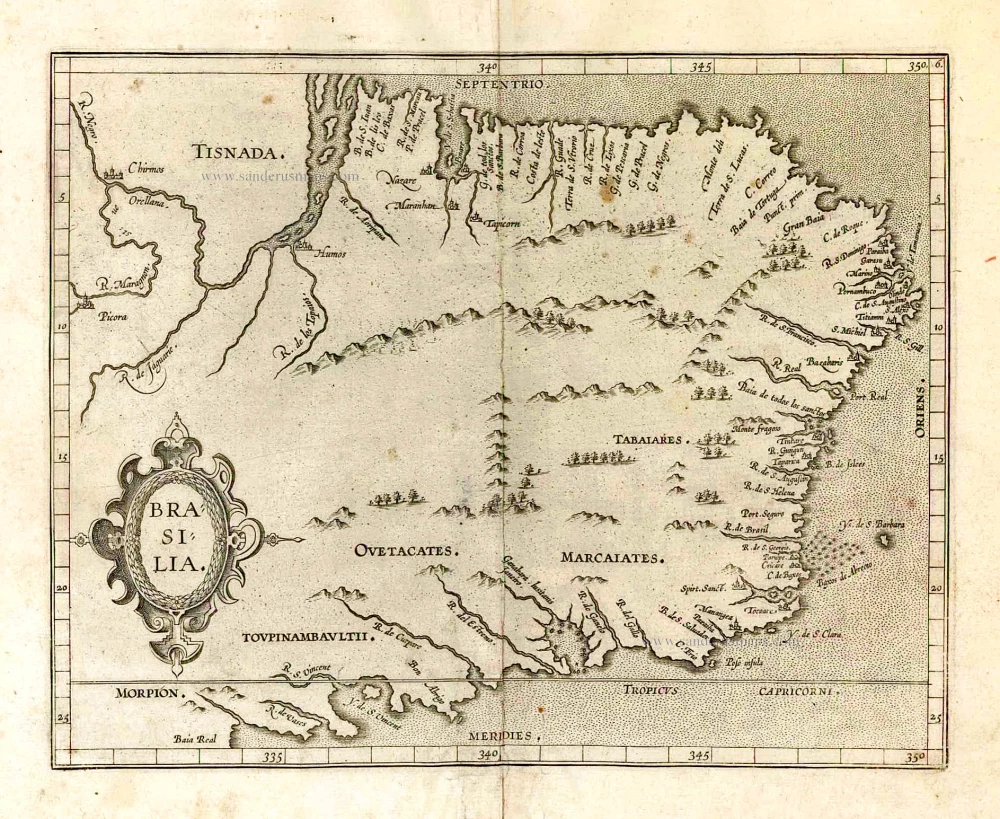
Brasilia. 1607
Brazil, by C. van Wytfliet.
[Item number: 26509]

With cannibals
Brasilia. 1602
Brazil by Langenes, published by Bertius P.
[Item number: 26537]

Brasil Nuova Tavola. 1598
Brazil by Girolamo Ruscelli.
[Item number: 28430]

Brasilia. 1645
Brazil, by Joan Blaeu.
[Item number: 29707]
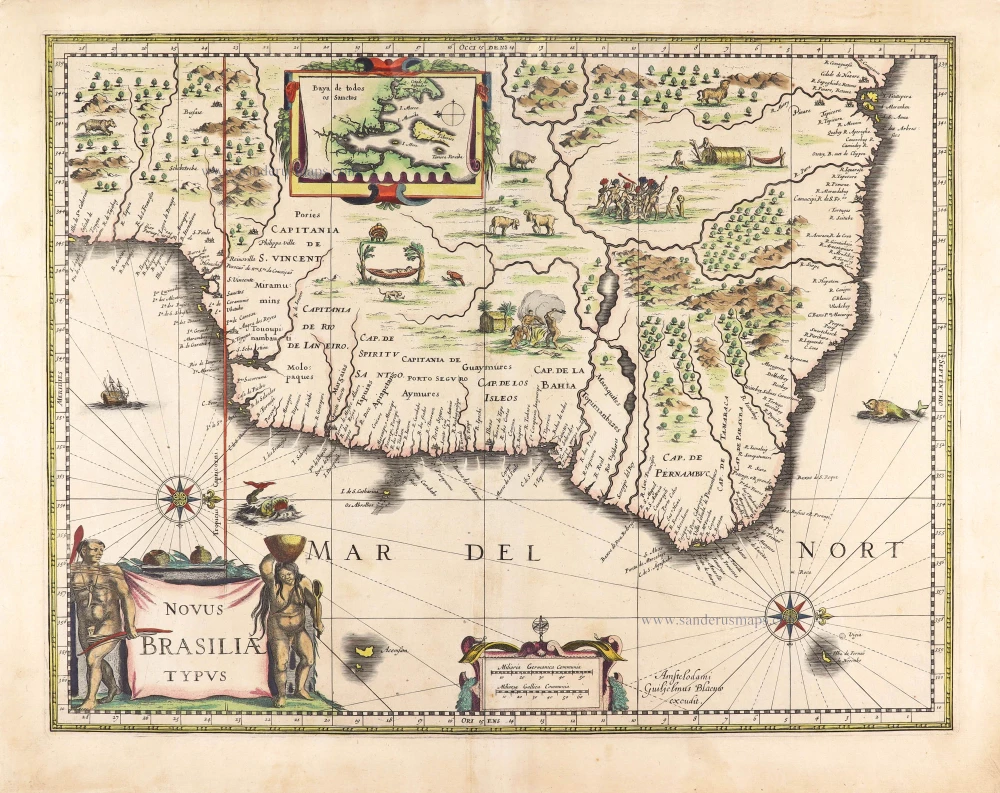
Novus Brasiliae Typus. c. 1640
Brazil, by Willem Blaeu.
[Item number: 29848]
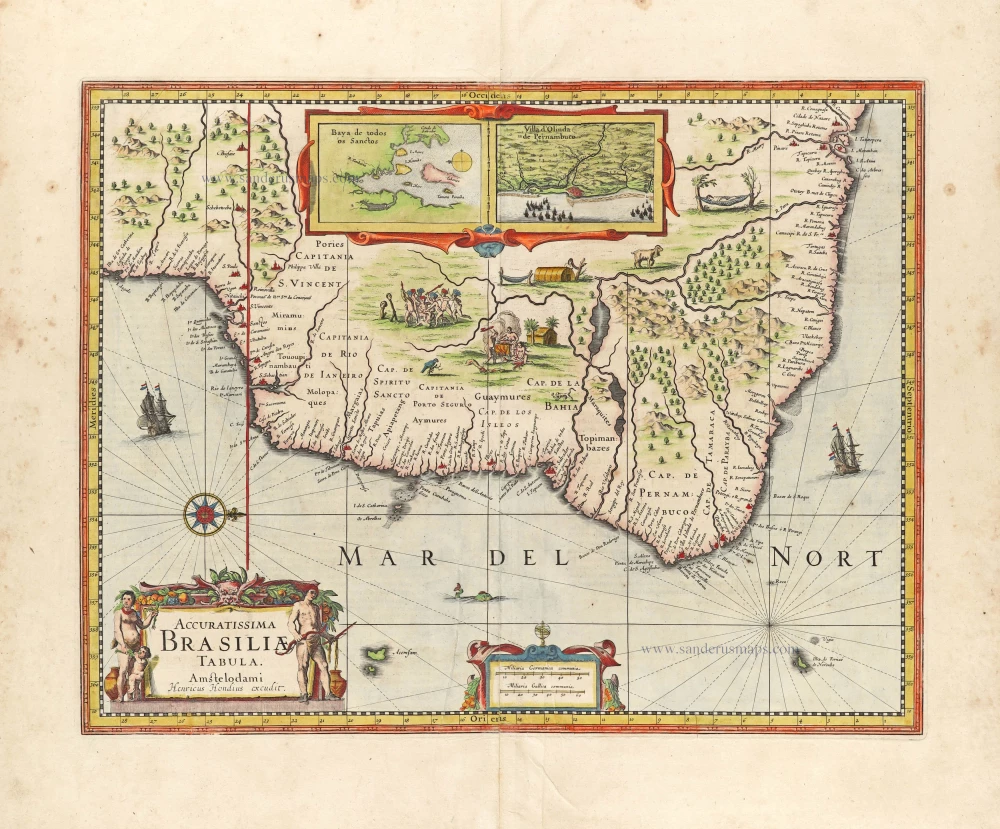
Accuratissima Brasiliae Tabula. 1638
Brazil by Henricus Hondius.
[Item number: 29851]
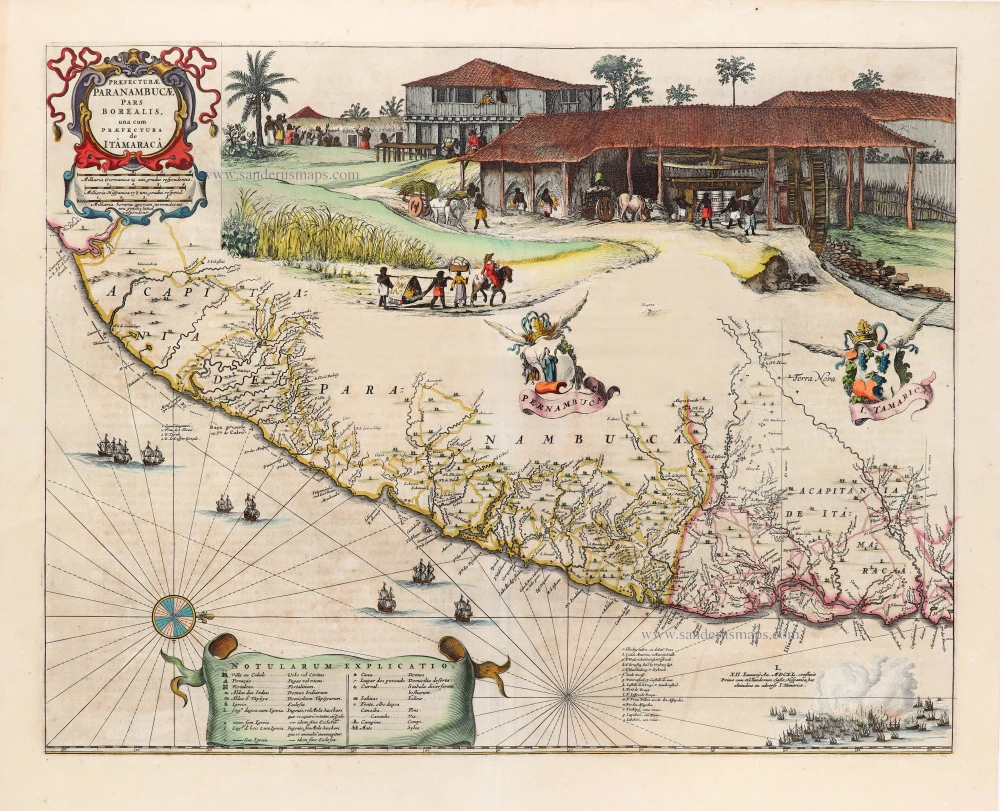
Praefecturae Paranambucae, pars Borealis, una cum Praefectura de Itâmarcâ. 1663
Brazil - Pernambuco (North) by Joan Blaeu.
[Item number: 30149]

Unrecorded view of Pernambuco (Brazil) by Carel Allard
Paranbuca. 1673
View of Pernambuco (Brazil) by Carel Allard.
[Item number: 30558]

SCARCE !
Serinhaim. 1685/90
View of Serinhaem (Pernambuco - Brazil), by Carel Allard.
[Item number: 30588]